Care of a client identifying as LGBTQ+: Nursing
Introduction0:00–1:24
As a nurse, you’ll be providing care for patients who are lesbian, gay, bisexual, transgender, queer or questioning, and other orientations and identities, also known as LGBTQ+.
Members of the LGBTQ+ community often experience health inequities that can be explained by the minority stress model. This model describes how disparities can be traced to cultural stressors like stigma, harassment, and discrimination.
For example, people who identify as LGBTQ+ experience higher rates of substance and tobacco use as well as increased rates of mental health disorders, like depression and anxiety.
Historically, people who identify as LGBTQ+ have experienced discrimination within the health care system. In fact, a significant majority of people who are gay, lesbian, bisexual and transgender report discrimination by a health care provider.
Additionally, health care providers receive limited education on how to provide culturally appropriate care to people who identify as LGBTQ+.
This lack of training can add to the health inequities, but by using correct terminology and creating an inclusive environment, nurses can provide culturally appropriate care to the patients who identify as LGBTQ+.
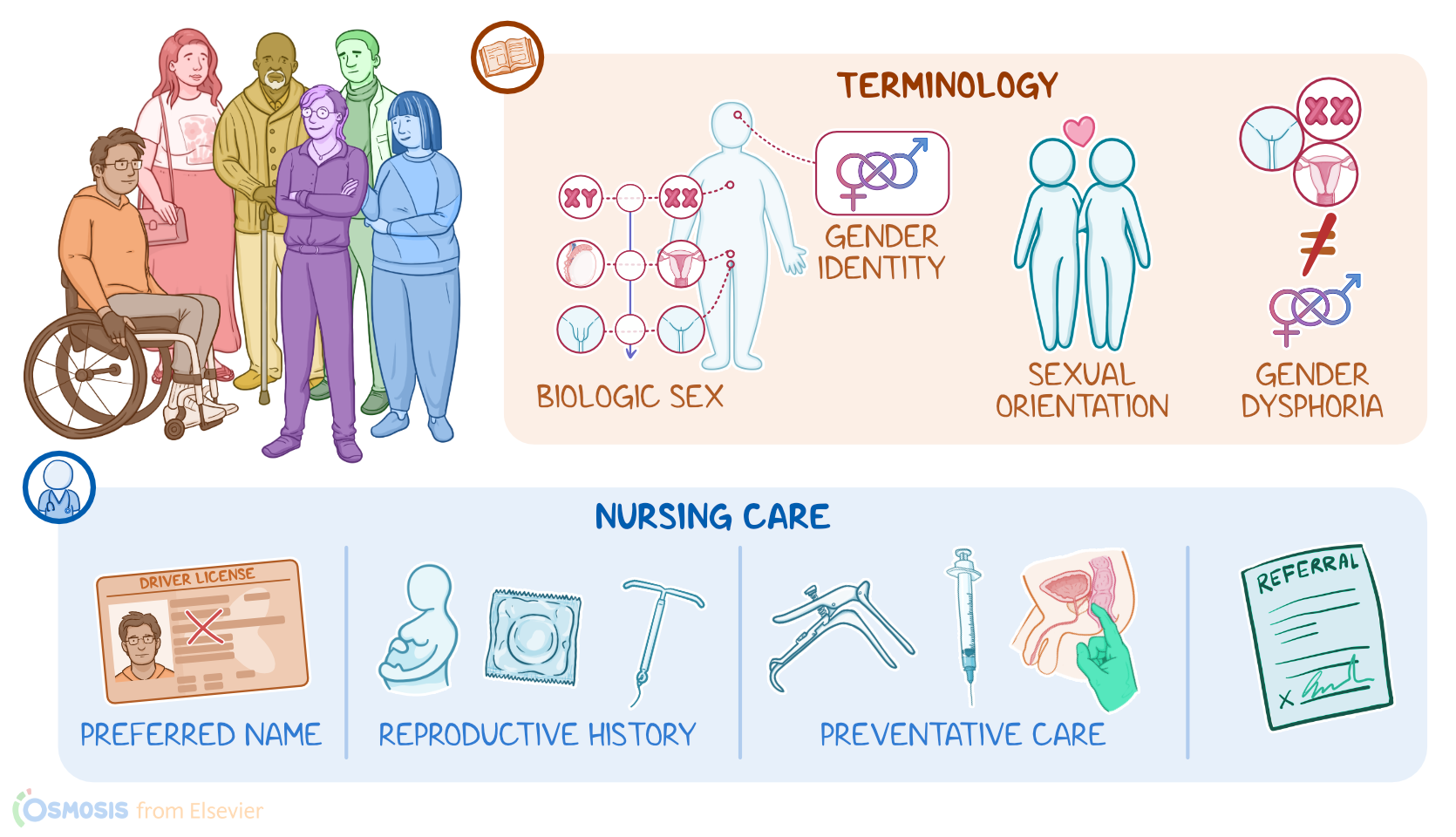
First, let‘s focus on terminology, starting with the difference between biologic sex and gender identity. Someone’s biologic sex, or sex assigned at birth, is determined by their genitalia, reproductive organs, and chromosomes, and can be classified as male, female, or intersex.
Terminology1:24–3:07
On the other hand, gender identity refers to someone's self-perceived gender and may or may not align with their sex assigned at birth.
So, a person who’s cisgender has a gender identity that’s the same as their sex assigned at birth, and a person who's transgender is someone whose gender identity is different from their sex assigned at birth.
For example, a transgender man is someone who was assigned female at birth but identifies as a male. Additionally, people who are non-binary may not identify as one gender at all, but instead identify on a continuum between, or outside, male and female.
When a person’s gender identity doesn't match their sex assigned at birth, some people may experience gender dysphoria, which is a mental health diagnosis describing the distress caused by this conflict.
Okay, let’s move on to sexual orientation, which is separate from someone’s gender identity. Sexual orientation is how someone identifies based on who they are attracted to sexually or romantically.
A person who is heterosexual, or straight, is attracted to people of the opposite sex. Accepted terms for people who aren’t straight include gay man for a male who's attracted to other males, lesbian for a female who's attracted to other females, and bi or bisexual for a person who's attracted to more than one gender.
Now, let’s talk about nursing care you’ll provide to create an inclusive environment for your patients. Using correct terminology, your patient’s preferred name, and their pronouns can help build trust and set the tone for effective communication.
Nursing Considerations3:07–4:51
To begin, establish your patient’s preferred name by asking, “Is there a name you would prefer to be called?” This gives all patients who use a name different from their legal name, a chance to share this information, whether it's a nickname or a gendered name that differs from their sex at birth.
Next, determine your patient’s sex assigned at birth and their gender identity, or verify if the existing information in the health record is correct.
A straightforward, two-step question works well, such as, “What was your sex assigned at birth, and what's your current gender?” While gathering social history, use gender neutral terms when asking about your patient’s relationship status, such as, “Do you have a partner or spouse?” instead of assuming their partner is the opposite sex or gender.
Then, gather reproductive history, as you would for all patients, asking about pregnancies and family planning while being sensitive to a variety of sexual practices.
Now, you’ll also educate your patient on preventative care regarding screenings, vaccines, and safe sexual practices. Be sure to include topics that are specific to their sexual orientation and gender identity.
For example, not all patients who are transgender have gender-affirming surgery, so your patient may still need cancer screenings recommended for their sex assigned at birth, such as regular prostate exams, pap smears, and mammograms.
Finally, remember to obtain a referral for social services, as needed. Alright, as a quick recap...
Review4:51–5:18
People who identify as LGBTQ+ experience health disparities that stem from a history of stigma and discrimination, including discrimination in the health care system.
Nurses can help create a welcoming and inclusive environment by learning correct terminology and using inclusive language when speaking to all their patients.
By establishing trust and using effective communication, nurses can better provide culturally appropriate
| CARE OF A CLIENT IDENTIFYING AS LGTBQ+ | ||
| KEY POINTS | NOTES | |
| DEFINITION |
| |
| TERMINOLOGY |
| |
| NURSING CONSIDERATIONS |
| |
- "Cultural competence in the care of LGBTQ patients" StatPearls (2022)
- "Lewis's medical-surgical nursing: Assessment and management of clinical problems (12th ed.)" Elsevier (2022)
No notes for this video yet
Try adding a note below