Case study - Autism spectrum disorder: Nursing
Introduction0:00–0:32
Nurse Abisola works at a primary care clinic and is caring for Nico, a three-year-old child recently diagnosed with moderate autism spectrum disorder, or ASD.
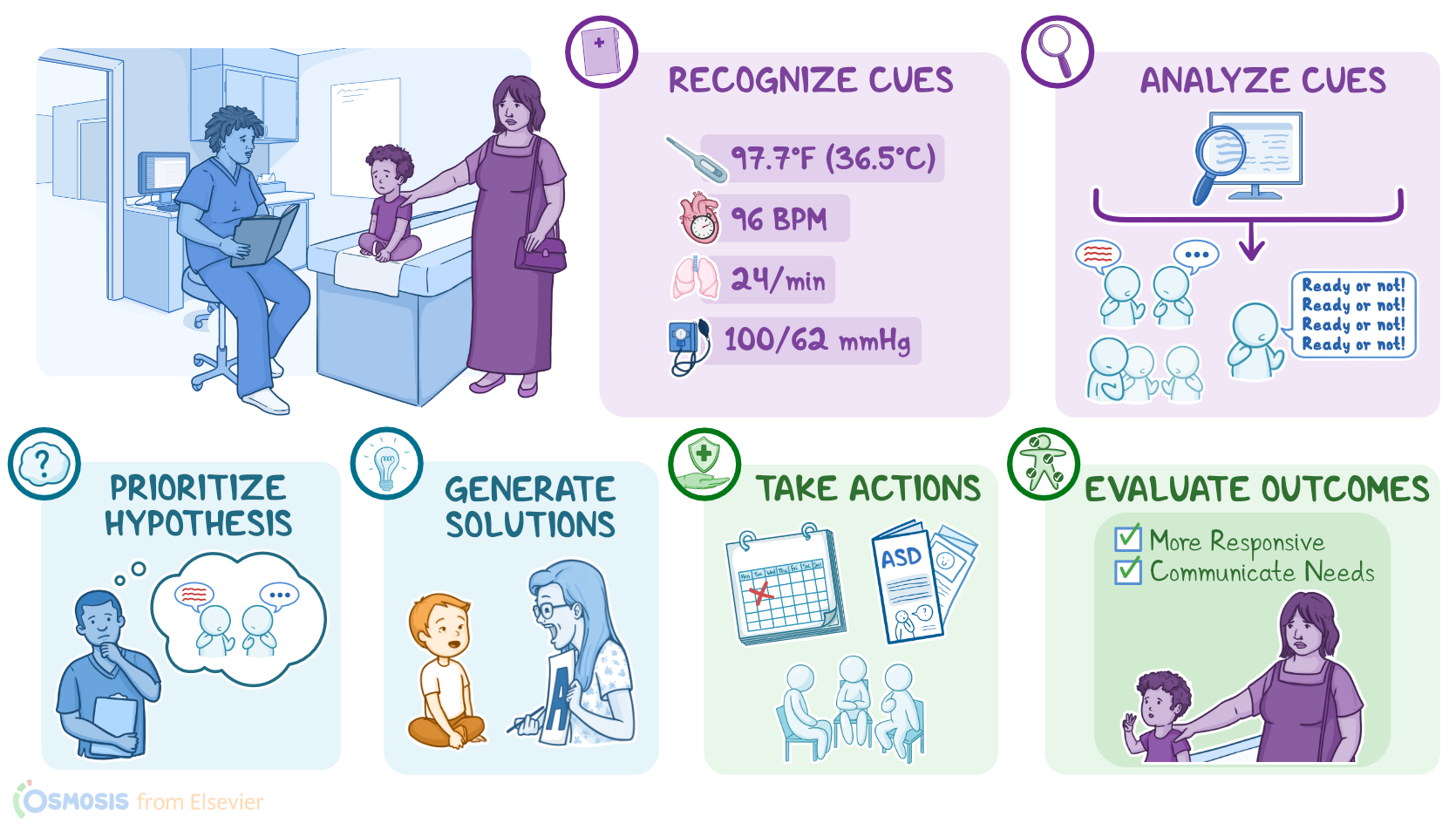
After settling Nico and his caregiver, Anne, in a room, Nurse Abisola goes through the steps of the Clinical Judgment Measurement Model to make clinical decisions about Nico’s care by recognizing and analyzing cues, prioritizing hypotheses, generating solutions, taking action, and evaluating outcomes.
First, Nurse Abisola recognizes important cues, including Nico’s vital signs, which are temperature 97.7 F or 36.5 C, heart rate 96 beats per minute, respirations 24 breaths per minute , and blood pressure 100/62 mmHg.
Recognizing and Analyzing Cues0:32–1:53
She also notices that Nico appears withdrawn, isn’t making eye contact, and when addressed, he doesn’t respond. Next, Nurse Abisola analyzes these cues.
She reviews the electronic health record, or EHR, and notes that other than ASD, Nico has no medical or surgical history.
Nurse Abisola reviews previous notes from the pediatrician, who states that Nico has missed some communication milestones for his age; for example, he's unable to participate the normal back and forth of a conversation, he rarely initiates social interactions, and he often repeats unusual phrases over and over.
Nurse Abisola understands that although the exact pathophysiology of ASD is not well understood, it seems to be caused by a combination of genetic and environmental causes, some of which are responsible for regulating social and communication behaviors.
Nurse Abisola realizes Nico needs effective management of ASD to support his communication. Now, using the information she's gathered, along with Nico’s medical history, Nurse Abisola chooses a priority hypothesis of impaired communication.
Prioritizing Hypotheses, Generating Solutions, and Taking Action1:53–3:41
Then, she generates solutions to address Nico’s impaired communication, and she establishes the expected outcome that Nico will communicate his needs effectively after meeting with a speech language pathologist for one month.
Nurse Abisola then takes action to implement these solutions. She reviews the EHR and sees that the pediatrician has placed a referral for Nico to see a speech language pathologist on an outpatient basis.
Nurse Abisola then re-enters the examination room to review the plan of care with Nico and Anne. Nurse Abisola: Hi Anne and Nico.
The pediatrician has ordered an evaluation for Nico by a speech language pathologist. This is a trained specialist who can help patients with communication barriers express themselves more effectively.
Anne: I would like that, and I think Nico would too. It can be very frustrating when I don’t know what Nico wants or needs.
Nurse Abisola: That must be very challenging. Anne: It really is.
Nico knows a few words, but other than those, he really doesn’t speak. It’s so strange, he started babbling at just four months old, but by age one, he couldn’t even say “mama” or “dada.” Nurse Abisola: That’s common in children with autism spectrum disorder; sometimes they develop milestones early but then fail to progress past those.
Hopefully the speech therapy will help Nico to meet some of those milestones. Anne: That sounds great.
I’m looking forward to Nico starting therapy. Nurse Abisola confirms Nico’s appointment with the speech language pathologist for the next week and provides Anne with additional education about ASD as well as information on a support group for parents of children with ASD.
One month later, Anne brings Nico back to the office for a follow-up appointment and Nurse Abisola evaluates the outcome of her actions.
Evaluating Outcomes3:41–4:47
She takes his vital signs which are temperature 98.5 F or 36.9 C, heart rate 98 beats per minute, respirations 26 breaths per minute, and blood pressure 106/68 mmHg.
Anne tells Nurse Abisola that Nico has been meeting with the speech language pathologist every week for the past month. Nurse Abisola: Hi Nico, my name is Abisola.
How old are you? Nico: I’m three.
Nico holds up three fingers. Nurse Abisola: Wow, great job!
Are you going to school? Nico nods his head back and forth: No.
Anne: This is more than he usually says to people he isn’t familiar with! Nurse Abisola: Good.
Anne, how has Nico been communicating at home? Anne: I’ve noticed he’s been able to tell me if he’s hungry or tired, which he wouldn’t do before, instead he would just cry.
I can tell he’s made improvements. Nurse Abisola: That’s wonderful.
Alright, as a quick recap… Nurse Abisola recognized and analyzed cues related to Nico’s impaired communication and prioritized hypotheses and generated solutions to address this problem.
Review4:47–5:16
Since Anne reported that Nico is more responsive and has begun to communicate his needs, Nurse Abisola determined that the plan of care was successful.
| CASE STUDY - AUTISM SPECTRUM DISORDER (ASD) | ||
| KEY POINTS | NOTES | |
| INTRODUCTION |
| |
| RECOGNIZING AND ANALYZING CUES |
| |
| PRIORITIZING HYPOTHESES, GENERATING SOLUTIONS, AND TAKING ACTIONS |
| |
| EVALUATING OUTCOMES |
| |
- "Varcarolis’s Canadian psychiatric mental health nursing. (3rd ed.)" Elsevier (2023)
- "Keltner’s psychiatric nursing." Elsevier (2023)
No notes for this video yet
Try adding a note below