Decision-making: Nursing
Nurse Alma is the charge nurse on a medical surgical unit. During today’s shift, the unit is understaffed by one nurse who was unable to come in due to illness, and Nurse Alma has just received notification that her unit will be receiving an unexpected client admission. Nurse Alma needs to decide which nurse should admit and care for the new client. She will use her decision-making skills to determine the best client assignment.
Decision-making is the process of making the best choice based on available evidence for a scenario. Thoughtful decision-making is important to determine what the most beneficial or least harmful option is for the people who it impacts. So Nurse Alma will consider all of her options and the evidence available to her to make the best decision for her team.
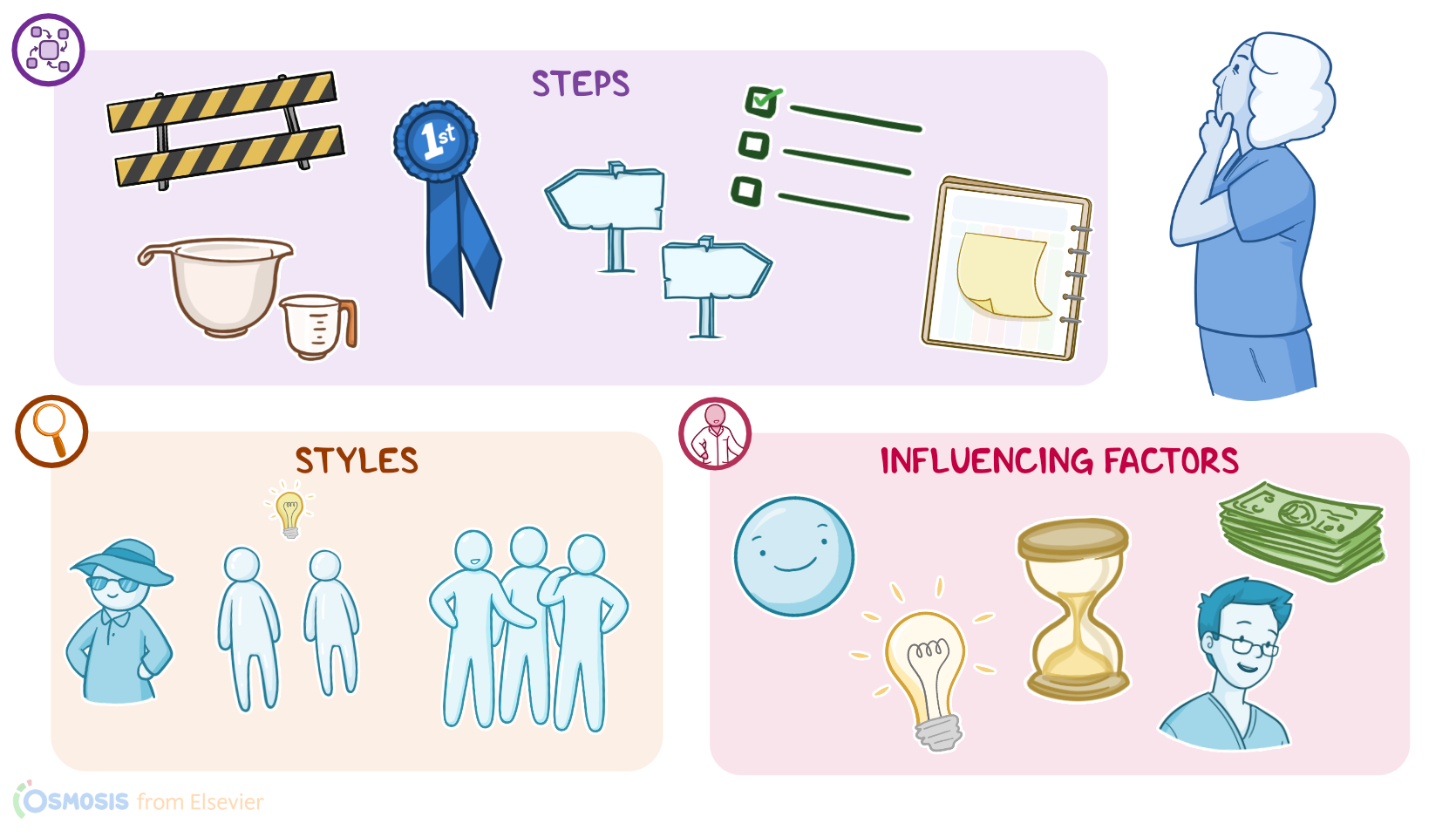
Now, when decision-making, a model that you can use to guide your process is the DECIDE model, which stands for: Define, Establish, Consider, Identify, Develop, and Evaluate.
The “D” in DECIDE is for Defining the problem. This sounds simple but it can be a multi-step process when evaluating larger issues and includes determining barriers to the desired outcome. So, Nurse Alma’s problem is that there is a new client admission on the way and her barrier is that she does not have an adequate number of nursing staff to accommodate the admission.
The “E” stands for Establishing the criteria you’ll base your decision on, or how you will measure the success of your decision. To do this, you can ask yourself three guiding questions: “What do I want to achieve with this decision?’”; “What do I want to preserve?”; “What problems do I want to avoid?” As Nurse Alma completes this step of decision-making, she decides she would like to achieve a safe client assignment, preserve her staff’s confidence in her, and avoid increasing staff stress.
Next, the “C” stands for Consider, which means you should consider all of the potential courses of action. When Nurse Alma Considers, she determines there are three reasonable solutions to her problem: she can assign the client to Nurse TJ, an experienced nurse with a full assignment, she can assign the client to Nurse Mike, a new graduate nurse, or Nurse Alma can take the client herself.
The “I” stands for Identify. This is when you identify the best course of action. When looking to Identify the best option, Nurse Alma considers adding another client to Nurse TJ’s full assignment but decides that this could increase Nurse TJ’s stress and also place his clients at risk. Nurse Alma also considers assigning the client to Nurse Mike, who is a new nurse. She values her colleague’s opinions and asks Nurse Mike if he would be comfortable taking on another client. Nurse Mike responds, “I don’t think I’m ready for that.” Finally, Nurse Alma considers taking on the new client admission herself. She is the charge nurse but has no assigned clients so she decides that taking on the new admission would be the best decision.
Now that Nurse Alma has Identified, she moves onto the second “D” which stands for Develop and implement the plan. Nurse Alma communicates to the team that she will take the admission. She knows that she has to complete next month’s staff schedule before the end of the shift, so she develops a plan to complete that task before the arrival of the new admission.
Finally, “E” is for Evaluate. When implementing a decision, you should evaluate if your choice met the criteria established earlier in the process. So when Nurse Alma evaluates her decision against the developed criteria, she finds that the new admission is safely settled in the room and stable. In addition, Nurse TJ reports that he is “all caught up”, Nurse Mike has completed administering the scheduled medications and is on a meal break. Lastly, Nurse Alma finished making next month’s schedule before the admission arrived. Therefore, Nurse Alma determines that her decision has met the criteria that she set.
There are many tools available to you in the decision-making process. Some of the most commonly used tools include decision grids and SWOT analyses. Decision grids are visual representations that allow for a quick way to compare and contrast different options. Each potential decision is listed separately within columns to address pertinent criteria for the decision, similar to a pros and cons list. When Nurse Alma was considering her options, she could have made a decision grid to visualize her options and quantify complex criteria such as stress or experience level.
| DECISION MAKING | ||
| KEY POINTS | NOTES | |
| INTRODUCTION |
| |
| DEFINITION |
| |
| DECISION-MAKING TOOLS |
| |
| INFLUENCING FACTORS |
| |
| DECISION-MAKING STYLES |
| |
No notes for this video yet
Try adding a note below