Case study - Benign prostatic hyperplasia (BPH): Nursing
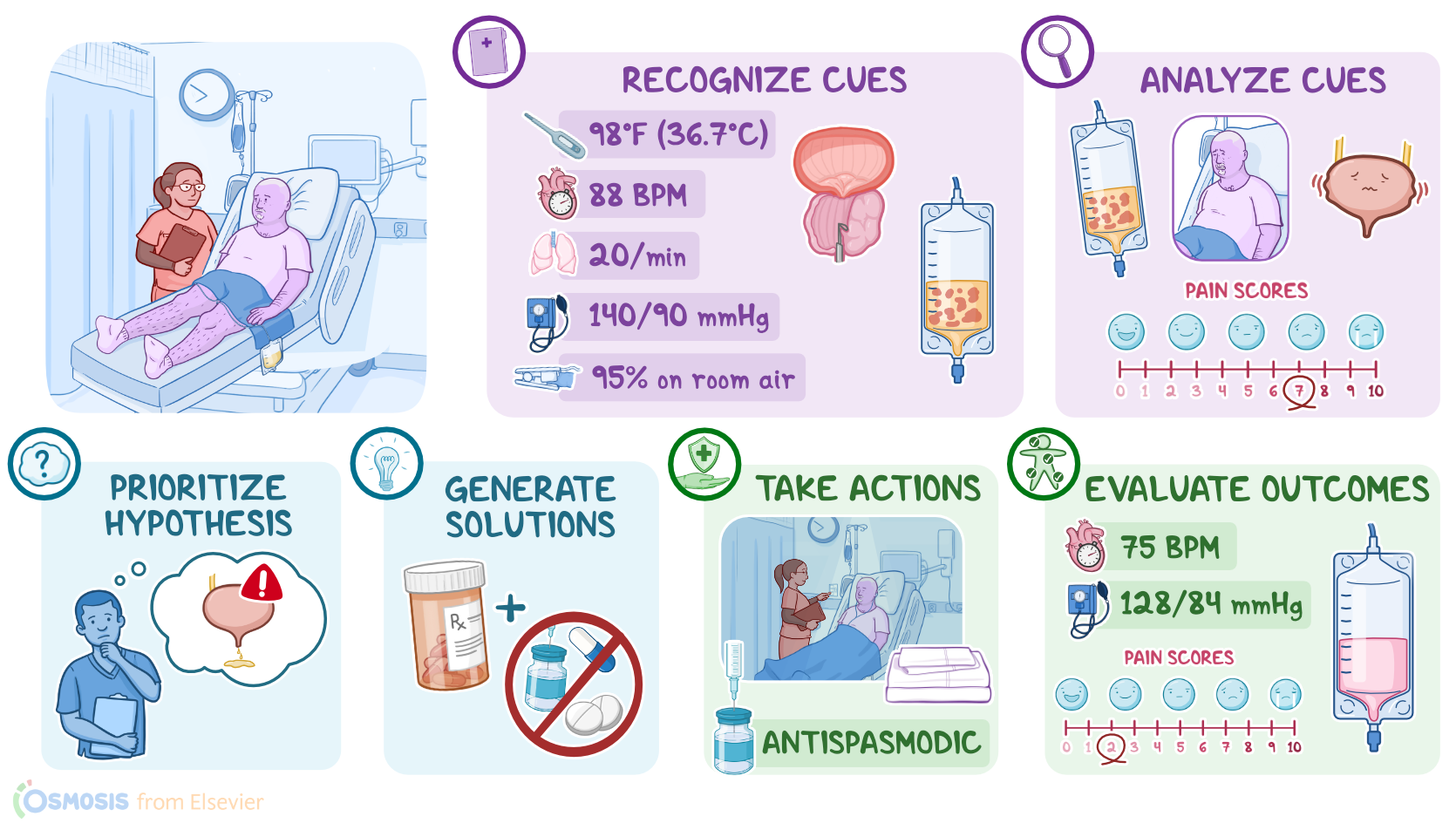
Nurse Suleena works on a Surgical Step-Down Unit and is caring for Pedro, a 55-year-old male with a history of benign prostatic hyperplasia, or BPH, who was admitted two days ago following a transurethral resection of the prostate, or TURP. After settling Pedro in his room, Nurse Suleena goes through the steps of the Clinical Judgment Measurement Model to make clinical decisions about Pedro’s care by recognizing and analyzing cues, prioritizing hypotheses, generating solutions, taking action, and evaluating outcomes.
First, Nurse Suleena recognizes important cues, including vital signs, which are temperature 98.0 F or 36.7 C, blood pressure 140/ 90 mmHg, heart rate 88 beats per minute, respirations 20 breaths per minute, and oxygen saturation 95 percent on room air. She also notices Pedro grimacing and shifting uncomfortably in bed. When examining the collection bag for Pedro’s continuous bladder irrigation, or CBI, Nurse Suleena notices large blood clots and amber-colored drainage.
Next, Nurse Suleena analyzes these cues. She knows that the CBI output should be light pink, and that blood clots and amber-colored urine in the CBI drainage bag can indicate that the irrigation rate likely needs to be increased. Also, Pedro’s non-verbal cues and vital signs indicate he’s experiencing discomfort, which is also likely due to his ineffective urinary drainage. She also recognizes that bladder spasms resulting from his TURP procedure can cause additional pain. Then, she reviews the electronic health record, or EHR, and notes that Pedro’s last dose of pain medication was four hours ago.
Nurse Suleena: Pedro, how are you feeling after your procedure?
Pedro: I’m fine. Isn’t there a male nurse on this floor?
Nurse Suleena: I understand that having a female nurse care for you after your TURP procedure can be unfamiliar. There are no male nurses available today, but I’m going to do my best to take care of you and make you comfortable. Is there anything I can do to help you?
Pedro: I feel like I need to go to the bathroom a lot. I don’t like having the catheter.
Nurse Suleena: I can imagine it’s uncomfortable, but the catheter is meant to help your prostate heal. How would you rate your pain from 0 to 10?
Pedro: Seven, it really hurts and feels like pressure.
| CASE STUDY - BENIGN PROSTATIC HYPERPLASIA (BPH) | ||
| KEY POINTS | NOTES | |
| INTRODUCTION |
| |
| RECOGNIZING AND ANALYZING CUES |
| |
| PRIORITIZING HYPOTHESES, GENERATING SOLUTIONS, AND TAKING ACTIONS |
| |
| EVALUATING OUTCOMES |
| |
- "Lewis's medical-surgical nursing: Assessment and management of clinical problems. (12th ed.)" Elsevier (2022)
- "Medical-surgical nursing: Concepts for interprofessional and collaborative care. (10th ed.)" Elsevier (2021)
- "Lewis’s medical-surgical nursing in Canada: Assessment and management of clinical problems. (5th ed.)" Elsevier (2023)
No notes for this video yet
Try adding a note below