Case study - Bipolar disorder: Nursing
Introduction0:00–0:32
Nurse. Niel works on an inpatient psychiatric unit and is caring for Octavia, a 28 year old with a history of bipolar one disorder who was recently admitted for a manic episode.
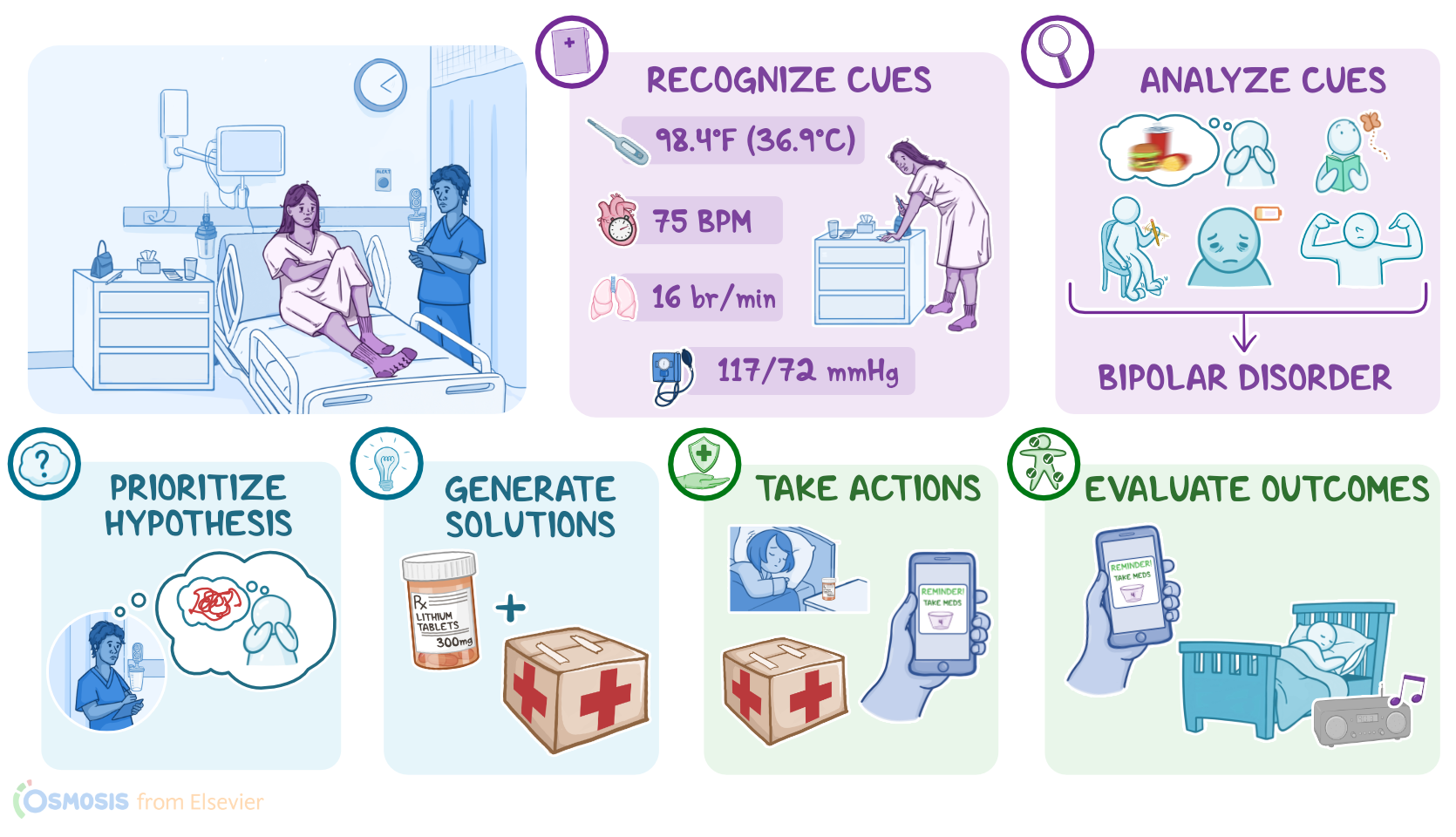
In collaboration with a registered nurse, RN Andre, nurse, Niel goes through the steps of the clinical judgment measurement model to make clinical decisions about Octavia's care by recognizing and analyzing cues, prioritizing hypotheses, generating solutions, taking action and evaluating outcomes.
Recognizing and Analyzing Cues0:32–2:27
First, nurse Nikhil recognizes important cues including Octavia's vital signs which are temperature 98.4 °F or 36.9 °C, heart rate, 75 BPM, respirations, 16 breaths per minute and BP.
117/72 millimeters of mercury upon entering her room, nurse, Niel Notes, Octavia is pacing back and forth, stopping intermittently to rearrange the items on her bedside table.
Hi, Octavia. I see you're cleaning your room.
Could you pause for a moment and speak with me? Oh, sure.
I totally have time for you, don't you see I'm doing something important. I really need to get my room cleaned up so I can start writing.
I have an amazing idea for a best selling book about a forest like the one I grew up next to my mom would know the name I should call her.
Do you have her number? Next?
Nurse Nikhil analyzes these cues. They review the electronic health record or E hr and note that prior to her hospitalization, Octavia had not been taking her lithium as prescribed.
The patient may have symptoms like racing thoughts, hyperactivity, distractibility, insomnia and feeling an inflated sense of self.
They understand that in patients experiencing mania, sleep disturbances can lead to exhaustion which can perpetuate manic or hypomanic episodes.
They also know that medications like lithium are prescribed to help with mood stabilization. Nurse Niel recognizes that Octavia needs management of her manic episode to promote effective sleep.
Now, using the information they've gathered along with Octavia's medical history. Nurse Nikhil reports their findings to RN Andre and together they choose a priority hypothesis of insomnia.
Prioritizing Hypotheses, Generating Solutions, and Taking Action2:27–4:55
Then nurse Nikhil collaborates with RN Andre to generate solutions to address Octavia's insomnia that will include pharmacologic and non pharmacologic interventions.
And they establish the expected outcome that after intervening, Octavia will demonstrate two sleep promotion strategies by the end of the shift.
Next. Nurse Nakil and A Andre take action to implement these solutions.
They check the E hr and see that Octavia is prescribed a dose of lithium. Then they reenter Octavia's room.
Hi, Octavia. I have your lithium for you.
Fine. But I'm kind of busy right now.
Can you just put it on the table and I'll take it later. Is there a reason you don't want to take your medication?
Honestly. I'm too busy.
Plus I've been off it for a while now and I'm fine. I don't have time to go to the pharmacy.
I've got things to do. I see it's important for you to take your lithium every day to manage your symptoms.
It's also not healthy to go days without sleeping. Yeah, I'm aware.
Ok, I'll take it. I just want to go home.
Nurse Nikhil then administers the lithium according to the principles of safe medication administration. Now, I heard you haven't been sleeping well, nurse Andre and I want to help you develop a routine so you can get some rest tonight.
Why do you care anyways? We're here to support you and help you get better so you can go home?
Ok. Then a and Andre discusses strategies to promote sleep, including establishing a sleep schedule by going to bed and waking up at the same time every day and to have a relaxing presleep routine by reading a book, listening to soothing music or taking a warm bath.
He also teaches her ways to decrease stimulation before bedtime, like limiting screen time and avoiding caffeinated beverages in the afternoons and evenings and to make her sleep environment more inviting for sleep by ensuring it's dark, quiet and cool.
Before exiting the room. Nurse Nikhil decreases environmental stimuli by dimming the lights and reducing the volume on the television Before their shift ends.
Evaluating Outcomes4:55–5:33
Nurse Nikhil enters Octavia's room to evaluate the outcome of their actions. Her vital signs are temperature 97.8 °F or 36.6 °C, heart rate, 63 BPM, respirations, 16 breaths per minute and BP, 110/70 millimeters of mercury.
Octavia is sitting up in her bed with her pajamas on, she shows nurse Nikhil the alert she set on her phone to remind her to take her daily lithium and another alert to remind her to initiate her bedtime routine.
Octavia asks nurse Nik to play some relaxing music on the radio to help her calm down before bed. All right.
Review5:33–6:04
As a quick recap, nurse Nikhil recognized and analyzed cues related to Octavia's insomnia due to her manic episode and in collaboration with RN Andre prioritized hypotheses and generated solutions to address this problem.
Nurse Nikki and A Andre then took action and implemented pharmacologic and non pharmacologic measures and evaluated Octavia's outcomes and compared them to the expected outcome.
Since Octavia was able to partake in two sleep promotion strategies, they determined the plan of care was successful.
| CASE STUDY - BIPOLAR DISORDER | ||
| KEY POINTS | MY NOTES | |
| INTRODUCTION |
| |
| RECOGNIZING AND ANALYZING CUES |
| |
| PRIORITIZING HYPOTHESES, GENERATING SOLUTIONS, AND TAKING ACTION |
| |
| EVALUATING OUTCOMES |
| |
- "Foundations of mental health care. (8th ed.)" Elsevier (2023)
No notes for this video yet
Try adding a note below