Case study - Borderline personality disorder: Nursing
Introduction0:00–0:38
Nurse Amirah works on an inpatient psychiatric unit and is caring for Yang, a 42-year-old with a history of borderline personality disorder, who was recently admitted for a self-harm ideation following a breakup with his partner.
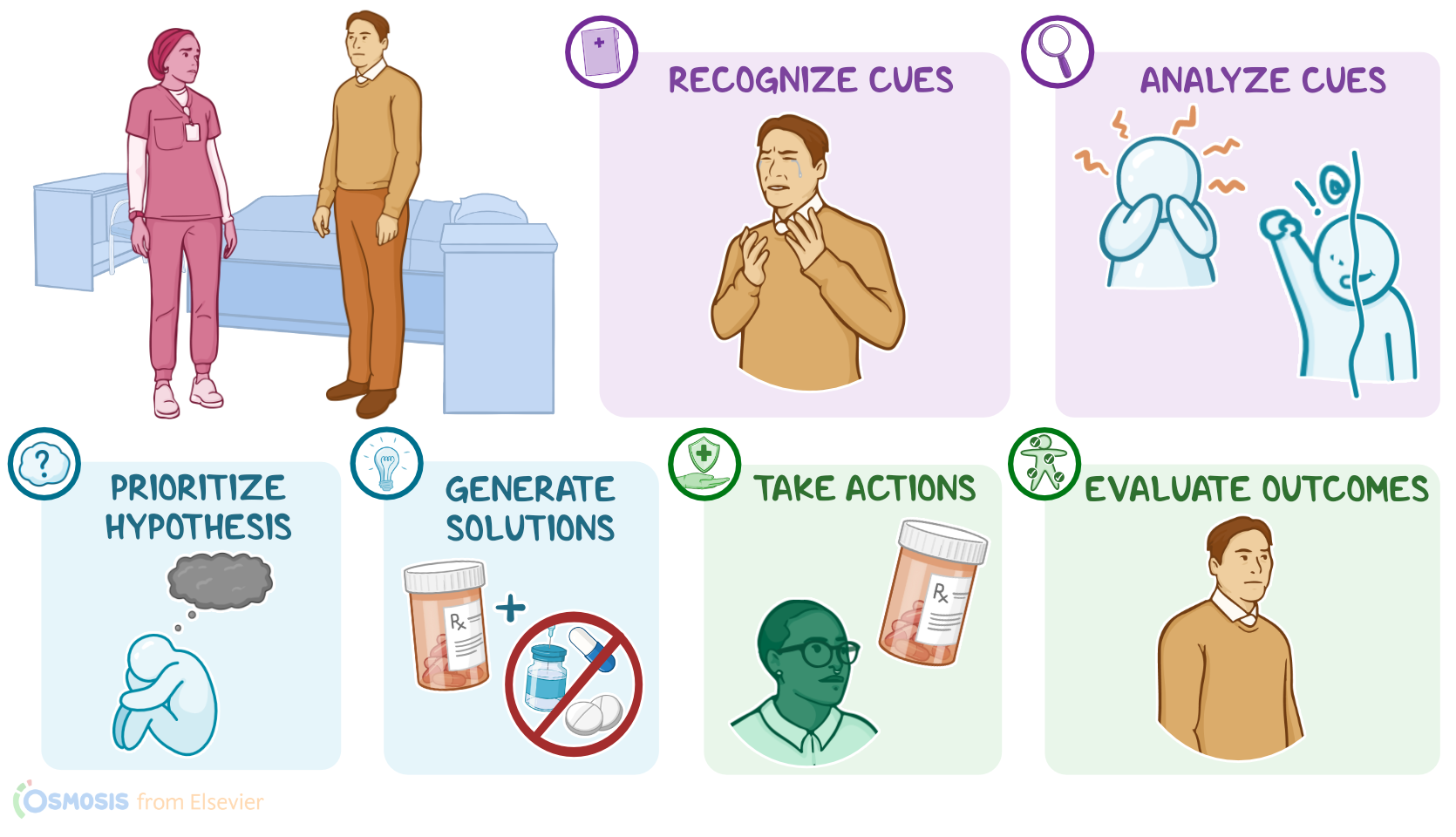
After settling Yang in his room, Nurse Amirah goes through the steps of the Clinical Judgment Measurement Model to make clinical decisions about Yang’s care by recognizing and analyzing cues, prioritizing hypotheses, generating solutions, taking action, and evaluating outcomes.
First, Nurse Amirah recognizes important cues, including Yang’s vital signs, which are temperature 98.9 F or 37.1 C, heart rate 70 beats per minute, respirations 16 breaths per minute, and blood pressure 132/82 mmHg.
Recognizing and Analyzing Cues0:38–2:12
She notes Yang is pacing back and forth and that his breakfast tray is untouched on the bedside table. Nurse Amirah: Hi Yang, I noticed you haven’t eaten your breakfast.
Yang: This is the most disgusting food I’ve ever seen. Where is my boyfriend?
I’m serious, I’ll hurt myself if he really decides to leave me. Nurse Amirah: I understand you’re upset.
Do you have a plan to injure yourself? Yang: No, but I’ll do it.
I just don’t get what happened. I thought I’d found my soulmate.
Next, Nurse Amirah analyzes these cues. She reviews electronic health record, or EHR, and notes Yang was diagnosed with borderline personality disorder, or BPD, five years ago, and has been hospitalized for self-harm ideation in the past.
Nuse Amirah recognizes that BPD is a condition where individuals have unstable moods and relationships. Those with BPD may also experience fear of abandonment, leading to threats of self-harm to keep someone from leaving them.
Nurse Amirah recognizes that Yang needs mood stabilization to prevent self-harm. Now, using the information she's gathered, along with Yang’s medical history, Nurse Amirah chooses a priority hypothesis of risk for violence against self.
Prioritizing Hypotheses, Generating Solutions, and Taking Action2:12–4:55
Then, she generates solutions to address Yang’s safety that will include pharmacologic and nonpharmacologic interventions and she establishes the expected outcome that after intervening, Yang will use coping strategies to remain safe and free from injury.
Nurse Amirah then takes action to implement these solutions. First, she confirms that items Yang could use to harm himself have been removed from his room.
Next, Nurse Amirah asks an unlicensed assistive personal, or UAP, to sit with Yang to prevent self-harming behaviors. Then, she checks the EHR, and see’s Yang is prescribed a mood stabilizer.
She gathers the supplies and enters Yang’s room. Nurse Amirah: Hi Yang, I’m here with your medicine.
Yang: I don’t see why I need a babysitter to sit with me, I’m not a child. Nurse Amirah: I know you aren't.
This is a nursing assistant who’s going to sit with you to make sure you’re safe. Could you tell me how you’re feeling?
Yang: It feels like my heart’s been ripped from my chest and I’m totally alone. I’m going to be alone forever.
I just feel so sad. Nurse Amirah: I’m sorry you’re going through this, but I want you to know that I’m here to support you along with the rest of your medical team.
I have your medication, lithium, to help stabilize your mood. Will you take it?
Yang: Okay, yeah. Nurse Amirah then administers the lithium according to the principles of safe medication administration.
Nurse Amirah: Do you want to tell me about what’s going on with you and your partner? Yang: He’s the most wonderful person I’ve ever met and is too good for me.
I told him I’d rather be dead than without him, so he called my sister, and she brought me here. Nurse Amirah: I see.
And I understand that your breakup has been very painful and is causing you to have thoughts about hurting yourself. Yang: Yeah.
Nurse Amirah: In the past, have you used any strategies to keep from harming yourself when you feel this way? Yang: Well, sometimes it helps if I write down thoughts in my journal.
It also helps me if I speak to my counselor, but she’s not here. Nurse Amirah: Okay, I can gather some paper for you to write on.
We also have a wonderful unit counselor who’s looking forward to speaking with you. Would you be willing to meet with them?
Yang: I guess. Nurse Amirah then contacts the unit counselor, who comes to meet with Yang.
While they’re meeting, Nurse Amirah gathers safe supplies for Yang to journal with and leaves them on his bedside table.
At the end of her shift, Nurse Amirah enters Yang’s room to evaluate the outcome of her actions. Yang is sitting at a table with his notebook in his lap.
Evaluating Outcomes4:55–5:23
He appears relaxed and is conversing with the UAP. Yang reports that he feels better after meeting with the unit counselor and that journaling allowed him to express his emotions.
He also tells Nurse Amirah that his thoughts of self-harm are still present, but he doesn’t feel pressure to act on them.
Alright, as a quick recap…Nurse Amirah recognized and analyzed cues related to Yang’s risk for self-harm and prioritized hypotheses and generated solutions to address this problem.
Review5:23–5:52
Nurse Amirah then implemented pharmacologic and nonpharmacologic interventions and evaluated Yang’s outcomes and compared them to the expected outcome.
Since Yang used coping strategies, and remained safe and free from harm, Nurse Amirah determined the plan of care was
| CASE STUDY - BORDERLINE PERSONALITY DISORDER (BPD) | ||
| KEY POINTS | NOTES | |
| INTRODUCTION |
| |
| RECOGNIZING AND ANALYZING CUES |
| |
| PRIORITIZING HYPOTHESES, GENERATING SOLUTIONS, AND TAKING ACTIONS |
| |
| EVALUATING OUTCOMES |
| |
- "Varcarolis’s Canadian psychiatric mental health nursing. (3rd ed.)" Elsevier (2023)
- "Keltner’s psychiatric nursing. (9th ed.)" Elsevier (2023)
No notes for this video yet
Try adding a note below