Case study - Child maltreatment: Nursing
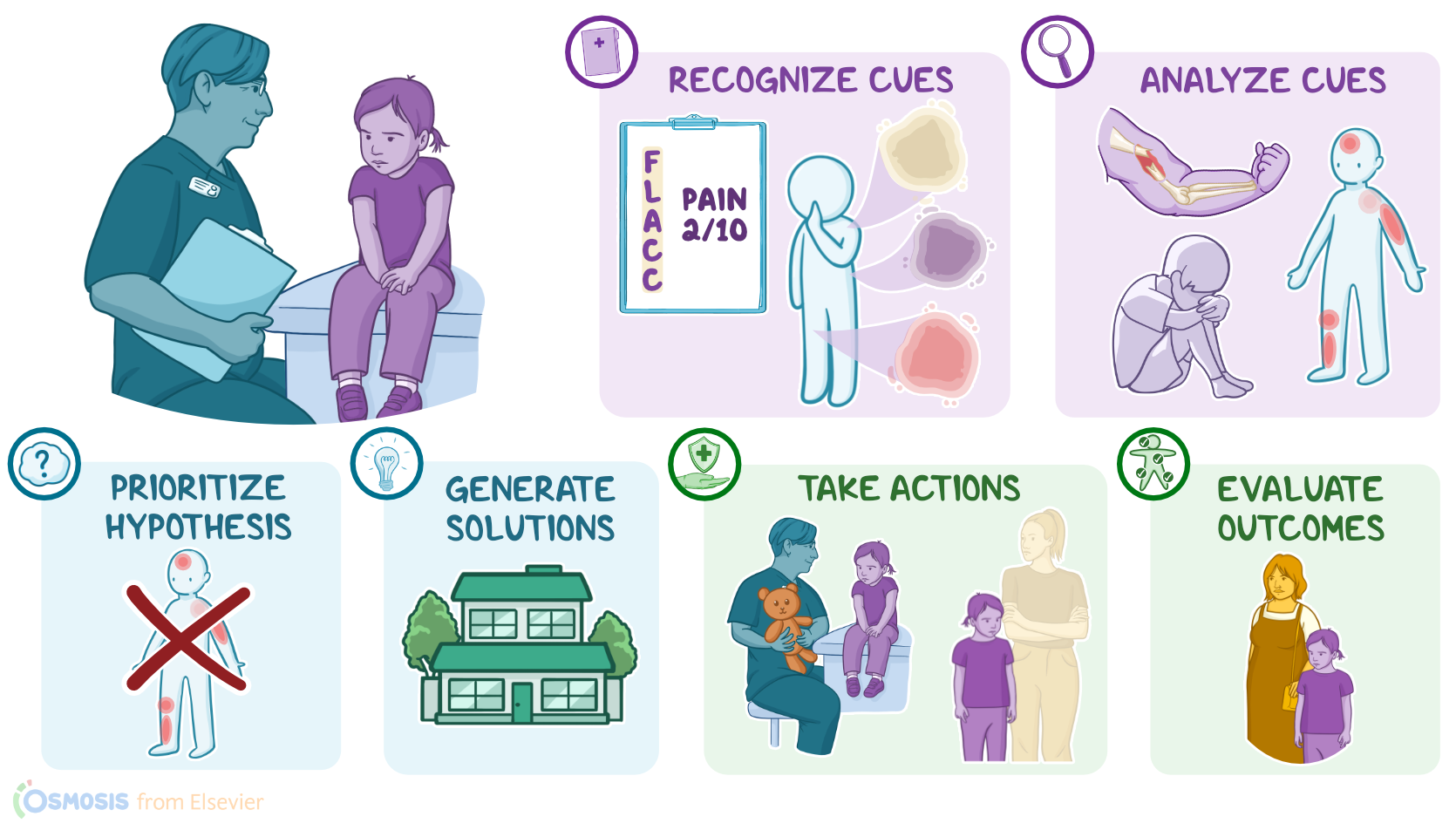
Nurse Angelo works in a family practice clinic and is caring for Maya, a 2-and-a-half-year-old who's brought in for a required wellness check before entering preschool. After settling Maya in the room, Nurse Angelo goes through the steps of the Clinical Judgment Measurement Model to make clinical decisions about Maya’s care by recognizing and analyzing cues, prioritizing hypotheses, generating solutions, taking action, and evaluating outcomes.
First, Nurse Angelo recognizes cues, including Maya’s vital signs which are temperature 98.6 F or 37 C, heart rate 105 beats per minute, and respiratory rate 23 breaths per minute. Nurse Angelo notes that Maya has multiple circular bruises ranging in color from pale yellow to deep purple on her upper arms, as well as a rounded, punctate burn to the back of her left shoulder about one centimeter in diameter.
Nurse Angelo also notes Maya grimaces occasionally and appears tense, so he determines Maya’s pain rating is two out of 10 according to the Face, Legs, Activity, Cry, and Consolability, or FLACC scale. Nurse Angelo also notes that when he asks Maya questions, she doesn’t respond or make eye contact with him.
He gathers additional information from Maya’s mother, Josie, about her injuries.
Nurse Angelo: I see that Maya has some bruising on her arms. Can you tell me what happened?
Josie: Oh, those? She’s just clumsy. She’s always bruised easily. She probably fell down while she was playing or something.
Nurse Angelo: I also noticed an injury to her left shoulder that looks like a burn. Do you know what happened there? Josie: That doesn’t look like a burn to me. Like I said, I think she probably scraped herself when she was playing.
Nurse Angelo then analyzes these cues. He reviews Maya’s electronic health record, or EHR, and notes that she has a history of a humerus fracture at age one year. When asked about the fracture, Josie says it was caused by a fall when Maya was learning to walk.
Nurse Angelo recalls that children experiencing physical abuse often present with injuries that have implausible or inconsistent explanations, and caregivers may downplay the seriousness of injuries. Then, he recognizes that, while the age of a bruise cannot be exactly determined, the varying colors of Maya’s bruises likely reflect different stages of healing from repeated injury. Additionally, the location of her injuries on her upper arms and posterior shoulder aren’t typical locations for childhood injuries, which are commonly found on the knees, shins, or forehead. Finally, Nurse Angelo understands that withdrawn behavior, like avoiding eye contact, can also be a symptom of physical abuse in young children. He determines that Maya requires interventions for possible child maltreatment.
Now, using the information he’s gathered, Nurse Angelo develops a priority hypothesis of risk for injury.
Then, Nurse Angelo generates solutions to address Maya’s risk for injury, and he establishes the expected outcome that after intervening, Maya will be discharged to a safe environment.
Nurse Angelo then takes action to implement these solutions. He reports his assessment findings to the health care provider, who determines that Maya’s injuries are likely consistent with physical abuse. The health care provider works together with Nurse Angelo to contact the designated child protection services and the clinical social worker.
| CASE STUDY - CHILD MALTREATMENT | ||
| KEY POINTS | NOTES | |
| INTRODUCTION |
| |
| RECOGNIZING AND ANALYZING CUES |
| |
| PRIORITIZING HYPOTHESES, GENERATING SOLUTIONS, AND TAKING ACTIONS |
| |
| EVALUATING OUTCOMES |
| |
- "Varcarolis’s Canadian psychiatric mental health nursing. (3rd ed.)." Elsevier (2023)
- "Keltner’s psychiatric nursing. (9th ed.). " Elsevier (2023)
No notes for this video yet
Try adding a note below