Case study - Chronic constipation: Nursing
Introduction0:00–0:34
Nurse. Kelly works at a primary care office and is caring for Francesca an 83 year old who is experiencing constipation in collaboration with the registered nurse, RN Evan.
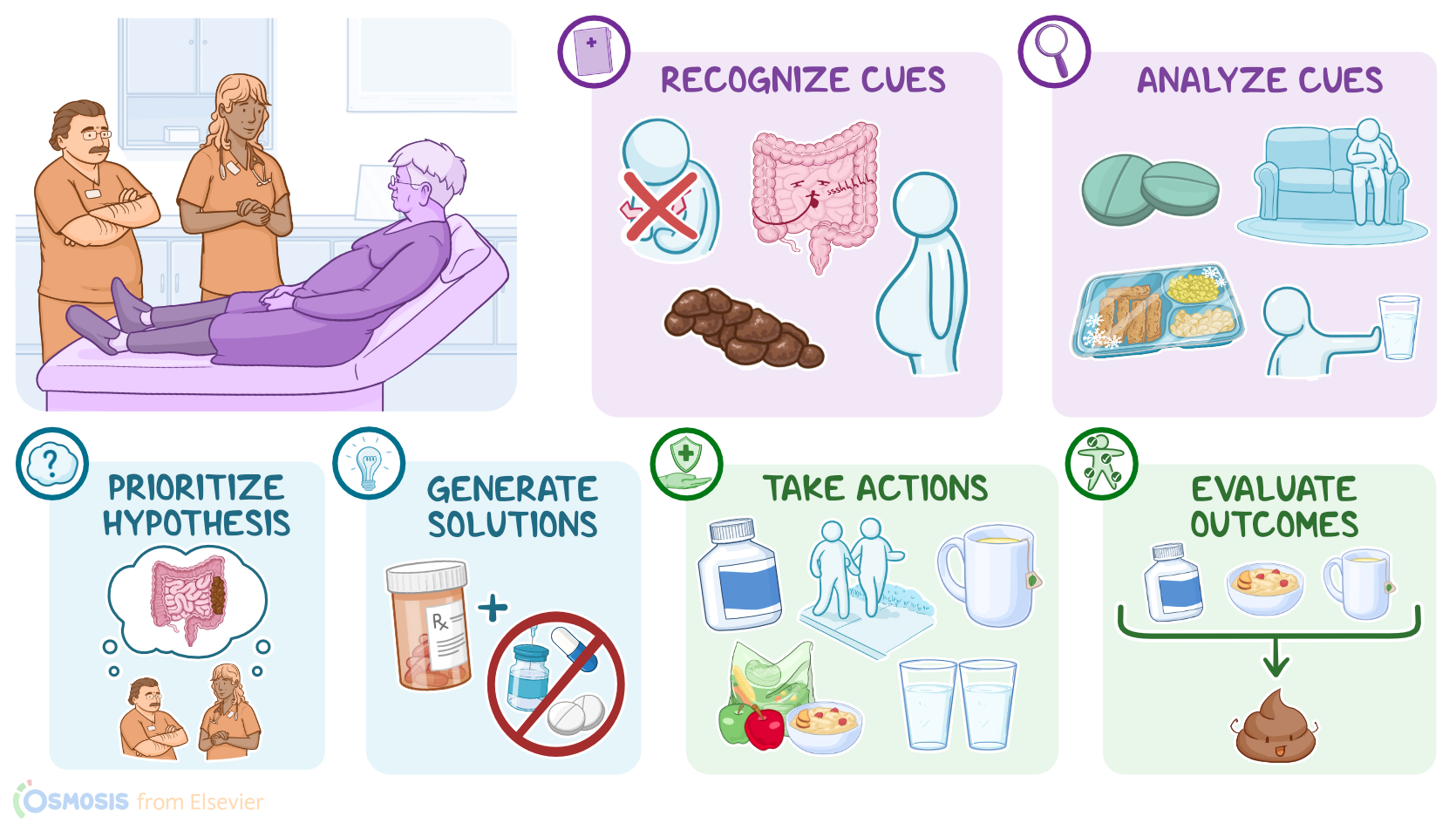
Nurse Kelly goes through the steps of the clinical judgment measurement model to make clinical decisions about Francesca's care by recognizing and analyzing cues, prioritizing hypotheses, generating solutions, taking action and evaluating outcomes.
First, nurse, Kelly recognizes important cues including Francesca's vital signs which are temperature 98.6 °F or 37 °C, heart rate, 90 BPM, respirations, 18 breaths per minute and BP 1 16/64 millimeters of mercury.
Recognizing and Analyzing Cues0:34–2:37
Francesca denies pain but states her abdomen feels full and distended. When asked about her last bowel movement.
Francesca replies that she hasn't had a bowel movement in three days and normally has 2 to 3 hard lumpy bowel movements each week.
Nurse Kelly listens to Francesca's bowel sounds which are hypoactive in all four quadrants. Next, nurse Kelly analyzes these cues.
She reviews the electronic health record or E hr and sees that Francesca takes a diuretic which can increase her risk for constipation due to the elimination of excess body fluids.
Then she gathers information from Francesca about other risk factors for constipation. Francesca.
How would you describe your activity level? I walk around my house but that's it.
Sometimes my knees bother me and I can't get around that. Well, so I guess I sit around a lot.
Ok. And how would you describe your fluid intake and diet?
I try not to drink too much water because then I have to go to the bathroom all the time, especially with my water pill.
As for my diet, I mostly have my meals delivered. I really like the frozen dinners.
They send me nurse. Kelly realizes that Francesca has several risk factors for constipation.
She has a mostly sedentary lifestyle and because of Francesca's age, her gastrointestinal motility is slower. Also, Francesca is more prone to dehydration since she limits her water intake and may not be prompted to drink due to an age related decrease in thirst sensation.
Nurse Kelly realizes that Francesca needs effective bowel elimination. Now using the information she has gathered along with Francesca's medical history.
Prioritizing Hypotheses, Generating Solutions, and Taking Action2:37–4:39
Nurse Kelly reports her findings to RN Evan and they choose a priority hypothesis of altered bowel elimination. They generate solutions to adjust Francesca's constipation that will include pharmacologic and non pharmacologic interventions.
And she establishes the expected outcome that after intervening, Francesca will report having a bowel movement within two days.
Nurse Kelly then takes action to implement these solutions. First.
RN Evans speaks with the health care provider who orders an osmotic laxative for Francesca. RN.
Evan teaches Francesca about her diagnosis and medication and nurse. Kelly reenters the room to review the plan of care.
So, Francesca, I'd like to review the plan for resolving your constipation. What new things will you be doing?
Well, I'm going to start taking the medication and I'm also planning to take a walk around my block in the mornings after breakfast with my grandson, he can help me if my knees start to hurt.
Those are great ideas. You can start taking your medication tomorrow morning with your breakfast.
What types of foods do you plan to eat? To help with your symptoms?
I usually have toast for breakfast. But RN Evan told me that oatmeal is a better choice since it's high in fiber.
And he also told me that frozen dinners don't have a lot of fiber. So I'm gonna have my grandson bring me more foods like apples and frozen vegetables.
That sounds great. Now, I know it can be frustrating to have to urinate more often, but make sure to also increase your fluid intake.
Sometimes drinking warm liquids like herbal tea can help you have a bowel movement too. Ok.
I do like herbal tea at the end of the appointment. Nurse Kelly walks Francesca out to the front desk and tells her that she will call Francesca to follow up.
Two days later, nurse Kelly calls Francesca to evaluate the outcome of her actions. Hi, Francesca.
Evaluating Outcomes4:39–5:14
It's nurse Kelly from your health care provider's office. I'm checking to see how you've been feeling.
I've been taking that medication once a day and today I finally had a large soft bowel movement. I feel much better.
That's great. Have you been able to include more fiber and fluids in your diet?
Yes. Today I made myself some oatmeal and had herbal tea to drink in the morning, which seemed to help good, keep up the good work.
All right. As a quick recap, nurse Kelly recognized and analyzed cues related to Francesca's altered bowel elimination.
Review5:14–5:44
And in collaboration with RN Evan prioritized hypotheses and generated solutions to address this problem. Nurse Kelly and RN Evan then implemented pharmacologic and non pharmacologic measures and evaluated Francesca's outcomes and compared them to the expected outcome.
Since Francesca had a bowel movement within two days. Nurse Kelly determined that the plan of care was successful.
| CASE STUDY - CHRONIC CONSTIPATION | ||
| KEY POINTS | MY NOTES | |
| INTRODUCTION |
| |
| RECOGNIZING AND ANALYZING CUES |
| |
| PRIORITIZING HYPOTHESES, GENERATING SOLUTIONS, AND TAKING ACTION |
| |
| EVALUATING OUTCOMES |
| |
- "Foundations of nursing. (9th ed.). " Elsevier. ISBN: 9780323827119 (2023)
- "Fundamental concepts and skills for nursing. (6th ed.). " Elsevier. ISBN: 9780323694780 (2022)
No notes for this video yet
Try adding a note below