Case study - Cirrhosis: Nursing
Introduction0:00–0:35
Nurse Abigail works on a Medical-Surgical unit and is caring for Thomas, a 72-year-old male with a history of hyperlipidemia and obesity, who was recently admitted for cirrhosis secondary to nonalcoholic fatty liver disease.
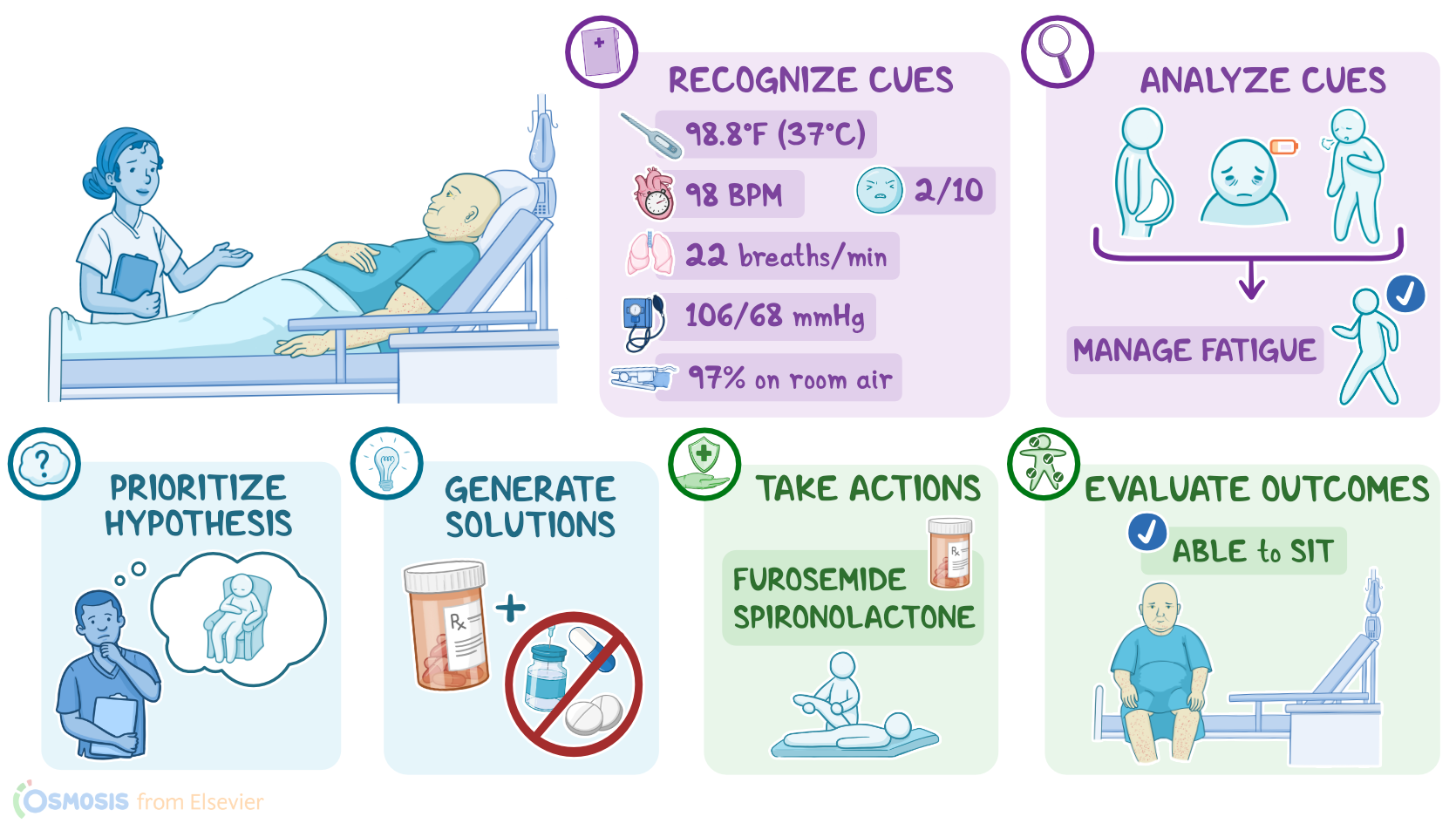
After settling Thomas in his room, Nurse Abigail goes through the steps of the Clinical Judgment Measurement Model to make clinical decisions about Thomas’ care by recognizing and analyzing cues, prioritizing hypotheses, generating solutions, taking action, and evaluating outcomes.
First, Nurse Abigail recognizes important cues, including Thomas’ vital signs, which are temperature 98.8 F or 37 C, heart rate 98 beats per minute, respirations 22 breaths per minute, blood pressure 106/68 mmHg, and oxygen saturation 97 percent on room air.
Recognizing and Analyzing Cues0:35–2:03
When asked to turn side-to-side during assessment, Thomas becomes fatigued and short of breath. Next, Nurse Abigail analyzes these cues.
She reviews the electronic health record, or EHR, and notes that Thomas has gained 17 pounds since his last health care provider visit, which was approximately two weeks ago.
Nurse Abigail recognizes that the fluid build-up in Thomas’ abdomen, also known as ascites, has contributed to his weight gain, and can make it difficult to perform physical activities because of increased pressure on his diaphragm, leading to dyspnea.
She also knows that chronic illness in general can cause fatigue. Nurse Abigail realizes Thomas needs management of his fatigue in order to promote physical mobility.
Now, using the information she's gathered, along with Thomas’ medical history, Nurse Abigail chooses a priority hypothesis of activity intolerance.
Prioritizing Hypotheses, Generating Solutions, and Taking Action2:03–3:48
Then, she generates solutions to address Thomas’ activity level that will include pharmacologic and nonpharmacologic interventions; and she establishes the expected outcome that after intervening, Thomas will tolerate sitting on the edge of the bed for five minutes.
Nurse Abigail then takes action to implement these solutions. First, she calls the health care provider to report her assessment findings and receives orders for two diuretics, furosemide and spironolactone, as well as a physical therapy consult.
As she waits for the pharmacist to approve the medication order, she speaks to Thomas about his plan of care. Nurse Abigail: Hi Thomas, your health care provider has ordered some medications to help with the fluid in your abdomen and they’ve also ordered physical therapy to come see you.
How do you feel about that? Thomas: I don’t know.
It’s hard for me to move around with my belly being so swollen. Nurse Abigail: I understand that must be uncomfortable.
The diuretics I'm going to give you should help with that a little bit. The physical therapist will also help you with some techniques to make it easier to move around.
Thomas: Okay, I’ll try. Nurse Abigail: Great!
I’m glad. Then, Nurse Abigail administers the prescribed diuretics according to the principles of safe medication administration.
She ensures that Thomas is comfortable and gives him the call bell. As she leaves his room, she notices the physical therapist arrives on the unit.
After Thomas has finished working with physical therapy, Nurse Abigail reenters the room to evaluate the outcome of her actions.
Evaluating Outcomes3:48–4:35
She takes Thomas’ vital signs, which are blood pressure 105/68 mmHg, heart rate 99 beats per minute, and respirations 20 breaths per minute.
She notes he’s sitting on the edge of the bed reading the dinner menu. Nurse Abigail: Hi, Thomas, how was your session with physical therapy?
Thomas: Good, they taught me some techniques to conserve energy and helped me sit on the edge of the bed, but it’s been about ten minutes now, so I think I’m ready to lie down again.
Nurse Abigail assists Thomas back into the bed and elevates his head. She covers him with a warm blanket, gives him the call bell, and exits the room.
Alright, as a quick recap…Nurse Abigail recognized and analyzed cues related to Thomas’ activity intolerance and prioritized hypotheses and generated solutions to address this problem.
Review4:35–5:02
Nurse Abigail then implemented pharmacologic and nonpharmacologic interventions and evaluated Thomas’ outcomes and compared them to the expected outcome.
Since Thomas was able to sit on the edge of the bed for five minutes after working with physical therapy, Nurse Abigail determined that the plan of care
| CASE STUDY - CIRRHOSIS | ||
| KEY POINTS | NOTES | |
| INTRODUCTION |
| |
| RECOGNIZING AND ANALYZING CUES |
| |
| PRIORITIZING HYPOTHESES, GENERATING SOLUTIONS, AND TAKING ACTIONS |
| |
| EVALUATING OUTCOMES |
| |
- "Lewis's medical-surgical nursing: Assessment and management of clinical problems. (12th ed.)" Elsevier (2022)
- " Medical-surgical nursing: Concepts for interprofessional and collaborative care. (10th ed.)" Elsevier (2021)
- "Lewis’s medical-surgical nursing in Canada: Assessment and management of clinical problems. (5th ed.)" Elsevier (2023)
No notes for this video yet
Try adding a note below