Case study - End-of-life care: Nursing
Introduction0:00–0:35
Nurse Leslie works in a hospice house and is caring for Ester an 89 year old with a history of end stage chronic obstructive Pulmonary Disease or COPD.
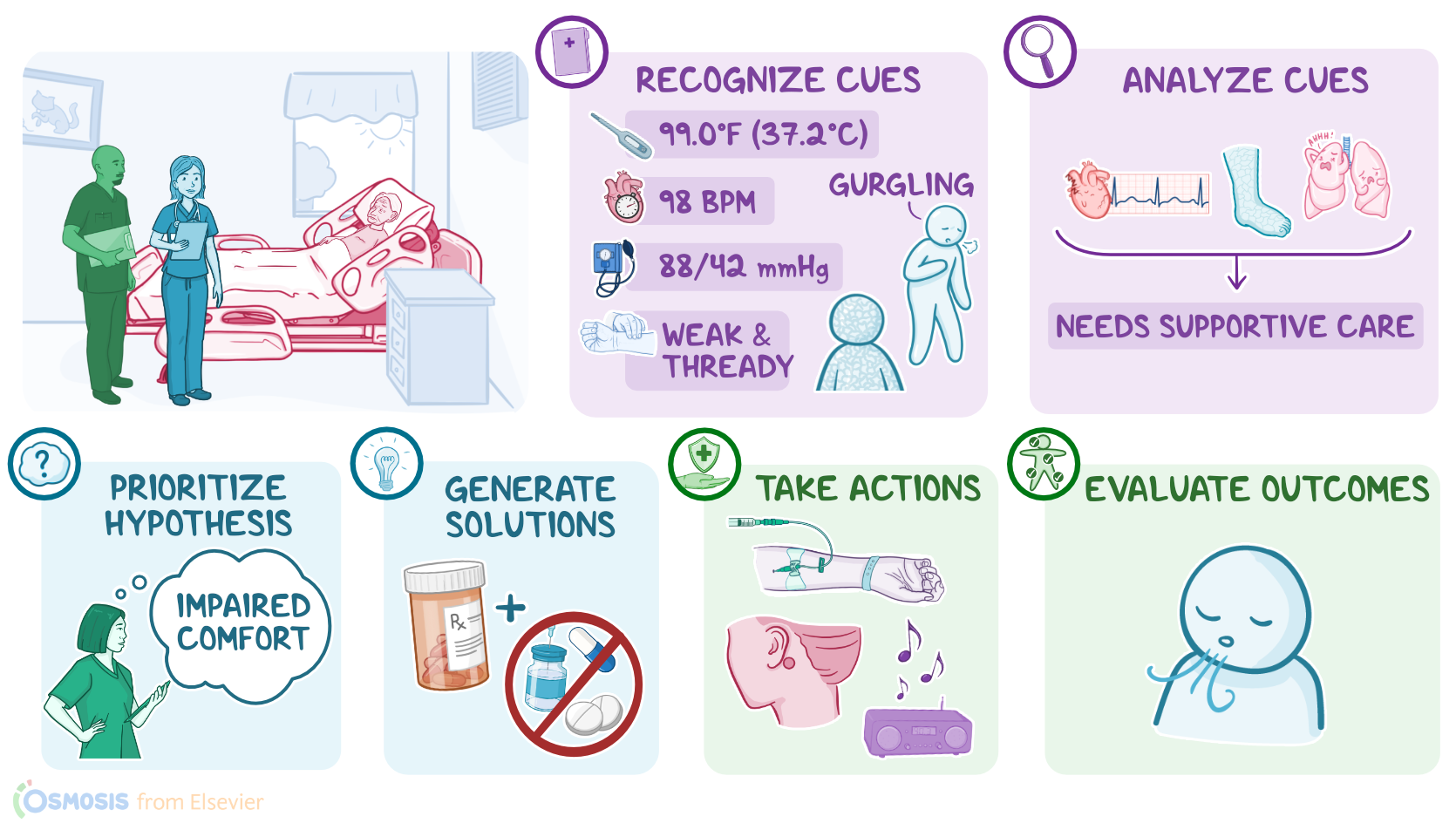
In collaboration with the registered nurse, RN Zak. Nurse Leslie goes through the steps of the clinical judgment measurement model to make clinical decisions about Ester's care by recognizing and analyzing cues, prioritizing hypotheses, generating solutions, taking action and evaluating outcomes.
First, nurse Leslie recognizes important cues including Ester's vital signs which are temperature 99 °F or 37.2 °C, heart rate, 98 BPM and BP 88/42 of her radial pulse is weak and thready.
Recognizing and Analyzing Cues0:35–2:18
Ester's breathing pattern is shallow and there's an audible gurgling sound as she breathes in and out. Nurse.
Leslie notices that ers skin looks mottled and pale and that it feels cool to the touch. She also notes that Ester appears restless and uncomfortable.
Next. Nurse Leslie analyzes these cues.
She reviews the electronic health record or EHR and sees that Ester has a current do not resuscitate or DNR order and is on comfort care.
She also notes that Ester's urine output was 90 mil over the past 12 hours. Nurse leslie knows that as death approaches, body functions begin to slow BP and heart rate decrease and pulses become weak.
Then as circulation slows there's less urine output due to decreased renal perfusion and extremities can become edematous, mottled, dusky and cool.
Since there's less circulation to the periphery, respirations become slow and irregular. And as death nears a build up of saliva and mucus in the throat and upper airways cause breathing to sound wet and gurgling.
Episodes of apnea and hyperventilation called chain Stokes, respirations may also occur. Nurse Leslie realizes that Ester needs supportive care at the end of her life.
Now using the information she has gathered along with Ester medical history. Nurse Leslie reports her findings to RN Zac.
Prioritizing Hypotheses, Generating Solutions, and Taking Action2:18–4:13
And together they choose the priority hypothesis of impaired comfort. They generate solutions to address ester impaired comfort.
As she approaches the end of life that will include pharmacologic and nonpharmacologic interventions. And they establish the expected outcome that after intervening ester, restlessness will decrease by the end of the shift.
Nurse Leslie then takes action to implement these solutions. Nurse Leslie and RN Zack review the EHR and note the health care provider has ordered PRN medications for ester that can help decrease restlessness and increase her comfort.
Then according to the principles of safe medication administration, RNZ administers the prescribed IV LORazepam to treat Ester's restlessness and nurse.
Leslie applies a scopolamine patch to help lessen the secretions building up in Ester's airways. Aren Zak and nurse Leslie work together to reposition Ester so that she's more comfortable.
Next. Nurse Leslie dims the lights and plays soft music in the background.
Afterwards, are ANZAC calls Ester family and asks them to come be by Ester side soon. Ers daughter Lena arrives and sits at her mothers bedside.
Hi, Lina. Thanks for coming.
How are you? I'm ok.
Just sad. Am glad our ANZAC told me to come in.
I was wondering about that noise mom is making in the back of her throat. Is that normal?
I know that can be a scary sound. It's expected at this stage because it's hard for your mom to deal with the fluid that's building up in her airways.
ARN Zak and I just gave her some medication to help her relax and lessen some of those secretions. Ok.
Thank you. At the end of the shift.
Evaluating Outcomes4:13–4:30
Nurse Leslie evaluates the outcomes of her interventions. Ester respirations have become slower and quieter and her restlessness has resolved.
Ester is resting comfortably with Lena at the bedside, holding her mothers hand. Alright.
Review4:30–4:58
As a quick recap, nurse, Leslie recognized and analyzed cues related to esters, impaired comfort and in collaboration with RN Zac prioritized hypotheses and generated solutions to address this problem.
Nurse Leslie and RNZ then implemented pharmacologic and non pharmacologic measures and evaluated esters outcomes and compared them to the expected outcome since Esters, restlessness decreased.
They determined the plan was successful.
| CASE STUDY - END OF LIFE CARE | ||
| KEY POINTS | MY NOTES | |
| INTRODUCTION |
| |
| RECOGNIZING AND ANALYZING CUES |
| |
| PRIORITIZING HYPOTHESES, GENERATING SOLUTIONS, AND TAKING ACTION |
| |
| EVALUATING OUTCOMES |
| |
- "Foundations of nursing. (9th ed.). " Elsevier. ISBN: 9780323827119 (2023)
- "Palliative & hospice care: Nursing. " Osmosis (2023, 3/8)
- "Fundamental concepts and skills for nursing. (6th ed.). " Elsevier. ISBN: 9780323694780 (2022)
No notes for this video yet
Try adding a note below