Case study - Generalized anxiety disorder: Nursing
Introduction0:00–0:29
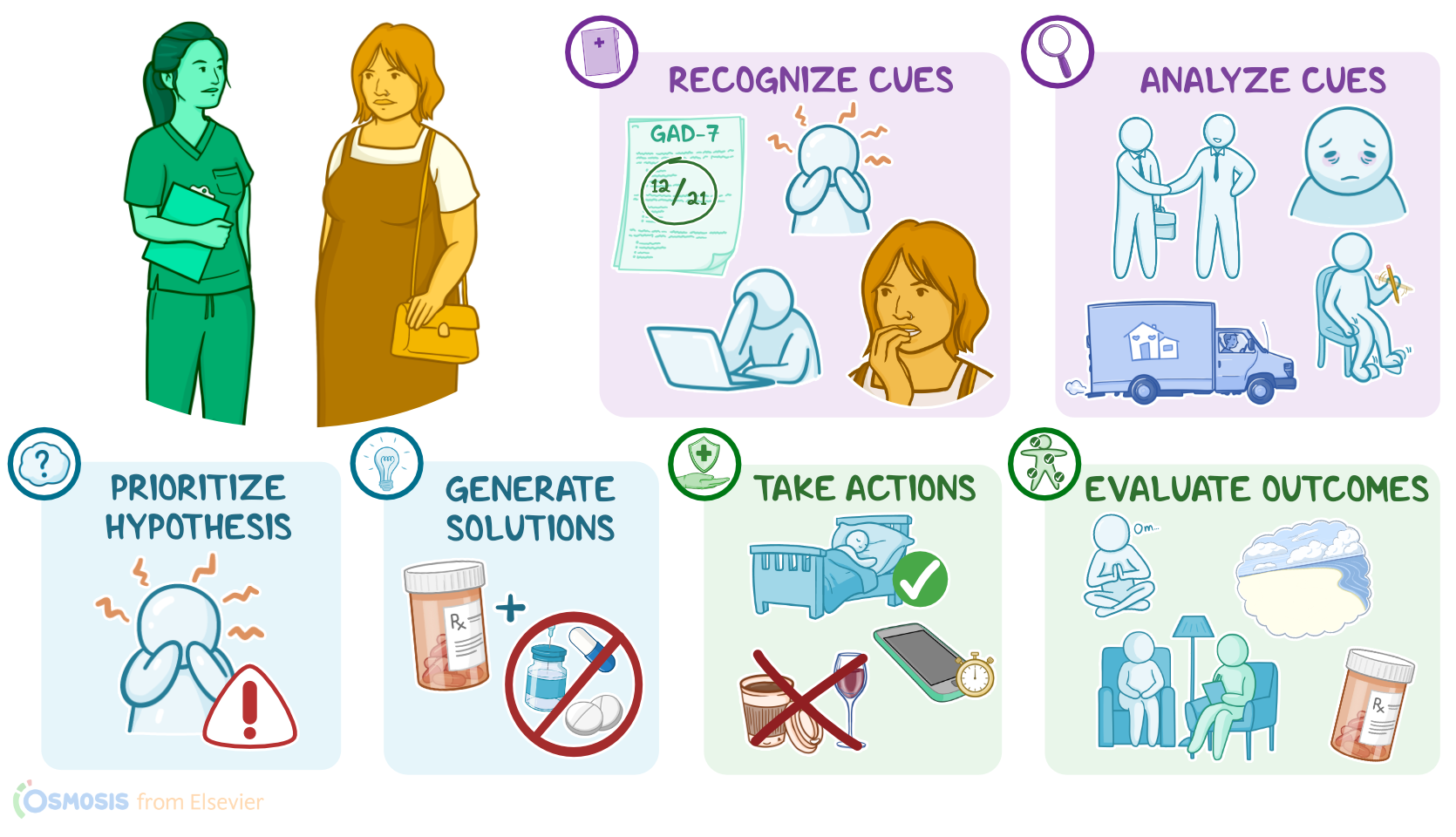
Nurse Becca works in a family practice clinic and is caring for Holly, a 32-year-old who presents with anxiety. After settling Holly in the room, Nurse Becca goes through the steps of the Clinical Judgment Measurement Model to make clinical decisions about Holly’s care by recognizing and analyzing cues, prioritizing hypotheses, generating solutions, taking action, and evaluating outcomes.
Recognizing and Analyzing Cues0:29–2:44
First, Nurse Becca recognizes important cues, including Holly’s vital signs which are temperature 98.6 F or 37 C, heart rate 88 beats per minute, respiratory rate 19 breaths per minute, and blood pressure 136/75 mmHg.
Nurse Becca: Hi Holly, tell me how you’re feeling. Holly: Well, I’m feeling really overwhelmed lately.
I’m worried about so many things. And I’m having trouble concentrating at work.
Nurse Becca: That sounds difficult. How are you sleeping?
Holly: I only sleep a few hours each night, I can’t stop thinking about things. Nurse Becca: When did your symptoms start?
Holly: Around seven months ago right after I moved and started my new job. Next, Nurse Becca administers the Generalized Anxiety Disorder 7-item screening tool, or GAD-7, and notes Holly has a score of 12 out of 21, which is consistent with moderate anxiety.
Nurse Becca then analyzes these cues. She reviews the electronic health record, or EHR, and notes that Holly has no previous history of mental health disorders.
She reports her assessment findings to the health care provider who diagnoses Holly with generalized anxiety disorder, or GAD.
Nurse Becca remembers that one of the main features of GAD is excessive worry; and although the exact cause of GAD isn’t known, but it’s thought to be caused by an imbalance of the neurotransmitters, where serotonin system activity is low and noradrenergic system activity is elevated.
This leads to symptoms of restlessness, difficulty concentrating, and impaired sleep. It can be brought on by stressful events or life changes, like moving and starting a new job.
Prioritizing Hypotheses, Generating Solutions, and Taking Action2:44–5:04
Then, Nurse Becca generates solutions to address Holly’s ineffective coping, including pharmacological and nonpharmacological interventions; and she establishes the expected outcome that after intervening, Holly will adopt two effective coping strategies by her follow up appointment.
Nurse Becca then takes action to implement these solutions. She reviews the EHR and notes that Holly has been prescribed escitalopram and outpatient cognitive behavioral therapy, or CBT, for her anxiety.
After the health care provider speaks with Holly about her diagnosis, Nurse Becca enters the room to review the plan of care.
Nurse Becca: Hi Holly, your health care provider prescribed you a medication called escitalopram to help regulate your mood and reduce your anxiety symptoms.
Holly: But what can I do until then to manage my anxiety? Nurse Becca: Let’s review some coping strategies that I think will help.
Holly: Okay. Nurse Becca then practices guided relaxation with Holly.
She asks Holly to take slow, deep breaths and gently close her eyes, imagining she's on a warm, sunny beach with the water at her feet.
She encourages Holly to stay at this beach for as long as she wants, imagining the sounds of the waves and the smells in the air.
After Holly opens her eyes, Nurse Becca explains that she can guide her own relaxation during times when she’s feeling stressed.
Next, Nurse Becca teaches Holly some strategies to promote sleep, like limiting screen time and avoiding caffeinated beverages and alcohol before bed, since these can interfere with falling and staying asleep.
Nurse Becca informs Holly that she’s scheduled for outpatient CBT the following week which will help her develop additional skills for stress management.
At Holly’s two-week follow-up appointment, Nurse Becca evaluates the outcomes of her actions. Holly reports that she’s been taking her escitalopram as prescribed and tells Nurse Bacca that she’s been practicing guided imagery and has started to do yoga to relieve her anxiety.
Evaluating Outcomes5:04–5:27
Holly also mentions that she’s attended two CBT sessions and is looking forward to going back next week. Alright, as a quick recap .
Review5:27–6:00
. .
Nurse Becca recognized and analyzed cues related to Holly’s ineffective coping, prioritized hypotheses, and generated solutions to address this problem.
Nurse Becca then implemented pharmacologic and nonpharmacologic measures to address Holly’s anxiety, and evaluated Holly’s outcomes, comparing them to the expected outcome.
Since Holly was able to adopt two effective coping strategies by her follow-up appointment, Nurse Becca determined that the plan
| CASE STUDY - GENERALIZED ANXIETY DISORDER (GAD) | ||
| KEY POINTS | NOTES | |
| INTRODUCTION |
| |
| RECOGNIZING AND ANALYZING CUES |
| |
| PRIORITIZING HYPOTHESES, GENERATING SOLUTIONS, AND TAKING ACTIONS |
| |
| EVALUATING OUTCOMES |
| |
- "Varcarolis’s Canadian psychiatric mental health nursing. (3rd ed.)" Elsevier (2023)
- "Keltner’s psychiatric nursing. (9th ed.)" Elsevier (2023)
No notes for this video yet
Try adding a note below