Case study - Head injury: Nursing
Introduction0:00–0:39
Nurse Laquanna works on an oncology unit but was floated to the neurology unit earlier today. She's caring for Molly, a 74-year-old female with a history of atrial fibrillation, or a-fib, who was recently admitted for a head injury.
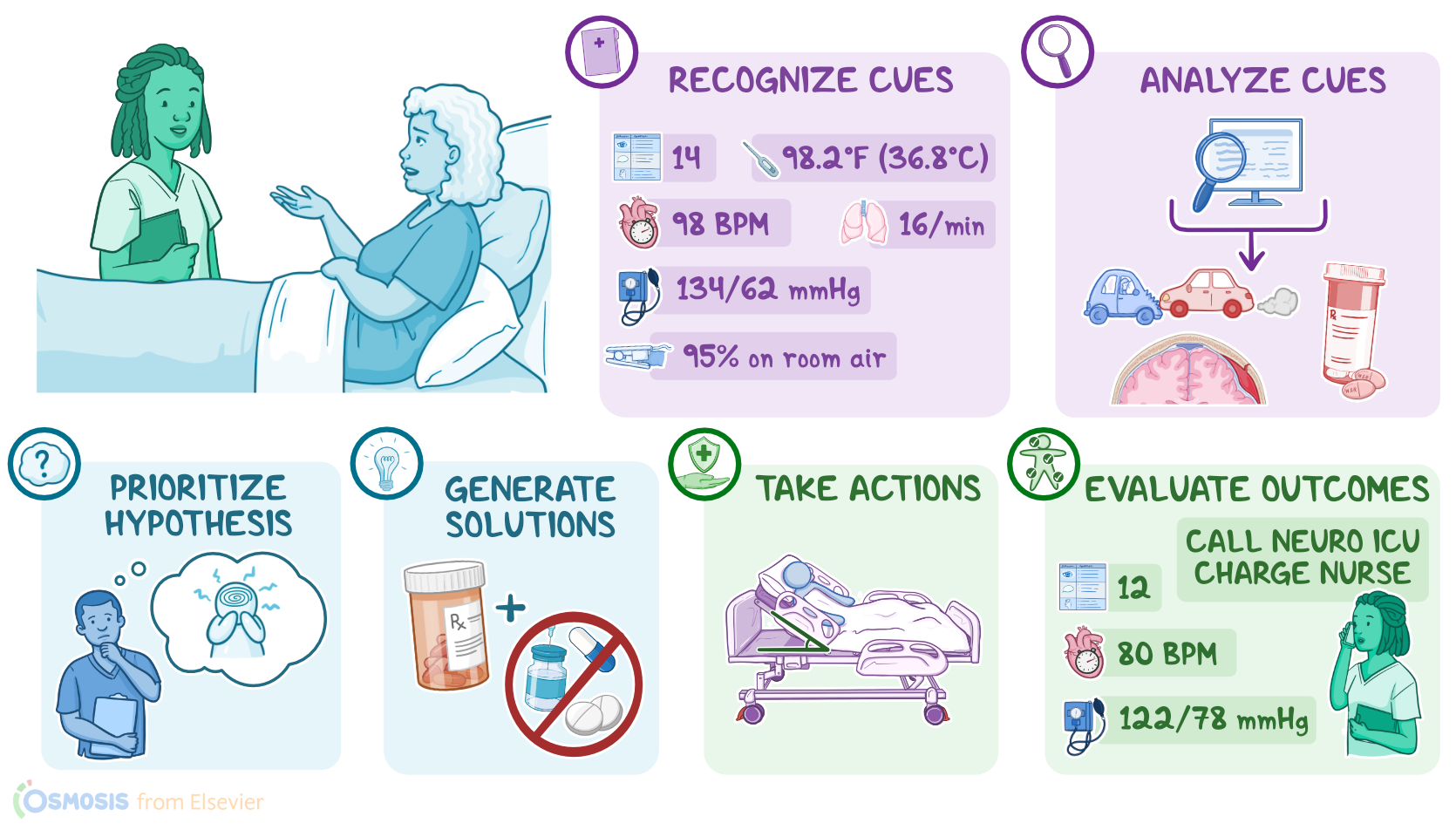
After settling Molly in her room, Nurse Laquanna goes through the steps of the Clinical Judgment Measurement Model to make clinical decisions about Molly’s care by recognizing and analyzing cues, prioritizing hypotheses, generating solutions, taking action, and evaluating outcomes.
First, Nurse Laquanna recognizes important cues including a Glasgow Coma Scale, or GCS, score of 14, and vital signs which are temperature 98.2 F, or 36.8 C, heart rate 98 beats per minute, respirations 16 breaths per minute and regular, blood pressure 134/62 mmHg, and oxygen saturation 95 percent on room air.
Recognizing and Analyzing Cues0:39–1:14
Prioritizing Hypotheses, Generating Solutions, and Taking Action1:14–4:09
She reviews the electronic health record, or EHR, and sees Molly was involved in a head-on motor vehicle collision with airbag deployment, and she takes an anticoagulant daily to treat her a-fib.
Nurse Laquanna recognizes that a head injury coupled with Molly’s history of anticoagulation places her at risk for intracranial bleeding.
She also knows that subtle neurologic changes can be early indicators of complications. Nurse Laquanna knows Molly will require frequent neurological assessments, or neuro checks, to monitor for changes in her mental status.
During Molly’s neuro check an hour later Nurse Laquanna notes Molly opens her eyes when her name is called; she’s disoriented; and does not respond when asked to move her fingers.
I don’t have much experience in neurology, so I’m wondering what I should do next. Nurse Elijah: I’m glad you asked.
Let’s call the health care provider to report the changes in your patient. Now, using the information she’s gathered, Nurse Laquanna chooses a priority hypothesis of altered mental status.
Then, she generates solutions to address Molly’s altered mental status that'll include pharmacologic and nonpharmacologic interventions, and she establishes the outcome that after intervening, Molly will maintain adequate cerebral oxygenation and perfusion.
Nurse Laquanna then takes action to implement these solutions. The health care provider informs Nurse Laquanna that Molly may have an acute subdural hematoma.
Then, the health care provider orders Molly’s anticoagulant to be discontinued to prevent further bleeding; emergent transfer to the neurologic intensive care unit, or ICU; a repeat head CT scan; and a surgical consultation.
Is there anything else we can do while we wait? Nurse Elijah: We can raise the height of the bed to 30 degrees to increase venous drainage, which can help eliminate some intracranial pressure.
We should also call Molly’s family to update them on her immediate transfer. I’ll help you.
Then, Nurse Laquanna evaluates the outcome of her interventions. Molly’s vital signs are as follows: temperature 98.4 F, or 36.8 C, heart rate 80 beats per minute, respirations 16 breaths per minute, blood pressure 122/78 mmHg, and oxygen saturation 96 percent on room air.
Evaluating Outcomes4:09–4:51
Alright, as a quick recap…Nurse Laquanna recognized and analyzed cues related to Molly’s head injury and prioritized hypotheses and generated solutions to address this problem.
Review4:51–5:24
She then took action to implement pharmacologic and nonpharmacologic measures to address Molly’s altered mental status and evaluated outcomes by comparing them to the expected outcomes.
Since Molly’s GCS did not decline and she is set to be transferred to the neuro ICU, Nurse Laquanna has determined her plan of care was successful.
set to be transferred to the neuro ICU nurse Lacuna has determined her plan of care
| CASE STUDY - HEAD INJURY | ||
| KEY POINTS | NOTES | |
| INTRODUCTION |
| |
| RECOGNIZING AND ANALYZING CUES |
| |
| PRIORITIZING HYPOTHESES, GENERATING SOLUTIONS, AND TAKING ACTIONS |
| |
| EVALUATING OUTCOMES |
| |
- "Lewis's medical-surgical nursing: Assessment and management of clinical problems. (12th ed.)" Elsevier (2022)
- "Medical-surgical nursing: Concepts for interprofessional and collaborative care. (10th ed.)" Elsevier (2021)
- "Lewis’s medical-surgical nursing in Canada: Assessment and management of clinical problems. (5th ed.)" Elsevier (2023)
No notes for this video yet
Try adding a note below