Case study - Iron-deficiency anemia: Nursing
Introduction0:00–0:31
Nurse Michael works on an inpatient Medical-Surgical unit and is caring for Hannah, a 26-year-old female with a history of Crohn disease who was admitted for iron deficiency anemia.
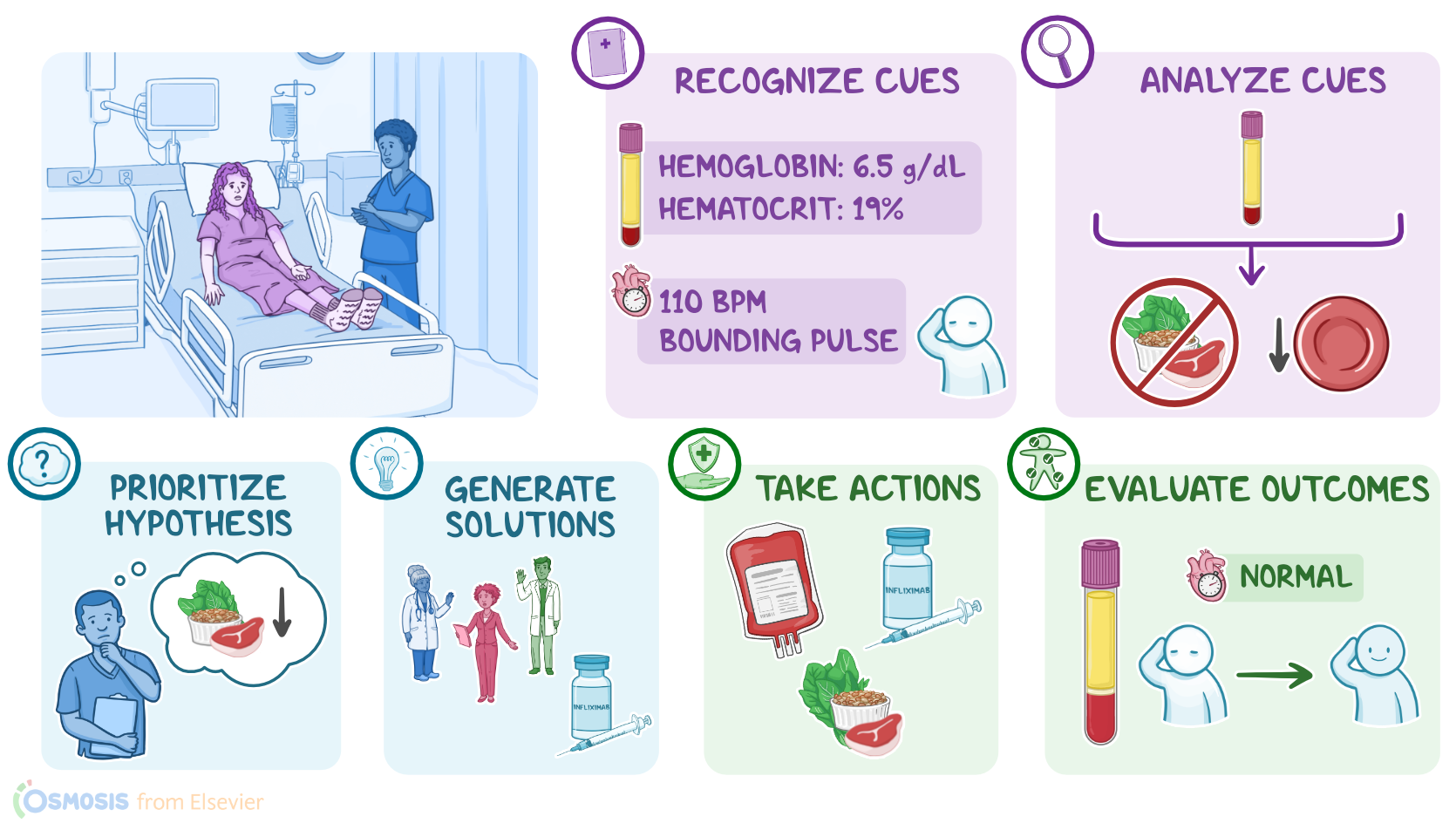
After settling Hannah in her room, Nurse Michael goes through the steps of the Clinical Judgment Measurement Model to make clinical decisions about Hannah’s care by recognizing and analyzing cues, prioritizing hypotheses, generating solutions, taking action, and evaluating outcomes.
First, Nurse Michael recognizes important cues, like Hannah's laboratory results from the emergency department showing a hemoglobin of 6.5 g/dL and a hematocrit of 19 percent.
Recognizing and Analyzing Cues0:31–2:23
Further assessments reveal pallor and a heart rate of 110 per minute with a bounding pulse. Next, Nurse Michael asks Hannah about her prescribed medications.
Nurse Michael: I see in your chart you’ve been taking infliximab for eight months. Has that helped your Crohn symptoms?
Hannah: Well, I took it for a while, but I’ve had to skip my last two infusion appointments. I don't have the money to keep going to the infusion clinic.
Nurse Michael: I understand. How has that affected your symptoms?
Hannah: The medicine really helped while I was getting it, especially since I didn’t feel as tired as I do now. I could also eat more foods that I like without pain.
Nurse Michael: That makes sense. So, what types of food are you eating now?
Hannah: Crackers and bananas, mostly. Sometimes an egg.
That’s about it, because I feel like my symptoms are really flaring up. My belly really hurts after I eat.
Nurse Michael: I'm sorry to hear that. I'm glad you are here so we can help you.
Nurse Michael finishes his assessment and ensures Hannah is comfortable. He then places the call bell within her reach before leaving the room.
Next, he analyzes these cues. Nurse Michael recognizes that stopping infliximab infusions puts Hannah at risk of experiencing a Crohn disease flare-up, and that this is likely the cause of her pain after eating, as well as poor nutrient absorption and anemia.
Nurse Michael understands that Hannah’s decreased hemoglobin and hematocrit reflect her inability to consume nutrient dense foods with iron, resulting in iron deficiency anemia.
He also recognizes that for Hannah to be successfully treated, she'll need consistent access to her prescribed infliximab.
Now, using the information he's gathered, Nurse Michael chooses a priority hypothesis of compromised nutrition. Then, he generates solutions to address Hannah's nutritional status that will include working with a multidisciplinary team including the health care provider, social worker, and dietitian.
Prioritizing Hypotheses, Generating Solutions, and Taking Action2:23–4:01
He also establishes two expected outcomes that after intervening, Hannah’s symptoms of iron deficiency anemia will improve, and Hannah will receive her infliximab infusion.
Next, Nurse Michael takes action to implement these solutions. First, he calls the health care provider to report his assessment findings and that Hannah hasn’t been taking her infliximab because of financial concerns.
The health care provider orders a blood type and crossmatch and tells Nurse Michael to prepare her for a blood transfusion.
Additionally, the health care provider orders a consultation with the social worker and dietitian to address Hannah’s access to medication and iron-rich foods.
As Nurse Michael collects the lab work, he explains to Hannah that the blood transfusion will help improve her symptoms of anemia and her low hemoglobin and hematocrit values.
Then, he tells her to expect a visit from the social worker, who will help her to access her infliximab infusions, and the dietitian who will help her incorporate nutrient dense foods that she likes into her diet.
When the blood transfusion arrives from the blood bank, Nurse Michael follows his facility’s transfusion protocol to administer and monitor the infusion.
Three days later, Nurse Michael evaluates the outcome of his actions. He reviews the electronic health record and notes that Hannah’s hemoglobin and hematocrit levels rose to 7.2 g/dL and 22 percent the day after her blood transfusion and to 9.3 g/dL and 28 percent this morning after receiving additional transfusions.
Evaluating Outcomes4:01–5:05
Additionally, Hannah’s heart rate has remained normal, and her skin color is no longer pale. Nurse Michael reads the progress notes from the social worker, verifying a plan is in place for Hannah to resume her infliximab infusions after discharge.
Michael also reads progress notes from the dietitian, verifying she's received consultation about healthy food choices. Lastly, Nurse Michael reviews the plan of care with Hannah to reiterate the importance of taking her medication and maintaining nutrition; and he instructs her to call her health care provider if she has future problems with getting her medication or experiences symptoms of anemia.
Alright, as a quick recap. Nurse Michael recognized and analyzed cues related to Hannah’s compromised nutrition.
Review5:05–5:38
He then prioritized a hypothesis, and generated solutions to address this problem. Nurse Michael took action, and implemented pharmacologic, and nonpharmacologic interventions to address her compromised nutrition, evaluated Hannah's outcomes, and compared them to the expected outcome.
Since Hannah’s symptoms of iron deficiency anemia have improved, plans were made for her to receive regular infusions of her medication, Nurse Michael determined that the plan of
| CASE STUDY - IRON-DEFICIENCY ANEMIA | ||
| KEY POINTS | NOTES | |
| INTRODUCTION |
| |
| RECOGNIZING AND ANALYZING CUES |
| |
| PRIORITIZING HYPOTHESES, GENERATING SOLUTIONS, AND TAKING ACTIONS |
| |
| EVALUATING OUTCOMES |
| |
- "Lewis's medical-surgical nursing: Assessment and management of clinical problems. (12th ed.). ISBN: 978-0323792325" Elsevier. (2022)
- "Medical-surgical nursing: Concepts for interprofessional and collaborative care. (10th ed.). ISBN: 978-0323654050" Elsevier. (2021)
- "Lewis’s medical-surgical nursing in Canada: Assessment and management of clinical problems. (5th ed.). ISBN 978-0323791588" Elsevier. (2023)
No notes for this video yet
Try adding a note below