Case study - Pediatric anaphylaxis: Nursing
Introduction0:00–0:29
Nurse Anya works in the emergency department and is caring for Pablo, a 10-year-old who’s having difficulty breathing following a bee sting.
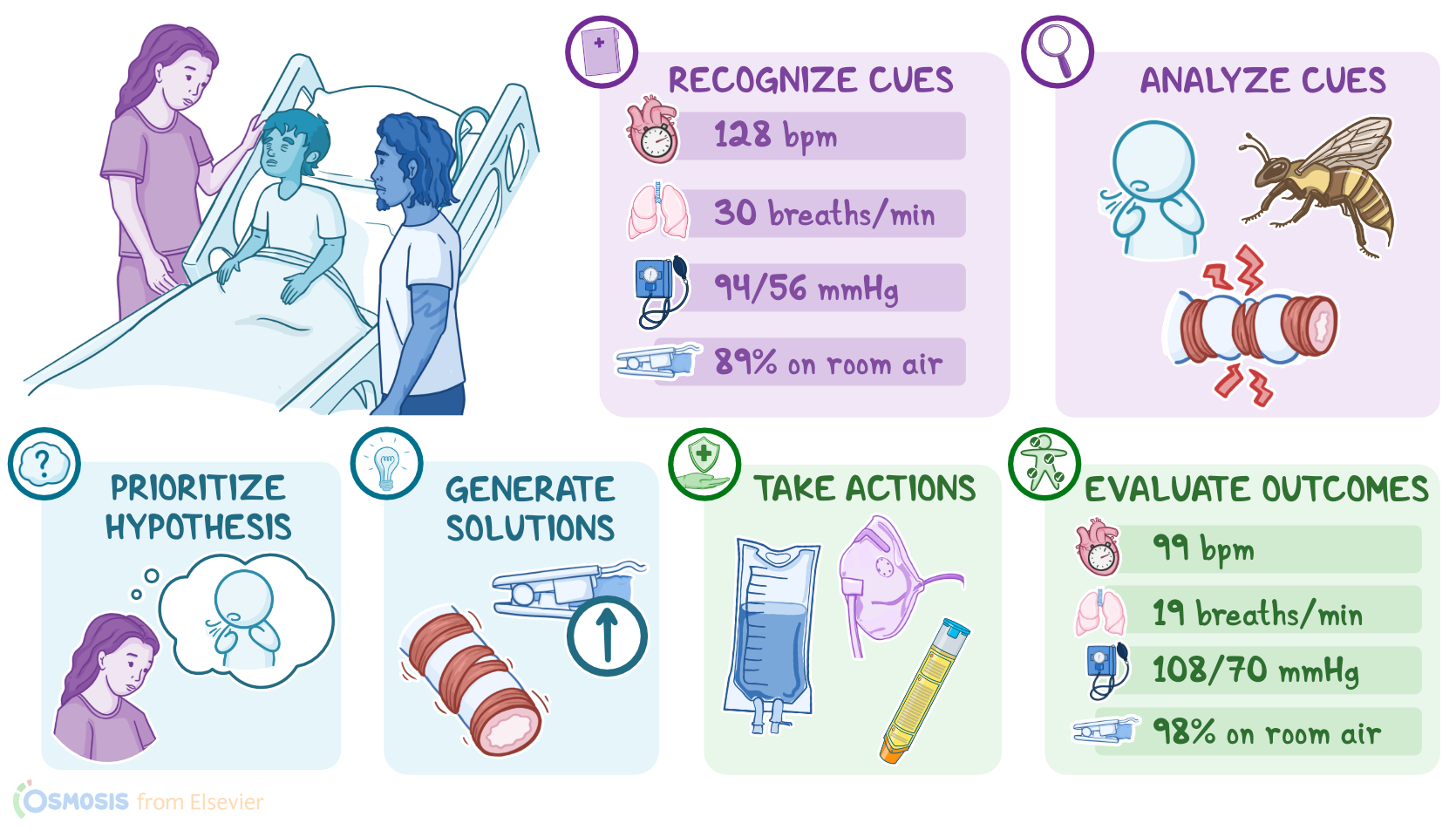
After settling Pablo in his room, Nurse Anya goes through the steps of the Clinical Judgment Measurement Model to make clinical decisions about Pablo’s care, by recognizing and analyzing cues, prioritizing hypotheses, generating solutions, taking action, and evaluating outcomes.
First, Nurse Anya recognizes important cues, including Pablo’s vital signs which are temperature 98.2 F or 36.8 C, heart rate 128 beats per minute, respiratory rate 30 breaths per minute and labored, blood pressure 94/56 mmHg, and oxygen saturation 89 percent on room air.
Recognizing and Analyzing Cues0:29–2:13
She notes angioedema to Pablo’s eyelids, lips, and tongue. She also notices that Pablo appears anxious.
While auscultating Pablo’s lungs, Nurse Anya hears wheezing in the upper lobes. She asks Pablo’s father, Ramón, who’s at the bedside, about the onset of Pablo’s symptoms.
Nurse Anya: Did you give Pablo any medicine before coming to the hospital? Ramon: No, we came straight here.
Nurse Anya then analyzes these cues. She understands that Pablo’s first exposure to a bee sting caused his body to produce antibodies against bee venom, sensitizing him.
Then, on his second exposure, the antibodies triggered the release of chemical mediators, causing smooth muscle contraction and bronchoconstriction, leading to Pablo’s wheezing and difficulty breathing.
The reaction also caused systemic vasodilation, leading to decreased blood pressure and tachycardia, as well as increased vascular permeability, resulting in angioedema.
Nurse Anya recognizes that Pablo needs immediate airway management. Now, using the information she's gathered, along with Pablo’s medical history, Nurse Anya develops a priority hypothesis of ineffective breathing pattern.
Prioritizing Hypotheses, Generating Solutions, and Taking Action2:13–3:36
Then, Nurse Anya generates solutions to address Pablo’s breathing, and she establishes the expected outcome that after intervening, Pablo will maintain a patent airway, with an oxygen saturation greater than 94%.
Nurse Anya then takes action to implement these solutions. She consults with the health care provider, who determines that Pablo is experiencing anaphylaxis due to the bee sting, and prescribes intramuscular epinephrine, supplemental oxygen, and intravenous fluids.
While explaining the plan of care to Pablo and Ramón, Nurse Anya injects the epinephrine into Pablo’s left lateral thigh using the principles of safe medication administration, while another nurse applies a non-rebreather mask over Pablo’s nose and mouth.
She encourages Ramón to stay by the bedside to help reduce Pablo’s anxiety and reassures them that she’ll continue to monitor Pablo’s vital signs and breathing.
After fifteen minutes, Nurse Anya evaluates the outcome of her actions. Pablo’s vital signs are temperature 98.6 F or 37 C, heart rate 99 beats per minute, respiratory rate 19 breaths per minute, and blood pressure 108/70 mmHg.
Evaluating Outcomes3:36–4:10
Pablo’s breathing is now non-labored, and upon auscultation no wheezing is present. Nurse Anya then removes the non-rebreather mask and reassesses his oxygen saturation on room air; which is 98 percent.
Review4:10–4:40
Alright, as a quick recap . .
. Nurse Anya recognized and analyzed cues related to Pablo’s ineffective breathing pattern, prioritized hypotheses, and generated solutions to address this problem.
Nurse Anya then took actions to address Pablo’s anaphylactic reaction, and evaluated Pablo’s outcomes, comparing them to the expected outcome.
Since Pablo’s oxygen saturation improved after interventions, Nurse Anya determined that the plan of care was successful.
| CASE STUDY - PEDIATRIC ANAPHYLAXIS | ||
| KEY POINTS | NOTES | |
| INTRODUCTION |
| |
| RECOGNIZING AND ANALYZING CUES |
| |
| PRIORITIZING HYPOTHESES, GENERATING SOLUTIONS, AND TAKING ACTIONS |
| |
| EVALUATING OUTCOMES |
| |
- "Wong’s essentials of pediatrics. (11th ed.)." Elsevier (2022)
- "Wong’s nursing care for infants and children. (11th ed.)." Elsevier (2019)
No notes for this video yet
Try adding a note below