Case study - Pressure injury prevention: Nursing
Introduction0:00–0:37
Nurse. Nathan works at a rehabilitation hospital and is caring for Larry a 72 year old with a left below the knee, amputation related to complications from diabetes mellitus.
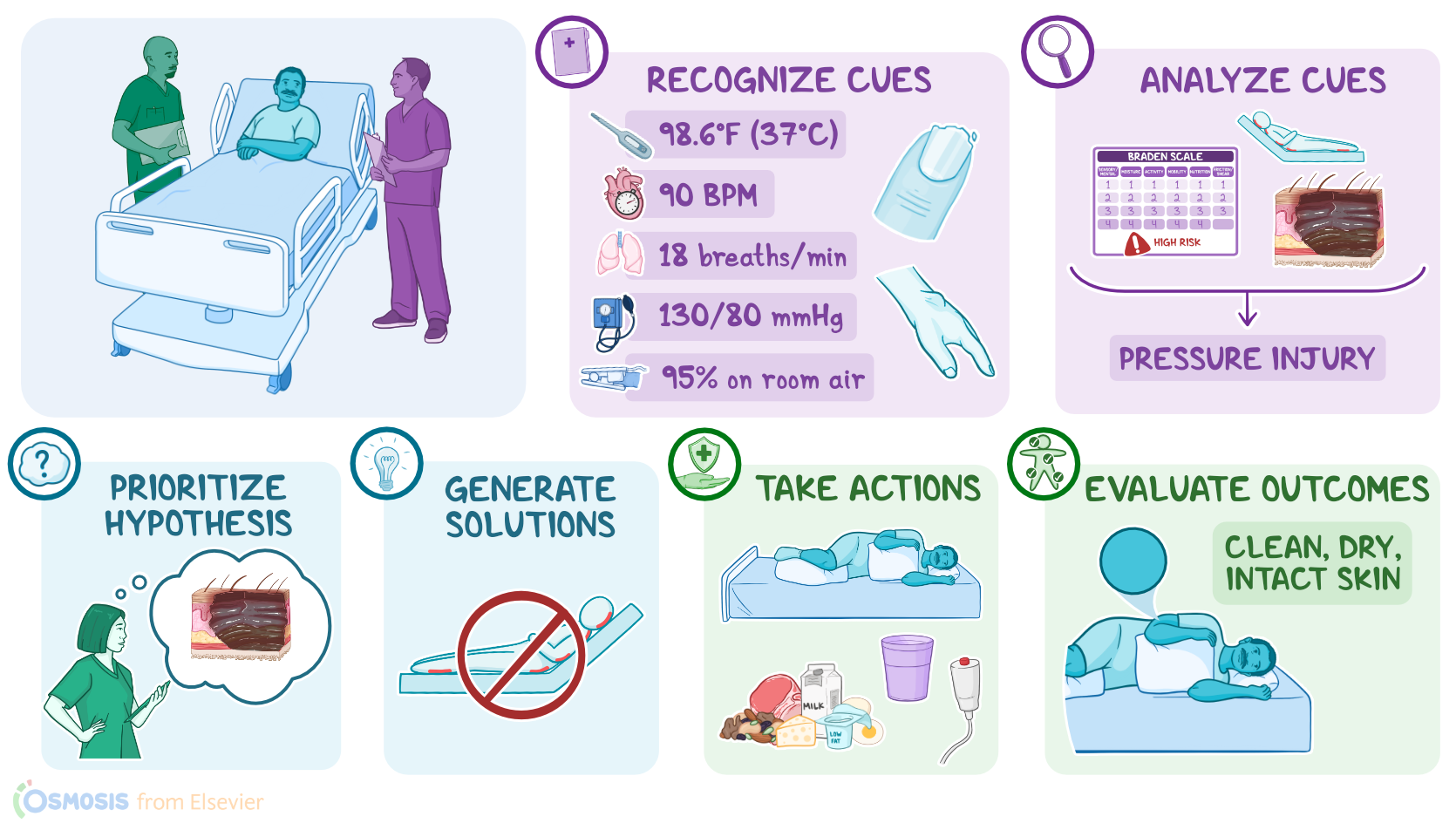
In collaboration with the registered nurse, RN USH nurse, Nathan goes through the steps of the clinical judgment measurement model to make clinical decisions about Larry's care by recognizing and analyzing cues, prioritizing hypotheses, generating solutions, taking action and evaluating outcomes.
First, nurse, Nathan recognizes important cues including Larry's vital signs which are a temperature of 98.6 °F or 37 °C, heart rate, 90 BPM respirations, 18 breaths per minute BP, 1 30/80 millimeters of mercury and oxygen saturation, 95% on room air nurse.
Recognizing and Analyzing Cues0:37–2:36
Nathan notes that Larry has been incontinent of urine and is struggling to effectively reposition himself in bed. Nurse.
Nathan also notices that Larry has clinical signs of malnourishment such as dry, thin skin and brittle nails and hair. Next, nurse, Nathan analyzes these cues.
He reviews the electronic health record or E hr and notes that Larry developed a pressure injury on his sacrum during a past hospitalization that has since healed He also sees that RN USM calculated Larry's pressure injury risk using the Braden scale which indicated that Larry is at high risk for developing another pressure injury.
Nurse, Nathan understands that pressure injuries involve damage to the skin or underlying tissue because of prolonged pressure which causes reduced blood flow.
This results in tissue hypoxia and ischemia which ultimately leads to necrosis and ulceration. Nurse.
Nathan knows that most often pressure injuries develop in patients who have difficulty moving around or are totally immobile.
He also knows other factors increase the risk for pressure injury, like thinning of skin and subcutaneous tissue due to age and impaired nutrition and hydration, exposure to skin irritants like urine as well as diabetes mellitus which can impair blood flow.
Nurse. Nathan realizes Larry needs effective pressure injury prevention.
Now using the information he has gathered along with Larry's medical history. Nurse.
Prioritizing Hypotheses, Generating Solutions, and Taking Action2:36–4:50
Nathan discusses his findings with RN USH and they choose a priority hypothesis for risk of impaired skin integrity. Then they generate solutions to address Larry's risk for impaired skin integrity and they establish the expected outcome that after intervening, Larry will not develop a pressure injury during the shift.
Nurse, Nathan then takes action to implement these solutions. He starts by working with the unlicensed assistive personnel to keep Larry clean and dry and apply barrier cream to his groin and buttocks.
They also change the sheets and ensure there are no wrinkles in the bedding that could cause friction and irritate Larry's skin.
They use pillows to reposition Larry on his left side and elevate his heel and elbows off the bed. Then nurse Nathan sets an alarm as a reminder to reposition Larry again in two hours.
RN USH Meat also speaks with the health care provider who orders protein shakes to enrich Larry's diet and a pressure relieving mattress for Larry RN USM also teaches Larry about the importance of consuming protein rich foods to promote skin integrity.
After RN USH leaves the room, nurse, Nathan re enter the room to give Larry the protein shake and reinforce teaching. Hi, Larry.
I have your protein shake here. I'd also like to review the information.
Ari Nhmi went over with you. Could you tell me about some foods that are high in protein?
Well, he showed me some things on the menu that can help prevent me from getting another pressure sore like meats, nuts and eggs.
He also told me it's important to drink plenty of water. That's good.
What do you plan to order today for lunch? I'm going to order the baked chicken with asparagus and I'd like to drink my protein shake before lunch if that's ok.
Of course, nurse, Nathan gives Larry the protein shake in a cup with ice. He then provides him with his call light and exits the room at the end of his shift.
Evaluating Outcomes4:50–5:25
Nurse, Nathan evaluates the outcomes of his actions. He takes Larry's vital signs which are temperature, 98.6 °F or 37 °C heart rate, 89 BPM respirations, 19 breaths per minute BP, 1 28/74 millimeters of mercury and oxygen saturation of 97% on room.
Air nurse, Nathan and RN USH inspect Larry's skin which is clean, dry and intact with no evidence of new pressure injuries.
All right. As a quick recap nurse, Nathan recognized and analyzed cues related to Larry's risk for impaired skin integrity.
Review5:25–5:55
And in collaboration with RN USH prioritized hypotheses and generated solutions to address this problem. Nurse, Nathan and RN USH then implemented interventions and evaluated Larry's outcomes and compared them to the expected outcome.
Since Larry didn't develop a pressure injury. By the end of the shift, they determined the plan of care was successful.
| CASE STUDY - PRESSURE INJURY PREVENTION | ||
| KEY POINTS | MY NOTES | |
| INTRODUCTION |
| |
| RECOGNIZING AND ANALYZING CUES |
| |
| PRIORITIZING HYPOTHESE, GENERATING SOLUTIONS, AND TAKING ACTION |
| |
| EVALUATING OUTCOMES |
| |
- "Foundations of nursing. (9th ed.). " Elsevier. ISBN: 9780323827119 (2023)
- "Fundamental concepts and skills for nursing. (6th ed.). " Elsevier. ISBN: 9780323694780 (2022)
No notes for this video yet
Try adding a note below