Complete blood count (CBC) - White blood cells (WBC) and differential: Nursing
1,118views
Complete blood count (CBC) - White blood cells (WBC) and differential: Nursing
Exam 1 Fall 2024 Pathophysiology Pre Nursing
Exam 1 Fall 2024 Pathophysiology Pre Nursing
Notes
| WHITE BLOOD CELLS (WBCs) AND DIFFERENTIAL | ||
| KEY POINTS | NOTES | |
| PHYSIOLOGY |
| |
| PATHOLOGY |
| |
| NURSING IMPLICATIONS |
| |
Transcript
A 16-year-old client is brought to the clinic by their mother, with a report of fever, malaise, nausea, and diarrhea. On assessment, you note a temporal artery temperature of 101.5 F or 38.6 C. Based on these findings, a complete blood count, or CBC, is ordered to check their white blood cell count and differential.
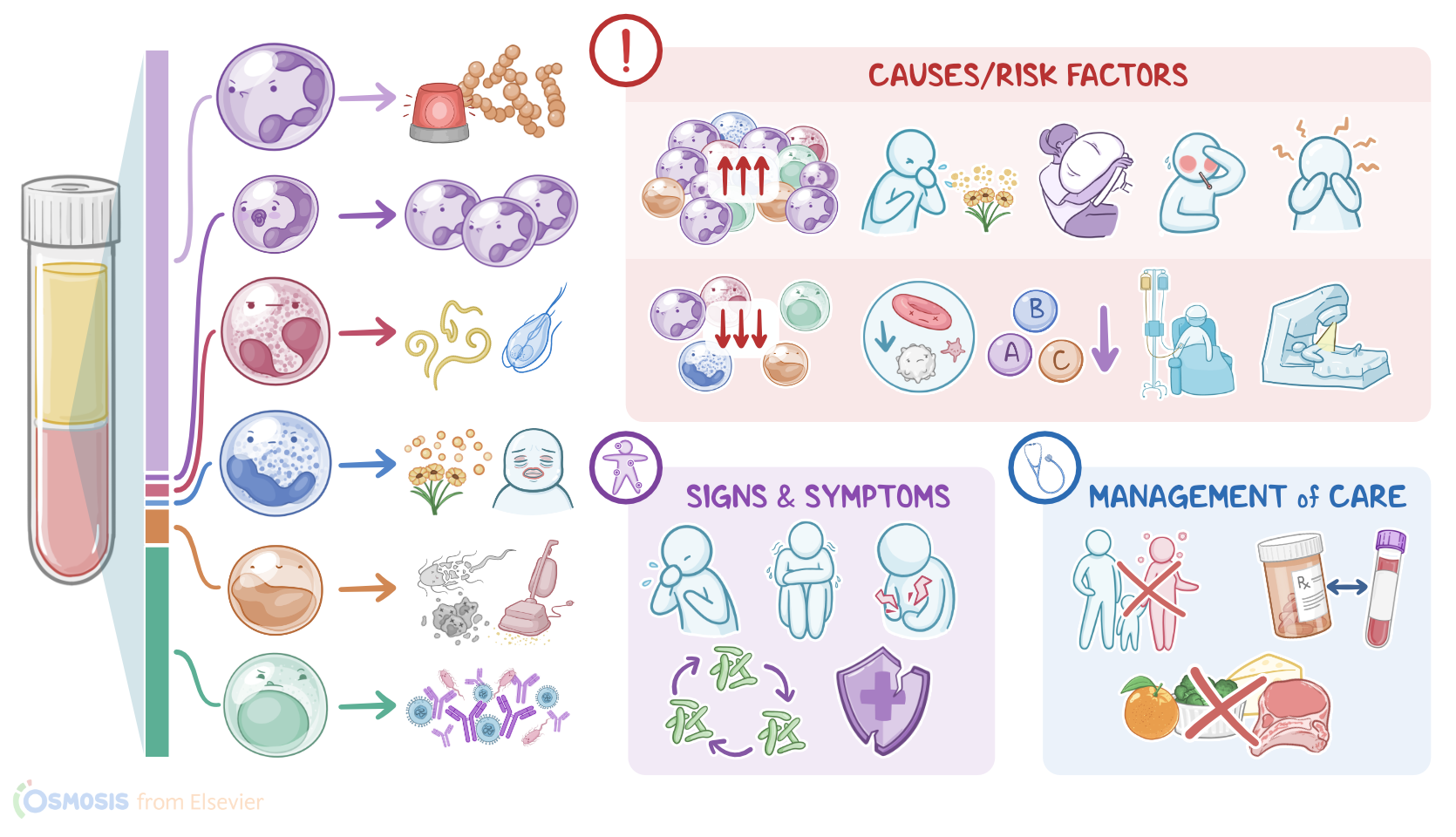
White blood cells, also called leukocytes or WBCs for short, are created by the bone marrow from precursor cells. White blood cells help to ward off pathogens like bacteria and viruses, destroy cancerous cells, and neutralize toxins.
There are five types of WBCs that circulate in the body. First, there are neutrophils, which are the most plentiful WBC. They are also called polymorphonuclear leukocytes or PMNs because of their distinct nuclei, which have 2 to 5 lobes. Immature neutrophils are called bands or stabs. Neutrophils are the first type of WBC to respond to an infection.
Next, there are eosinophils, which are involved in allergic reactions, and are responsible for fighting off parasitic infections.
Then there are basophils, which have granules that contain histamine, so they specialize in inflammation and allergic reactions.
Next, there are monocytes that serve as the clean-up crew by removing foreign particles and dead cells. Finally, there are lymphocytes, which respond to viral and bacterial infections. These include B cells that make antibodies and T cells which kill pathogens and help other immune cells.
Now, the WBC count, also known as leukocyte count, or just white count, measures the number of WBCs in the blood, as is a part of a CBC. A normal WBC count ranges from 4,500 to 11,000/µL. Additionally, a WBC differential can be used to measure the proportion of each type of WBC. Usually, neutrophils make up about 50% to 70%, with 0% to 5% bands. Eosinophils make up about 1% to 3%, while basophils range from 0% to 2%, monocytes make up 2% to 11%. Finally, lymphocytes normally make 18% to 42% of total WBCs.
Alright, there are some conditions that can alter the WBC count. An increase in the total WBC count, also called leukocytosis, is commonly caused by infections, inflammation, trauma, and physical or emotional stress. So, if there is an acute bacterial infection, for example, the bone marrow will increase the production of neutrophils. At first, only mature neutrophils are released into the bloodstream; however, if the demand for neutrophils exceeds the bone marrow’s capacity to release them into circulation, then immature bands will also be released. This is referred to as a left shift. Another cause of a high WBC count are malignancies like leukemia and lymphoma, while an increase in eosinophils is often seen in allergies, asthma, and parasitic infections.