Complete metabolic panel (CMP) - Calcium: Nursing
The nurse is caring for a 65-year-old client after a total thyroidectomy on the medical-surgical unit. While taking his blood pressure, the nurse notices involuntary contraction of the muscles in the hand and wrist. Based on these findings, a basic metabolic panel, or BMP is ordered to check the client’s electrolytes, including their calcium level.
Calcium is a positively charged ion noted as Ca2+. About 99% of that calcium is in our bones in the form of calcium phosphate. The last 1% is split so that the majority, about 0.99% is extracellular, which means in the plasma and in the interstitial space between cells; and 0.01% is intracellular or inside cells. Most of the calcium in the plasma circulates in two forms; in a free, ionized form, or in a form bound to proteins, like albumin.
The total of these two forms of calcium can be measured on its own or as part of a complete metabolic panel, or CMP, which is also called a basic metabolic panel, or BMP; and in adults, it normally ranges from 9 to 10.5 mg/dL. Calcium is essential for strong bones and teeth, muscle contraction, cell membrane stability, and blood coagulation. It also helps with regulating a normal heart rhythm, releasing neurotransmitters from neurons, as well as releasing hormones from the endocrine glands.
Calcium comes from a variety of sources including dairy products like milk, cheese, and yogurt; as well as leafy green vegetables, and canned fish like salmon and sardines. Once ingested, calcium is absorbed into the bloodstream. Most of it goes to the bone, and the rest of calcium circulates in the bloodstream, while some of it is excreted by the kidneys and in the stool.
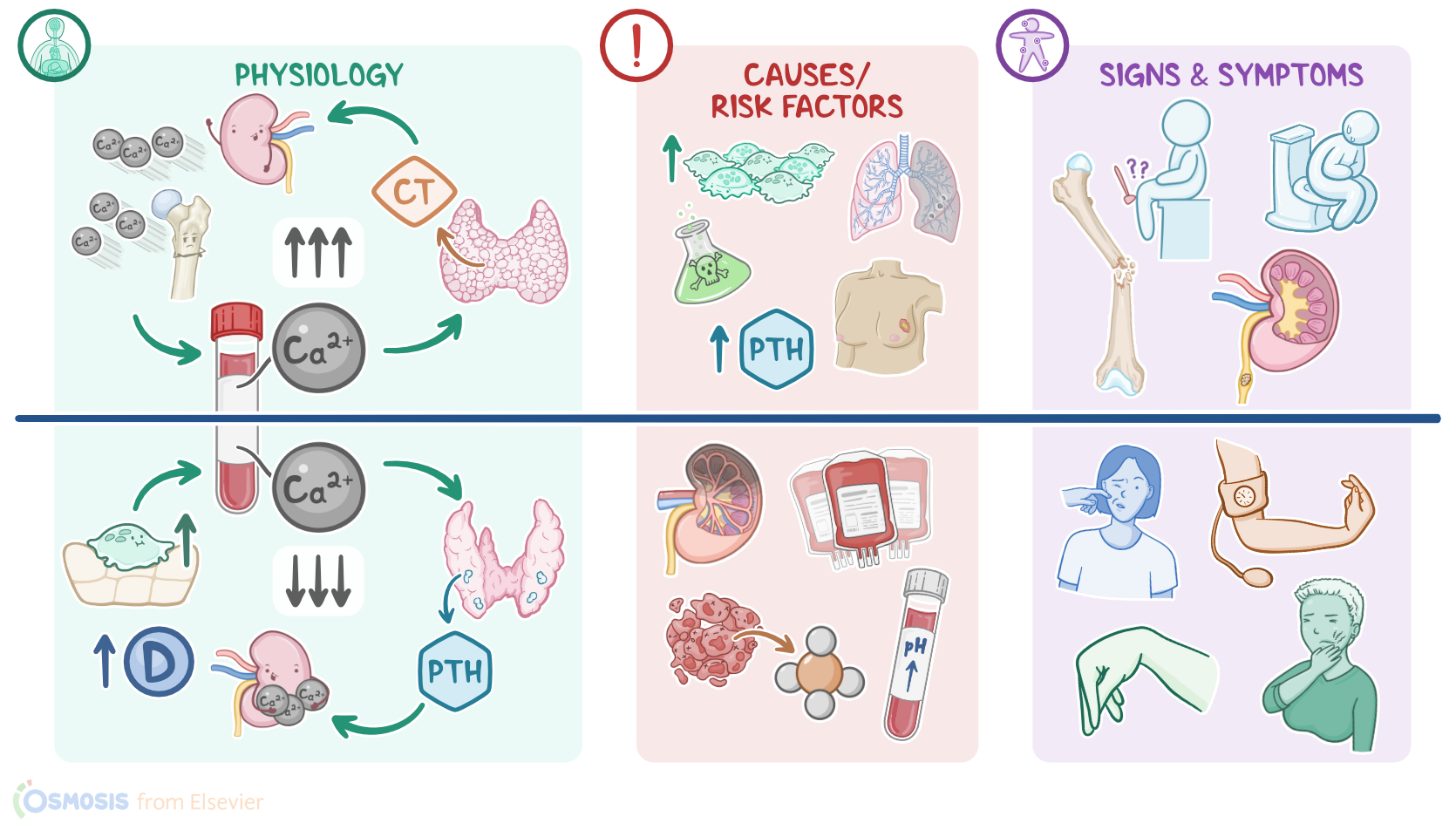
Now, calcium homeostasis is regulated by three molecules, parathyroid hormone, or PTH, a hormone made by the parathyroid glands located in the neck on top of the thyroid gland; calcitonin, which is produced by the parafollicular cells of the thyroid gland; and vitamin D, a fat-soluble vitamin synthesized in the skin through sunlight exposure and then activated in the liver and kidneys.
Okay, now when plasma calcium level decreases, that stimulates PTH secretion. In the bone, PTH activates osteoclasts, which are little bone eating cells, and as a result, calcium is released into the bloodstream. PTH also stimulates vitamin D synthesis in the kidneys, which promotes calcium absorption in the gut, thereby increasing the plasma calcium level. Finally, PTH increases calcium reabsorption by the kidneys.
| CALCIUM | ||
| KEY POINTS | NOTES | |
| PHYSIOLOGY |
| |
| PATHOLOGY |
| |
| INDICATIONS |
| |
| NURSING IMPLICATIONS |
| |
No notes for this video yet
Try adding a note below