Components of the birth process: Nursing
Introduction0:00–0:30
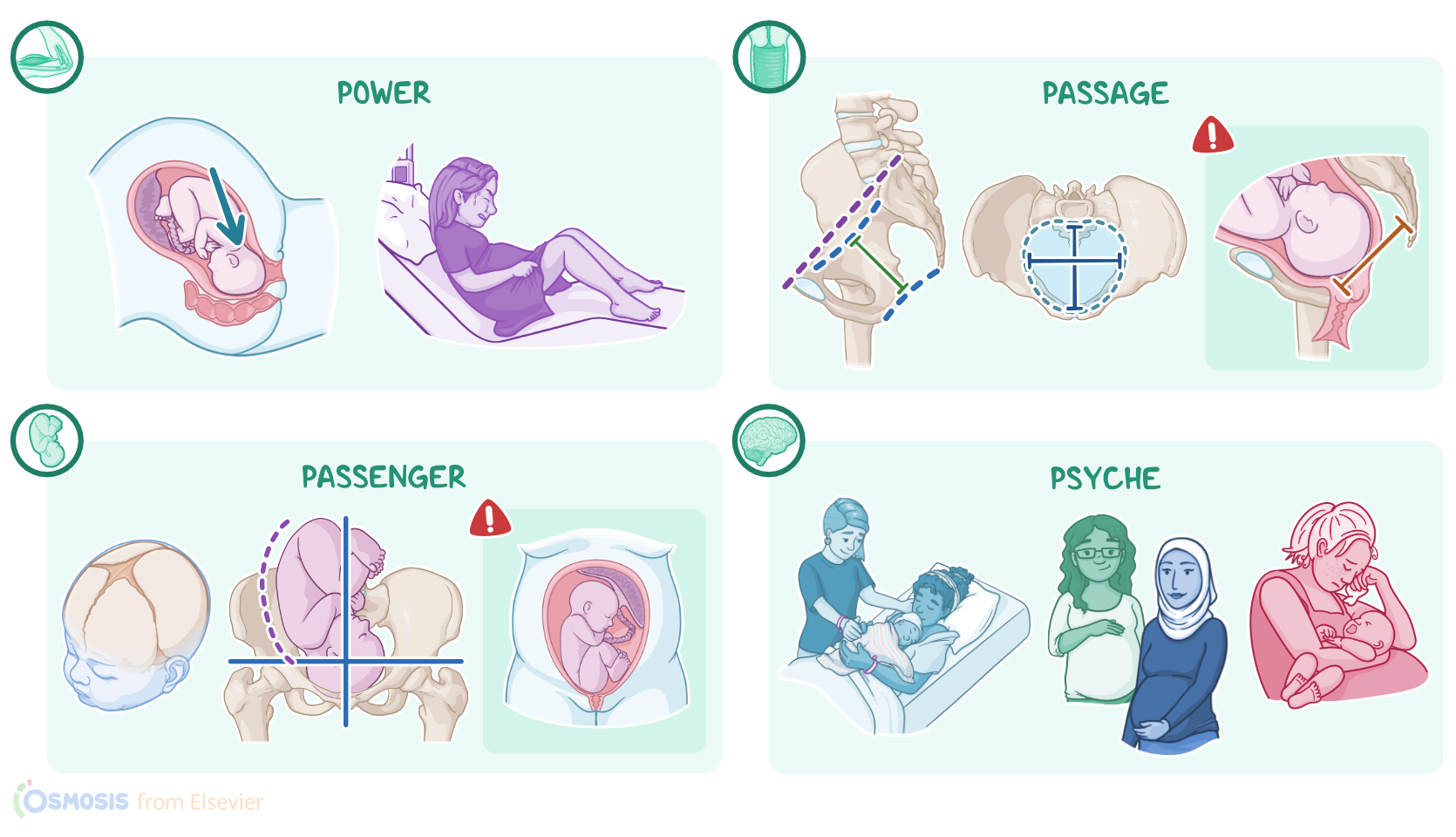
The main components of the birth process refer to the factors that interact with each other during childbirth. These components are grouped into 4Ps: power, which refers to uterine contractions and maternal pushing efforts; passage, which refers to the maternal pelvis that the baby passes through during labor; passenger, which refers to the fetus and placenta; and psyche, which refers to the client’s psychological status during labor.
Normal physiology0:30–2:47
The next P stands for passage, namely the maternal soft tissues, like the cervix, as well as the pelvis. Now, during labor, the cervix dilates and effaces, meaning it gets wider and thinner, to allow for an easier passage of the fetal head.
The pelvis is divided by an imaginary line called the pelvic brim into the upper or false pelvis, and the lower or true pelvis.
The true pelvis is divided into the pelvic inlet above; the pelvic cavity in the middle; and the pelvic outlet below. Now, the right and left sides of the maternal pelvis are connected by cartilage called the symphysis pubis.
During pregnancy, a hormone called relaxin increases, which softens joints, including, the symphysis pubis, which helps it to widen somewhat during childbirth to help accommodate the fetal head.
Overall, the shape of the pelvis can be classified into 4 types: the wider, more open gynecoid pelvis; the narrower android pelvis; the narrow and elongated anthropoid pelvis; and the wide but shallow platypelloid pelvis.
The pelvic shape, as well as the diameters of the pelvic inlet and outlet, can influence how easily the fetus can pass through.
This can be either because the fetal head is too large, or because the pelvic opening is too small, but either way, it makes passage significantly more difficult.
Okay, let’s switch to our next P, which stands for passenger, and refers to the fetus, the fetal membranes, and the placenta.
Now, for the fetus, there are a few components that can influence childbirth, including the fetal head, fetal lie, fetal attitude, as well as fetal presentation and position.
Let’s start with the fetal head, which is composed of skull bones connected by sutures with intervening spaces, called fontanelles.
Fetal head2:47–3:21
The skull bones that engage with childbirth include the frontal, parietal, and occipital bones. Typically, the sutures and fontanelles allow these bones to move slightly and change shape to adapt to the shape of the maternal pelvis, a process called moulding.
The next fetal component is the fetal lie, which describes the orientation of the fetal long axis to the maternal long axis.
fetal lie3:21–3:45
Typically, the fetal lie is longitudinal, meaning that the fetal long axis is parallel to the maternal long axis. Fetal lie can also be horizontal, which is when the fetal long axis is perpendicular to the maternal long axis.
fetal attitude3:45–4:07
An abnormal fetal attitude is when the head is tilted back, so the face presents first.Alright, now let’s discuss the next component, fetal presentation, which is determined by the fetal attitude and by the first fetal part that enters the maternal pelvis, which is also known as the presenting part.
fetal presentation4:07–5:15
The typical fetal presentation is cephalic, meaning that the presenting part is the head. Cephalic presentation is normally vertex, in which the head is flexed, but it can have variants like military, where there’s neither flexion or extension; brow, in which the head is partially extended; and face, in which the head is extended.
A less common fetal presentation is called breech, which is when the presenting part is the fetal buttocks or legs. The most common breech presentation is frank breech, in which the fetal legs are extended across the abdomen and towards the shoulders.
Less commonly, the presenting fetal part can be the shoulders.The next fetal component is the fetal position, which refers to the location of a fetal reference point on the fetal presenting part in relation to the four quadrants of the maternal pelvis.
fetal position5:15–7:15
These quadrants are the right anterior, left anterior, right posterior, and left posterior. Now, the fetal position is cited using three letters, with each letter representing an aspect of the fetal position.
The first letter describes whether the fetal presenting part is to the right or to the left of the maternal pelvis. So, the first letter can be R, meaning to the right, or L, meaning to the left.
The next letter refers to the fetal reference point which differs with each presentation. For example, the fetal reference point in vertex presentation is the occiput, which is abbreviated with the letter O.
The third letter describes whether the fetal reference point is in an anterior or posterior quadrant of the mother’s pelvis.
So, the letter A means anterior quadrant, whereas the letter P means posterior quadrant. In case the fetus lies between the anterior and posterior quadrant, then the letter T is used, meaning that the fetus lies transversely.
Now, to make this a bit easier, let’s take an example. If a fetus has their presenting part to the left of the maternal pelvis, we start with an L; if the presenting part is vertex, the second letter would be an O; and if the fetal presenting part lies in the anterior quadrant of the maternal pelvis, the last letter would be an A.
So, the fetal position in this case is LOA, which is short for left occiput anterior. The last of the 4Ps refers to the term psyche, which is the client’s psychological response to labor and birth.
This response can be influenced by anxiety, culture, expectations, the experience with the current pregnancy, in addition to life experiences, previous birth experiences, and available support during childbirth.Alright, as a quick recap, components of the birth process can be grouped into 4Ps: power, passage, passenger, and psyche.
| COMPONENTS OF THE BIRTH PROCESS | ||
| KEY POINTS | NOTES | |
| DEFINITION |
| |
| POWER |
| |
| PASSAGE |
| |
| PASSENGER |
| |
| PSYCHE |
| |
No notes for this video yet
Try adding a note below