Core measures: Nursing
Introduction0:00–0:56
Nurse Selena works in the emergency department and is reviewing the discharge policy for clients diagnosed with heart failure with the Nurse Educator, Liam.
Nurse Selena says to Nurse Liam, “I noticed that our facility’s discharge policy doesn’t align with the core measures for heart failure.” Nurse Liam notes that discharge paperwork for clients diagnosed with heart failure should include instructions for activity level, diet, discharge medications, follow-up appointments, weight monitoring, and what to do if symptoms worsen.
However, information about follow-up appointments and weight monitoring is missing from the facility’s electronic discharge template.
Nurse Liam says, “You’re right. Let’s work together to make our hospital compliant with these core measures.” Nurse Selena and Nurse Liam will use what they know about core measures to improve discharge care for clients diagnosed with heart failure.
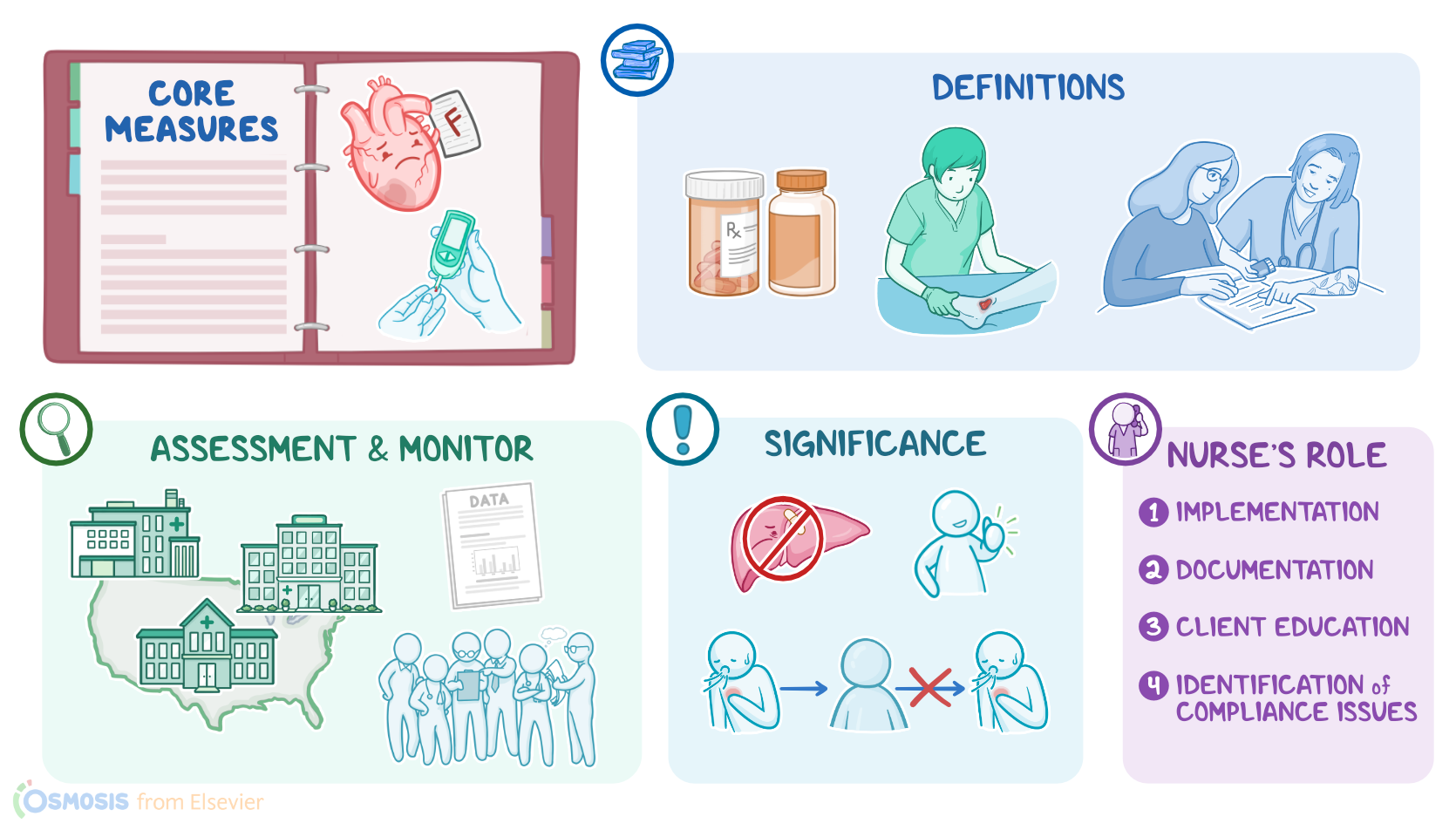
So, core measures are national standards of care for common conditions like diabetes and heart failure. Additional examples of core measures include instructions for tobacco screening and cessation, treatment of hypertension, and the scheduling of childhood immunizations.
Defining Core Measures0:56–1:37
These standards are based on the best available evidence and are designed by The Joint Commission, or TJC, and the Centers for Medicare and Medicaid Services, or CMS.
Although core measures differ depending on the condition, they usually include recommendations for prescribing and administering medications, assessment and treatment of disease, as well as client and family teaching.
Okay, so now that you know what core measures are, let’s learn how they are assessed and monitored. All healthcare facilities in the United States must report their compliance with core measures to healthcare accreditation organizations like TJC and CMS.
Assessing and Monitoring Core Measures1:37–2:25
Healthcare facilities generally track their core measure performance by examining documentation in the electronic healthcare record.
TJC and CMS compile this information to measure and rate the quality of care provided to clients. Periodically, TJC and CMS will update core measures based on the most current research and evidence.
Importantly, if a healthcare facility is not compliant with core measures, it may impact their CMS financial reimbursement and TJC accreditation.
Now, core measures can reduce complications of illness, help prevent recurrences or readmissions, and lead to better client outcomes.
Significance of Core Measures2:25–3:26
Higher core measure performance scores means that the healthcare facility is following the best practices to care for clients.
The information is released to the public, so clients and their families can view the core measurement performance of a healthcare institution, compare it to other facilities, and find the healthcare facility with the highest compliance scores and seek care there.
In addition, core measures are designed to decrease variation in care processes and increase collaboration across healthcare teams.
So, if the client with heart failure moves from one healthcare facility to another, the standards of care performed by the client’s new healthcare team should be very similar to the previous one.
Now that you understand why core measures are important, it’s time to discuss the role of the nurse in providing care while using core measures.
The Nurse Role in Core Measures3:26–4:52
There are many aspects of following core measures that are the responsibility of the healthcare provider; such as ordering tests, performing procedures, and prescribing medications.
However, the nurse plays a crucial role in four aspects of core measures: implementation, documentation, client education, and identification of compliance issues.
For example, a core measure for myocardial infarction specifies that clients should ingest a low-dose aspirin upon arrival to the emergency department to prevent further blood clot formation.
The nurse is responsible for implementation by administering the medication and for documenting that it was given within the correct time frame.
The nurse is also responsible for teaching clients after myocardial infarction how to take their beta blocker prescription after discharge.
Lastly, the nurse plays a role in identification of core measure compliance issues within their healthcare facility, like how Nurse Selena noticed the missing information in the heart failure discharge instructions.
Okay, let’s check back in with Nurse Selena and Nurse Liam. They partnered with the hospital’s informaticist to update the electronic health record to reflect the six discharge instructions indicated by the heart failure core measures.
Nurse Liam says, “Thank you for identifying this compliance issue within our facility!” Nurse Selena smiles and says, “You’re welcome.
If we’re compliant with core measures, we can improve client care.”All right, as a quick recap…Core measures are national standards of care designed to improve care for clients with common conditions.
Review4:52–5:35
All healthcare facilities in the United States must report their compliance with core measures to healthcare accreditation organizations, like The Joint Commission and Centers for Medicare and Medicaid Services.
Then TJC and CMS compile this information to rate the quality of care provided to clients within health care settings, which is then released to the public so that healthcare consumers can make informed healthcare decisions.
The nurse is responsible for identifying, performing, and documenting core measure practices as well as providing clients and their families
| CORE MEASURES | ||
| KEY POINTS | NOTES | |
| DEFINITION |
| |
| ASSESSING AND MONITORING CORE MEASURES |
| |
| SIGNIFICANCE OF CORE MEASURES |
| |
| THE NURSE'S ROLE IN CORE MEASURES |
| |
No notes for this video yet
Try adding a note below