Developing a research problem and hypothesis: Nursing
Introduction0:00–0:19
Nurse Joy works in the community health clinic. In the past year, there's been an increase in the number of clients not showing up for their appointments, and nurse Joy wants to understand why.
Research is a systematic process of validating, refining, and generating knowledge. It is used by members of the healthcare team, such as nurses to answer questions that come up when caring for clients.
Research Problem and Purpose0:19–1:09
A research problem is a specific area of knowledge that needs Further investigation and it is sometimes phrased as a question.
Nurse Joy wants to understand more about situations that impact clinic attendance, so they use the question, what reasons do clients give for not keeping their scheduled appointments at the community health clinic?
Next, the research purpose is generated from the research problem. The research purpose is a single sentence that explains what you are looking to learn by completing the research study.
So Nurse Jury's research purpose is the purpose of this research study is to explore barriers to appointment attendance.
After the research problem and purpose statement comes the research hypothesis by identifying the research variables. Research variables are the concepts that are measured, manipulated, or controlled in a study.
Research Variables1:09–7:40
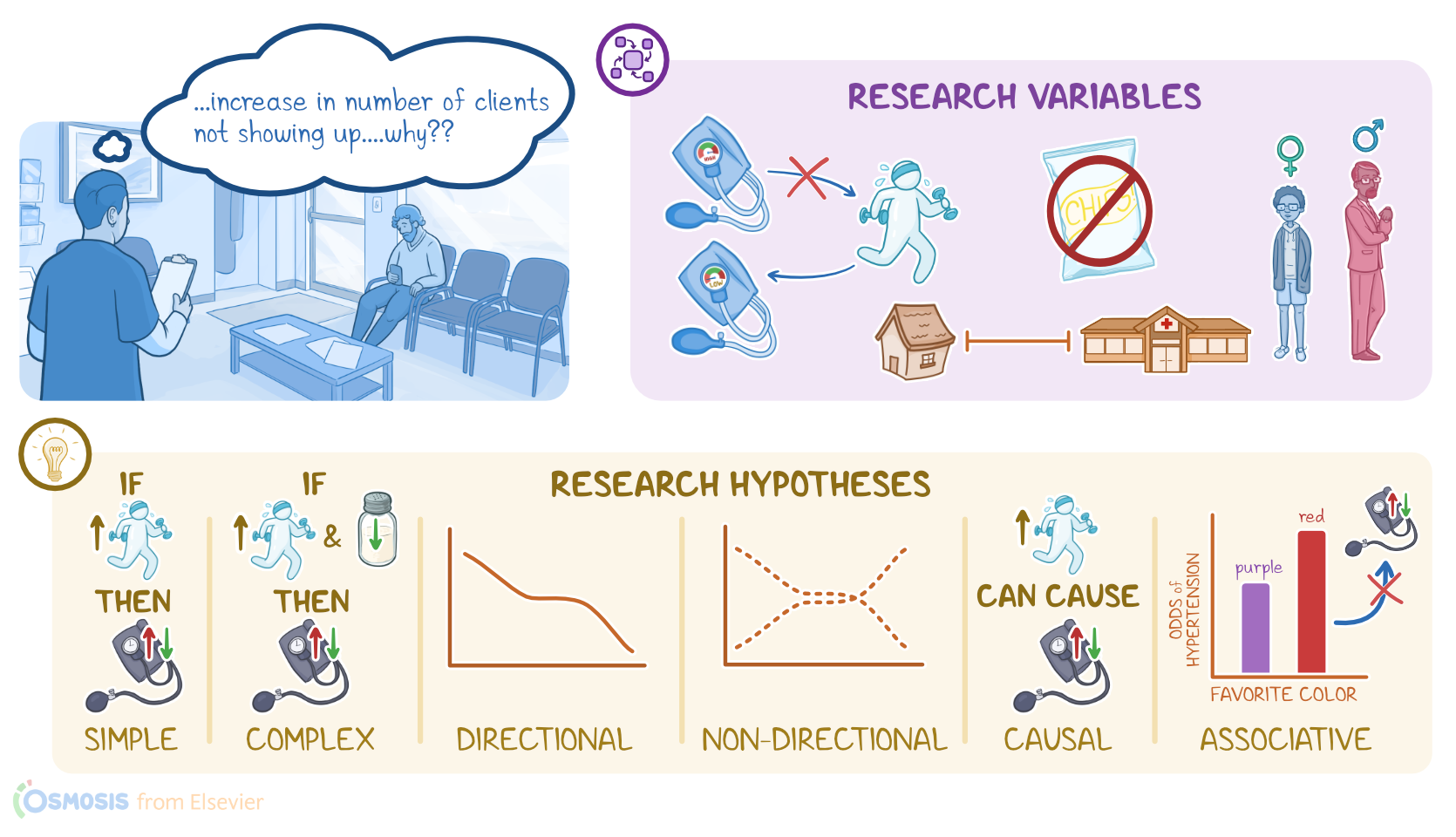
Oftentimes, researchers want to know how one variable affects another variable. For example, a researcher may want to know how daily exercise impacts BP.
Now, there are different types of variables to consider, including independent variables, dependent variables, extraneous variables, confounding variables, and demographic variables.
First are the independent and dependent variables. So let's go back to the exercise and BP example.
The independent variable is not affected by the other variables. So in this case, the amount of exercise you get does not depend on BP, so it's independent.
The dependent variable will change based on other variables in the study. In this case, your BP might change depending on the amount of exercise you get.
Sometimes there are also extraneous variables. Extraneous variables may impact the dependent or independent variable, even though they are not part of the study.
Confounding variables are a type of extraneous variable that only affect the dependent variable. In the exercise example, a low sodium diet is a confounding variable, since like exercise, it can change BP, but it is not a part of the study.
Finally, there are demographic variables, sometimes referred to as demographics. These variables describe characteristics of the study participants like age or gender.
This information can be used during data analysis to draw conclusions, like saying participants aged 45 to 54 had increased appointment attendance compared to clients aged 35 to 44.
Demographic variables can also be useful when you are reporting the findings of your study to describe the sample. For example, 20% of the total sample size was under the age of 30.
Sometimes demographic variables can be considered extraneous variables because the characteristics of the sample end up affecting other variables.
After the research problem and purpose statement have been created and the variables are understood, next comes the research hypothesis.
A research hypothesis is a prediction that will be tested during the study. It is created for all experimental and quasi-experimental research, as well as some descriptive and correlational studies.
The research hypothesis has a narrower focus than the research problem and purpose statement and helps to guide the study design.
The hypothesis is usually presented as an if and then statement of how one variable may affect the other, like, if clients increase their daily exercise by 10 minutes per day, their BP will change.
Now there are different types of hypotheses that can be used depending on what is being studied. First, there are simple or complex hypotheses.
A simple hypothesis is when there are only two variables, one independent and one dependent. A complex hypothesis, on the other hand, has more than one independent or dependent variable.
So the statement, if clients increase their daily exercise by 10 minutes per day, their BP will change, is a simple hypothesis with exercise as the independent variable and blood.
The next types of hypotheses are directional or non-directional hypotheses. A directional hypothesis describes the nature of the relationship between variables and is predicted by using terms like decrease or increase.
For example, if clients increase their daily exercise by 10 minutes per day, their BP will decrease is a directional hypothesis because the researcher is predicting a decrease in BP rather than an increase.
A non-directional hypothesis, on the other hand, assumes that a relationship exists but does not define the relationship.
A non-directional hypothesis uses wording like associated with. So the statement, if clients increase their daily exercise by 10 minutes per day, their BP will change is a non-directional hypothesis because the researcher is not predicting if the BP will increase or decrease.
However, if they predict that appointment attendance will change but do not specify if it will increase or decrease, that is a non-directional hypothesis.
There are also causal and associative hypotheses. A causal hypothesis looks at how one variable directly affects another variable, like how exercise can cause BP to change.
Alternatively, an associative hypothesis is when there is a relationship between variables, but not a direct cause and effect, like investigating if someone's favorite color is linked to their BP.
The study might find people who like red are more likely to have hypertension than people who like blue, but liking red does not cause hypertension.
Finally, there is the null hypothesis. The null hypothesis states that there is no relationship between the variables.
Through research, the null hypothesis can then be accepted or rejected. So if it were discovered that daily exercise did not change BP, the null hypothesis would be if clients increase their daily exercise by 10 minutes per day, their BP will not change.
Formulating a Research Hypothesis7:40–8:19
This is a simple hypothesis with one independent variable, stress, and one dependent variable, clinic appointment attendance.
With the research problem and hypothesis defined, nurse jury can now move on to designing their study. All right, as a quick recap, research is a systematic process of validating, refining, and generating knowledge.
Review8:19–10:23
A research problem identifies a specific area of knowledge that needs to be further investigated or what you'll specifically be studying.
The research purpose is a single sentence that explains what you are looking to learn by completing the research study. Research variables are the concepts that are measured, manipulated, or controlled in a study.
There are different types of variables. First, the independent variable is something that can cause a change in other study variables.
Next, the dependent variable is the one being measured or tested. There are also extraneous variables that may impact the dependent or independent variable even though they are not part of the study.
Confounding variables are a type of extraneous variable that can impact your dependent variable even though they are not part of the study.
Finally, there are demographic variables or demographics that describe characteristics of the study participants like age or gender.
In experimental research, a hypothesis is a prediction that will be tested using research. In a simple hypothesis, there is only one independent variable and one dependent variable, whereas in a complex hypothesis, there is more than one independent or dependent variable.
You can also categorize a hypothesis as being directional or non-directional. Directional hypotheses predict a particular directional change in the dependent variable like an increase or decrease.
In a non-directional hypothesis, the direction is not predicted. There are also causative and associative hypotheses.
When the hypothesis assumes the independent variable causes the dependent variable to change, it is known as a causal hypothesis.
Alternatively, there is an associative hypothesis, which is when there is a relationship between the variables, but not a direct cause and effect.
Finally, there is the null hypothesis which states that there is no relationship between the variables.
| DEVELOPING A RESEARCH PROBLEM AND HYPOTHESIS | ||
| KEY POINTS | NOTES | |
| INTRODUCTION |
| |
| RESEARCH PROBLEM AND PURPOSE |
| |
| RESEARCH VARIABLES |
| |
| RESEARCH HYPOTHESES |
| |
| FORMULATING A RESEARCH HYPOTHESIS |
| |
No notes for this video yet
Try adding a note below