Dialysis care: Nursing
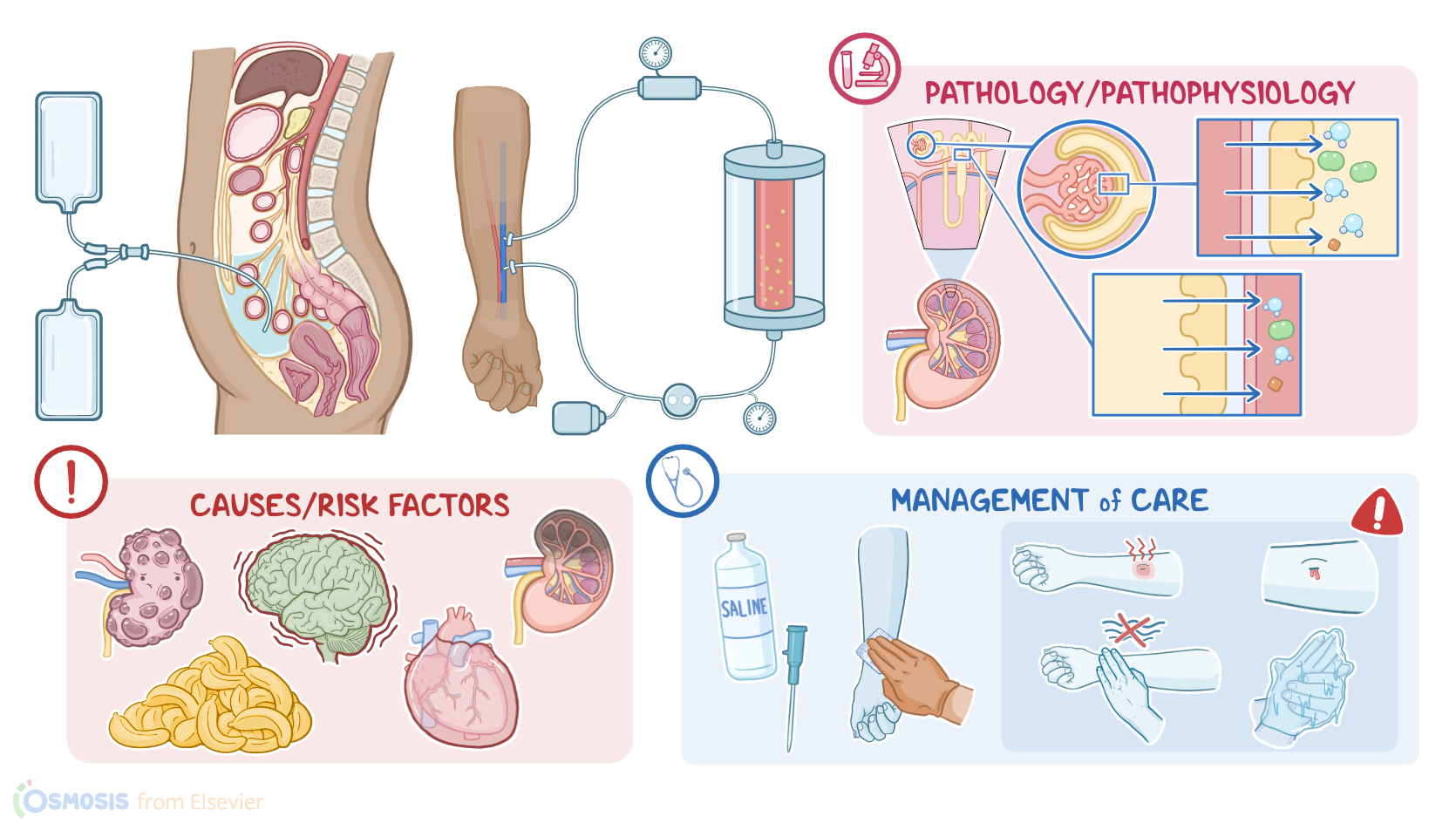
Dialysis is a type of kidney replacement therapy that removes toxic byproducts of protein metabolism, like urea, uric acid, and creatinine; waste products from the blood; as well as excess fluid. Additionally, through dialysis, electrolyte levels and acid-base imbalances can be corrected. There are two types of dialysis: hemodialysis and peritoneal dialysis. Now, let’s review some renal physiology. Each kidney is made up of millions of tiny functional units called nephrons, each of which consist of a renal corpuscle and the renal tubules. The renal corpuscle is where blood filtration happens, and it’s made up of the glomerulus, which is a tiny bundle of capillaries and the Bowman’s capsule, which is a cup-shaped structure surrounding the glomerulus. Blood flows through the glomerulus and then water and small solutes are filtered into Bowman’s capsule, creating an ultrafiltrate of blood. Then this ultrafiltrate goes through the renal tubules, where electrolytes and water can be secreted or reabsorbed.
In addition, they are important in regulating acid-base balance. The kidneys also clear blood of metabolic wasteful substances and toxins. Finally, what leaves the tubules becomes the urine, which flows into the bladder and is excreted during micturition. Okay, now, let’s look at some situations when dialysis is indicated. Most often, clients who require dialysis have end-stage chronic kidney disease, which means the kidneys have lost almost all their function. In this case, both hemodialysis and peritoneal dialysis are adequate long-term options. However, there are some urgent conditions that benefit from dialysis, and hemodialysis is usually preferred in these situations. These clients also usually have associated acute kidney injury.
Indications for urgent dialysis include pulmonary edema unresponsive to conventional treatment; life-threatening hyperkalemia, when potassium levels are over 6.5 mEq/L and there are associated electrocardiographic abnormalities; acidosis unresponsive to conventional treatment; signs of uremia, like encephalopathy or pericarditis; as well as intoxications, especially with methanol or ethylene glycol and certain medication overdoses, like lithium. Now, to perform dialysis on a client, first, you’ll need either vascular access for hemodialysis, or peritoneal access for peritoneal dialysis. Let’s start with hemodialysis, which requires venous access. In an acute setting, a temporary venous access is obtained through a temporary catheter in the subclavian, internal jugular or femoral vein. Clients on chronic hemodialysis need a more permanent access, such as an arterio-venous or AV fistula, where a connection between a small artery and a vein in the arm or less often the leg, is made surgically. Another semi-permanent access is a so-called permanent catheter that can be located in the same veins as the temporary catheter, but it can be used for a long time, is more comfortable for the client, and there’s a lower risk for infection than with the temporary access.
| DIALYSIS CARE | ||
| KEY POINTS | NOTES | |
| DEFINITION |
| |
| PHYSIOLOGY |
| |
| INDICATIONS |
| |
| TYPES OF DIALYSIS ACCESS |
| |
| PRINCIPLES OF DIALYSIS |
| |
| MANAGEMENT OF CARE |
| |
| PATIENT AND FAMILY TEACHING |
| |
No notes for this video yet
Try adding a note below