Disaster management: Nursing
Introduction0:00–0:31
Nurse Judy is working in the pediatric intensive care unit when she feels the ground start to shake beneath her feet. She looks around at the faces of her colleagues on the unit who appear confused and a bit afraid.
The shaking lasts 10 seconds and then the unit clerk asks, “Was that an earthquake?” Nurse Judy responds, “I’m not sure.
I’ve never been in an earthquake before.” Within minutes, the charge nurse is notified that there has been an earthquake and that the disaster management plan has been initiated.
A disaster, or mass casualty event, is when illnesses or injuries exceed the resources or capabilities of a healthcare facility or a community.
Definition/Theory0:31–0:52
Disaster management, also called emergency preparedness and response, is the planning and actions taken by the healthcare team to decrease the potential for harm during a disaster.
Transition0:52–3:02
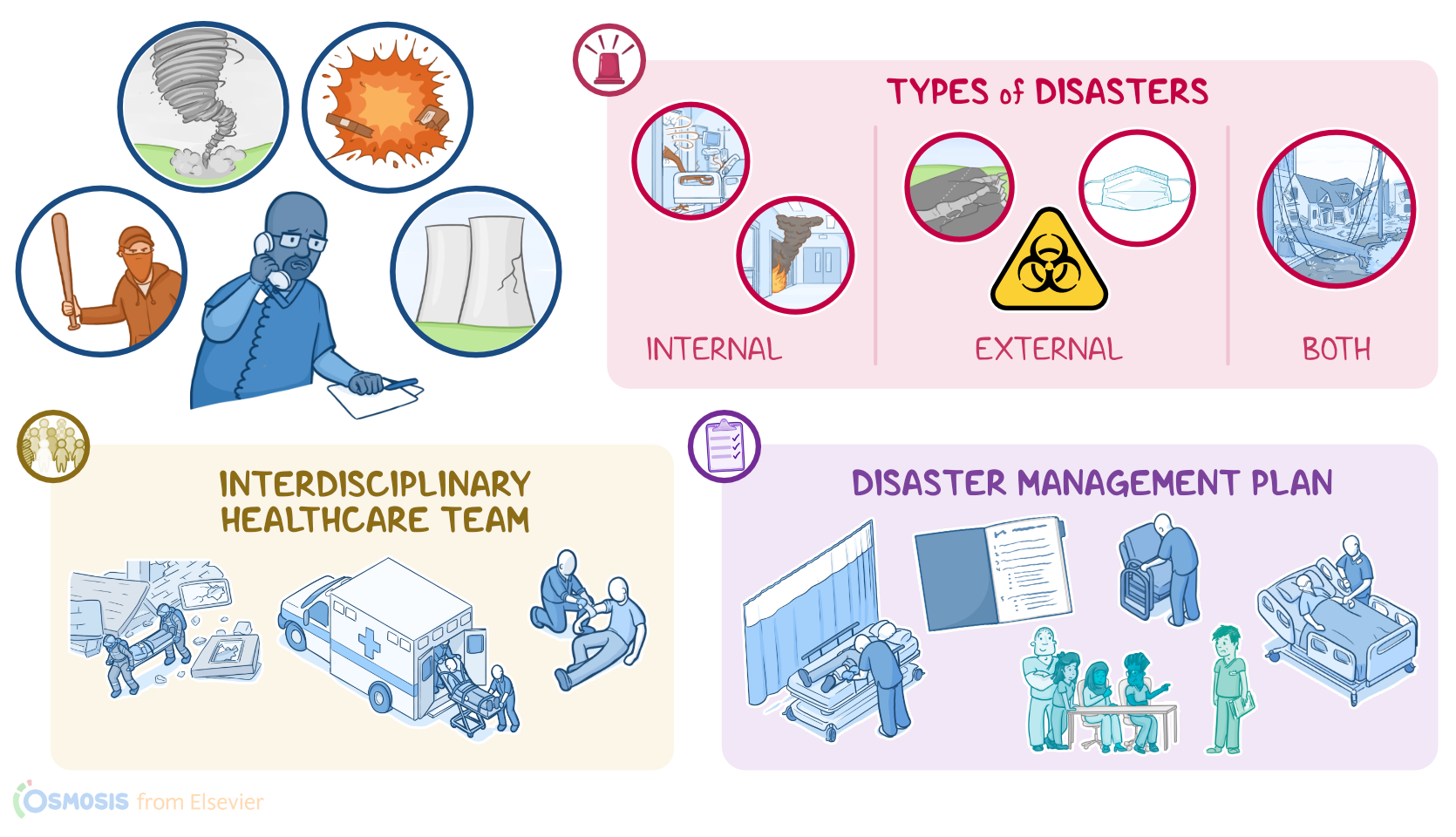
Now, disasters can be categorized as both internal and external. An internal disaster takes place within the facility and can include fires, hurricanes, explosions, violence in the facility, or loss of critical utilities like water or electricity.
These types of disasters may require evacuation of the facility.On the other hand, external disasters occur outside of the facility.
These disasters can be natural or man-made. Natural disasters include weather-related events such as hurricanes, tornadoes, earthquakes, like at Nurse Judy’s hospital, or pandemics.
Man-made disasters, also called technologic disasters, include events like a nuclear reactor malfunction or terrorism which can include nuclear, biologic, or chemical sources of terrorism.
At times, special considerations, like decontamination and containment, must be taken for nuclear, biologic, or chemical disasters.
In some cases, a disaster can be considered both internal and external, like when a hurricane results in loss of critical utilities at a hospital and also casualties in the community.
Most healthcare facilities have their own disaster management plan which involves many members of the interdisciplinary healthcare team.
The first-responders at the scene, like firefighters and emergency medical technicians, typically move people away from danger, rapidly triage victims at the site of the disaster, and transport them to the hospital.
Within the healthcare facility, there are various leadership roles on the disaster management team who help to oversee the response to the disaster.
This includes an incident commander who assumes overall leadership, a medical command physician who helps determine needed resources and staff, a triage officer who triages clients as they arrive at the hospital, and other officers who are in charge of supplies, communication, infection control, and community relations.
In addition, nurses, physicians, nurse practitioners, nurse’s aides and many other healthcare team members serve a critical role by providing care to the victims coming in as well as continuing care for the clients already in the hospital.
Now, there are several phases in an institution’s disaster management plan which include a mitigation and preparedness phase, response phase, and a recovery phase, and you, as the nurse, will take part in each phase.
Application3:02–6:38
Before a disaster occurs, in the mitigation and preparedness phases, you can help to develop internal and external response plans and participate in training drills that help to test the plans and simulate real disasters.
Most importantly you should understand your role in the event of a disaster before a disaster has occured. Now back to Nurse Judy.
Before the incident happened, she had participated in two disaster training drills since joining this hospital two years ago.
She knows who the incident commander is and understands her role in the event of an emergency which is to remain in her unit and provide care to the incoming clients.During the response phase, which is during or immediately following a disaster, you should follow the disaster management plan and begin functioning in your designated role.
If you typically work in the emergency department or intensive care unit, this may mean triaging or treating patients as they come in.
If you work in other care areas, you may continue to care for your own clients, help to determine which clients can be discharged or transferred to a different unit, help to prepare alternative care areas like waiting rooms, or even be reassigned to another care area, like the emergency department, to help care for the non-critical clients.
During this phase of the emergency response, it is most important for you to remain flexible and calm and to provide your clients a sense of safety and personal control.
Nurse Judy checks on each of her clients and is able to assess that none of the patients or families have been injured during the earthquake.
She provides comfort to the clients and families by telling them that they are safe. Judy then reports to her charge nurse who asks Judy to assess each of her clients for their readiness for discharge or transfer to a non-critical care unit.
Judy works with the providers to prepare one of her clients for discharge and another for transfer to a pediatric medical unit.
Once her clients have been moved, she helps to prepare the empty rooms for possible client arrivals from the emergency department.
She also helps to stage the waiting room to serve as an alternative client care area.Now, after a disaster is the recovery phase where the immediate danger and response has passed.
During this phase, you might be asked to take over for nurses who have worked extra time or restock areas with supplies.
Once a healthcare facility is no longer overwhelmed, the incident commander will announce a “standing down” which means that the emergency response has ended.
It is important for nurses to be involved in debriefing following the disaster. Debriefing is an opportunity to discuss and reflect upon the actions taken during the disaster.
It allows the disaster management team to analyze the plan and to look for areas of improvement. In addition, during the recovery phase, it is common for health care team members and clients to experience acute stress disorder, called ASD, and posttraumatic stress disorder, called PTSD.
It is important to assess your clients for symptoms of these disorders and refer them to the appropriate resources. You should also talk to your colleagues about the experience, work to develop coping strategies, and attend crisis counseling meetings.
So, in nurse Judy’s case, in the weeks following the earthquake, she recognizes that she is feeling more anxious while at work and she is experiencing trouble concentrating.
She attends crisis counseling meetings provided by her hospital and also contacts a therapist who helps her to develop coping mechanisms.
As a quick recap… a disaster is when illnesses or injuries exceed the available resources and capabilities of a healthcare facility or community.
Review6:38–7:37
Disasters can be categorized as internal, which is when the disaster is in the facility, or external, which is when the disaster occurs outside of the facility.
Disaster management includes creating an emergency response plan and the actions taken to decrease the potential for harm during a disaster.
The phases of disaster management include the mitigation and preparedness phases, the response phase, and the recovery phase.
During the mitigation and preparedness phase, it is most important for you to understand what role you have in the event of a disaster.
During the response phase, you must follow the disaster management plan. It is important to stay calm and flexible as the needs of your unit or hospital can change during the course of a disaster.
Lastly, during the recovery phase, you should participate in debriefing sessions and seek help when needed for acute stress disorder or
| DISASTER MANAGEMENT | ||
| KEY POINTS | NOTES | |
| INTRODUCTION |
| |
| DEFINITION |
| |
| TYPES OF DISASTERS |
| |
| DISASTER MANAGEMENT PLAN |
| |
| MITIGATION AND PREPAREDNESS PHASE |
| |
| RESPONSE PHASE |
| |
| RECOVERY PHASE |
| |
| MANAGEMENT OF CARE | ||
| PATIENT AND FAMILY TEACHING | ||
No notes for this video yet
Try adding a note below