Genomics - Pharmacogenomics: Nursing
Introduction0:00–1:00
Nurse Marta works in a primary care office and is caring for a client, Juan, who was recently diagnosed with HIV. Juan has come to the office for genetic counseling after testing positive for the HLA B*5701 allele.
While Nurse Marta is documenting Juan’s admission information, Juan says, “So I know I can’t take certain HIV drugs because of my genes, but I don’t really know why.” Nurse Marta responds, “Some people with HIV can develop a serious reaction to the medication abacavir if they have a genetic variation called the HLA B∗5701 allele.” Juan nods his head but looks puzzled.
He tells Nurse Marta, “I’m not following. Is there something wrong with me?” Nurse Marta assures Juan that they’ll work together to understand how his genes impact his response to this medication.
Nurse Marta will use what she knows about pharmacogenomics to support, educate, and assess Juan during this process. Pharmacogenomics combines genomics and pharmacology to understand how a client’s genetic variations affect their response to medication.
Defining Pharmacogenomics1:00–1:20
It examines the genetic factors that play a role in the effectiveness of medication therapy to provide individualized and safe care to clients.Now, most medication metabolism depends on a family of CYP450 enzymes.
The Effects of Genetic Variants1:20–4:11
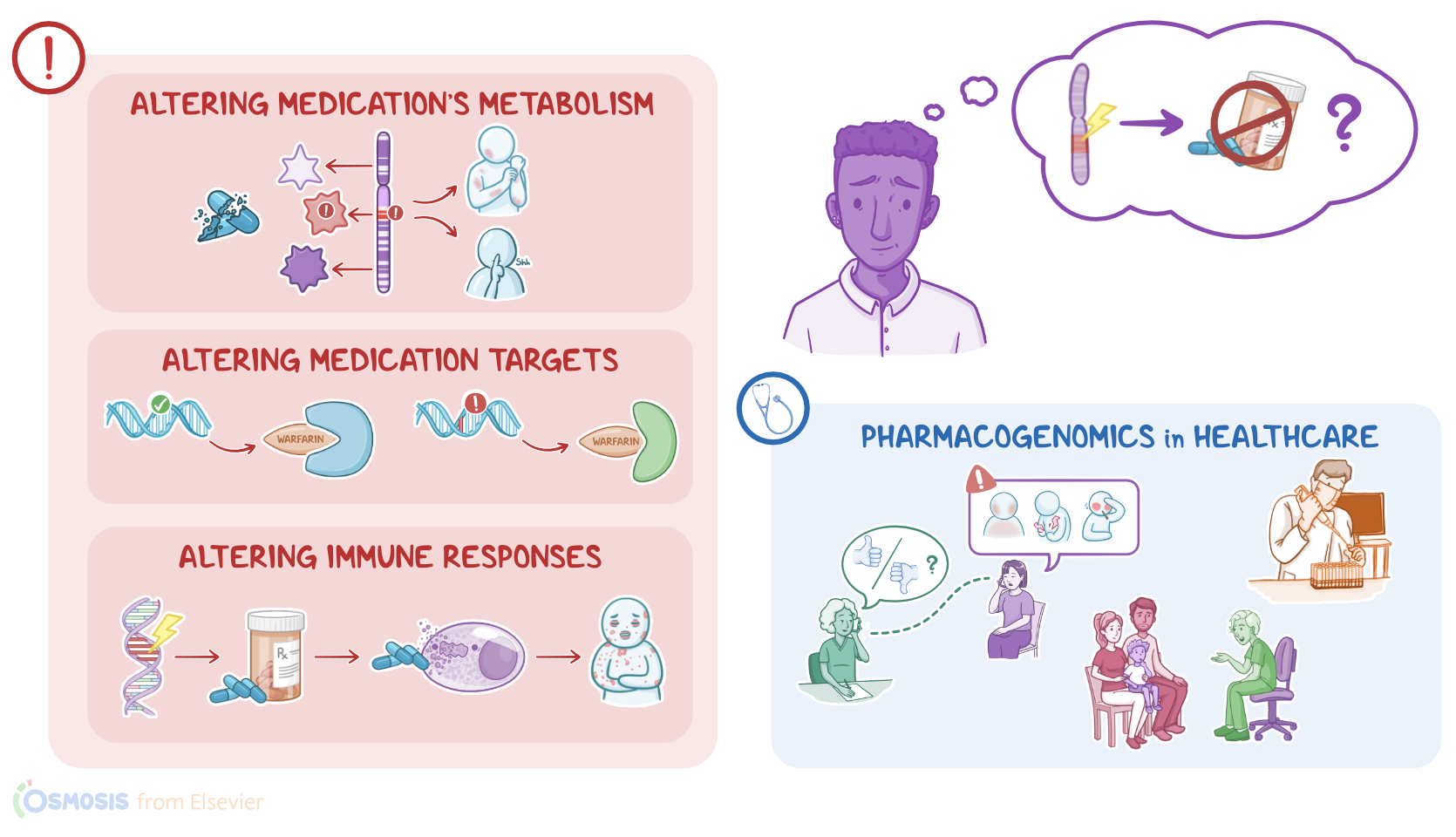
And there are a number of genes that code for these enzymes. So, one way a variant in one of these genes can modify a client’s response to medications is by altering the medication’s metabolism.
Depending on the genetic variant, when a client takes a certain medication, it can either cause an exaggerated response, leading to possible toxicity, or a muted response, leading to a reduction in the effect of the medication.
So, when codeine is administered to a client with this altered enzyme, the medication is ineffective because it doesn't reduce the client’s pain.
Likewise, some clients have another form of CYP2D6 that’s unable to metabolize venlafaxine, a serotonin and norepinephrine uptake inhibitor, or SNRI, leading to decreased medication effectiveness.
Next, genetic variants can also modify a client’s response to medications by altering medication targets around the body.
Some clients produce a gene variant of VKORC1 which alters the structure of the enzyme, causing clients to be more sensitive to the effects of warfarin.
In this situation, clients will need much smaller doses of warfarin to achieve a safe level of anticoagulation while preventing excessive bleeding.
Genetic variants can also affect receptors on cells that are targets of medications, such as those found on cancer cells.
For example, cetuximab is a cancer medication that is only successful in treating tumors that express the epidermal growth factor receptor, or EGFR.
This means tumors that don’t have this receptor aren’t responsive to cetuximab and another medication must be given instead.
Lastly, genetic variants can modify a client’s response to medications by altering immune responses to medications. So sometimes, a variant can increase the risk of a hypersensitivity reaction to a medication.
For clients, like Juan, who have a variant gene that codes for HLA B*5701, taking abacavir to treat HIV infection can possibly result in a severe and even fatal hypersensitivity reaction.
Applying concepts of pharmacogenomics to clinical care has proven crucial in enhancing medication effectiveness and reducing adverse medication reactions.
Pharmacogenomics in Healthcare4:11–6:02
Pharmacogenomics allows healthcare providers to more precisely prescribe medications based on a client’s genetic make-up.As a nurse, it’s essential that you support, educate, and assess clients in relation to pharmacogenomics.
You can support clients and their families in making informed decisions related to genetic testing. In fact, you’re often responsible for witnessing informed consent for genetic testing.
Genetic testing may also carry emotional implications for clients and their families, especially those diagnosed with genetic variations that impact health outcomes.
As a result, you may need to refer clients to a counselor, social worker, or other resources. You will also provide education for clients who are either interested in genetic testing or need assistance in interpreting results from genetic testing.
Additionally, you’ll play a role in assessing the client’s response to medication therapy once a genetic variant is identified, by monitoring for its efficacy as well as watching for signs of toxicity.
Lastly, you can also receive advanced education and training to become a licensed genetics nurse. Okay, now let’s check back in with Nurse Marta and Juan, who have discussed Juan’s genetic variation that’s affecting his immune response to the medication abacavir.
Juan says, “Nurse Marta thank you for everything! I feel so lucky that I was tested for this gene so I can get the right medication.” In the following weeks, Nurse Marta evaluates Juan in the office periodically as he receives antiretroviral therapy with positive results.
Alright, as a quick recap… Pharmacogenomics combines genomics and pharmacology to understand how a client’s genetic variations affect their response to medication.
Summary6:02–6:37
Genetic variants can impact a client’s response to medication by altering drug metabolism, drug targets, and immune responses to medications.
Applying principles of pharmacogenomics to clinical care, can enhance medication effectiveness and reduce adverse medication reactions.
Nurses should work to support, educate, and assess clients in relation to pharmacogenomics.
| GENOMICS - PHARMACOGENOMICS | ||
| KEY POINTS | NOTES | |
| DEFINITION |
| |
| EFFECTS OF GENETIC VARIANTS |
| |
| PHARMACOGENOMICS IN HEALTHCARE |
| |
No notes for this video yet
Try adding a note below