Growth and development - School-age: Nursing

Last updated: November 10, 2022

Growth and development - School-age: Nursing

Watch later

Watch later

Cholinomimetics: Direct agonists
Immunosuppressants for autoimmune diseases: Nursing pharmacology
Osteoporosis: Nursing
Osteomyelitis: Nursing
Paget disease of bone: Nursing
Cerebral palsy: Nursing
Down syndrome (Trisomy 21)
Encephalitis: Nursing
Headaches: Pathology review
Meningitis: Nursing process (ADPIE)
Seizure disorder: Nursing process (ADPIE)
Stroke: Nursing process (ADPIE)
Erysipelas and cellulitis: Nursing
Antibiotics - Penicillins: Nursing pharmacology
Antifungals - Topical: Nursing pharmacology
Cutaneous fungal infections: Nursing
Antibiotics - Cephalosporins: Nursing pharmacology
Antibiotics - Macrolides: Nursing pharmacology
Antivirals for influenza: Nursing pharmacology
Antivirals for herpesviruses: Nursing pharmacology
Antivirals for hepatitis B and C: Nursing pharmacology
Antibiotics - Fluoroquinolones: Nursing pharmacology
Antibiotics - Tetracyclines and glycylcyclines: Nursing pharmacology
Antidepressants - Tricyclic antidepressants (TCAs) and monoamine oxidase inhibitors (MAOIs): Nursing pharmacology
Glaucoma: Nursing process (ADPIE)
Antidepressants - SSRIs and SNRIs: Nursing pharmacology
Gout: Nursing process (ADPIE)
Antiretrovirals for HIV/AIDS - CCR5 antagonists, fusion inhibitors, and attachment inhibitors: Nursing pharmacology
Antiretrovirals for HIV/AIDS - Integrase strand transfer inhibitors: Nursing pharmacology
Antiretrovirals for HIV/AIDS - Protease inhibitors: Nursing pharmacology
Antiretrovirals for HIV/AIDS - NRTIs and NNRTIs: Nursing pharmacology
Cataracts: Nursing
Detached retina: Nursing
Macular degeneration: Nursing
Meniere disease: Nursing
Growth and development - Infant: Nursing
Otitis media: Nursing
Eye anesthetics: Nursing pharmacology
Mydriatics and cycloplegics: Nursing pharmacology
Ophthalmic anti-inflammatories and anti-infectives: Nursing pharmacology
Diabetes mellitus (DM): Nursing process (ADPIE)
Anatomy and physiology of the eye
Physical assessment - Eyes: Nursing
Conjunctivitis: Nursing process (ADPIE)
Eye conditions: Inflammation, infections and trauma: Pathology review
Anatomy of the eye
Pediatric psychosocial needs during illness and hospitalization: Nursing
Hearing impairment and otosclerosis: Nursing
Growth and development theories: Nursing
Growth and development - Preschool-age: Nursing
Growth and development - Toddler: Nursing
Growth and development - School-age: Nursing
Growth and development - Adolescent: Nursing
Antibiotics - Carbapenems and monobactams: Nursing pharmacology
Antibiotics - Trimethoprim and sulfonamides: Nursing pharmacology
Antibiotics - Beta lactam and beta lactamase inhibitor combinations: Nursing pharmacology
Antibiotics - Aminoglycosides: Nursing pharmacology
Medications for respiratory syncytial virus (RSV): Nursing pharmacology
Mycobacterium tuberculosis (Tuberculosis)
Hypersensitivity reactions - Type II: Nursing
Lyme disease: Nursing process (ADPIE)
Systemic lupus erythematosus (SLE): Nursing
Preoperative care: Nursing
Postoperative care: Nursing
Chest tube care: Nursing
Analgesics for obstetrics: Nursing pharmacology
Analgesics: Nursing pharmacology
Acne: Nursing
Burn injury: Nursing
Impetigo: Nursing
Insect stings and bites: Nursing
Psoriasis: Nursing
Herpes zoster: Nursing
Urticaria: Nursing
Pressure injury: Nursing process (ADPIE)
Cholinergic therapy (GU): Nursing pharmacology
Physical assessment - Skin, hair, and nails: Nursing
Acetylcholinesterase inhibitors for myasthenia gravis: Nursing pharmacology
Antiepileptics: Nursing pharmacology
Narcolepsy (NORD)
Autism spectrum disorder (ASD): Nursing
Insomnia
Hemorrhagic stroke - Intracranial hemorrhage (ICH) and subarachnoid hemorrhage (SAH): Nursing
Body fluid compartments
Anemia - Macrocytic: Nursing
Anemia - Iron-deficiency: Nursing
Vitamin D
Vitamin B12 deficiency
Role of Vitamin K in coagulation
Folate (Vitamin B9) deficiency
Coronary artery disease (CAD) and angina pectoris: Nursing process (ADPIE)
Hypertension: Nursing process (ADPIE)
Hypersensitivity reactions - Type I: Nursing
Hypersensitivity reactions - Type III: Nursing
Hypersensitivity reactions - Type IV: Nursing
Immune response - Adaptive: Nursing
Immune response - Innate: Nursing
Human immunodeficiency virus (HIV) and acquired immunodeficiency syndrome (AIDS): Nursing
Antiglaucoma medications: Nursing pharmacology
Oral antidiabetic medications - Sodium-glucose co-transporter-2 (SGLT-2) inhibitors: Nursing pharmacology
Insulin: Nursing pharmacology
Non-insulin injectable antidiabetic drugs - GLP-1 agonists and amylinomimetics: Nursing pharmacology
Oral antidiabetic medications - Biguanides and thiazolidinediones: Nursing pharmacology
Oral antidiabetic medications - Sulfonylureas and meglitinides: Nursing pharmacology
Oral antidiabetic medications - DPP-4 inhibitors: Nursing pharmacology
Oral antidiabetic medications - Alpha-glucosidase inhibitors: Nursing pharmacology
Antihistamines: Nursing pharmacology
Antacids: Nursing pharmacology
Antiemetics: Nursing pharmacology
Gastric mucosal protective agents: Nursing pharmacology
Antidiarrheals: Nursing pharmacology
Laxatives: Nursing pharmacology
Antispasmodics (GI): Nursing pharmacology
Chronic obstructive pulmonary disease (COPD): Nursing process (ADPIE)
Physiology of pain: Nursing

Notes

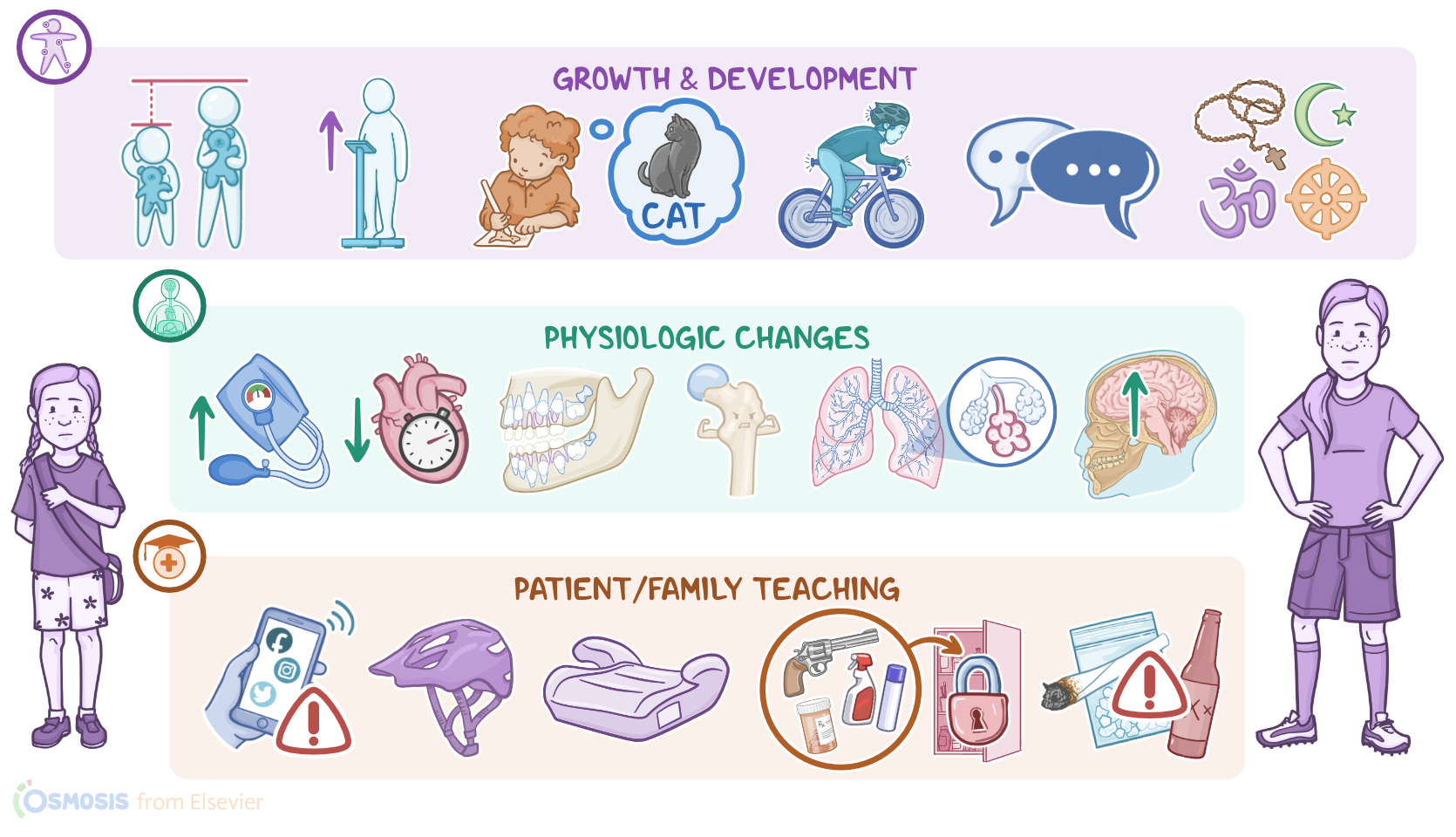
GROWTH AND DEVELOPMENT - SCHOOL-AGE

KEY POINTS
NOTES
DEFINITION
  • Begins when children start elementary school
    • Around age 6
  • Lasts until primary education is finished
    • Around age 12 

GROWTH
  • Physical changes in height, weight, and body appearance
  • Height 
    • Grow about 6–7 cm/year 
  • Weight 
    • Gains about 3–3.5 kg per year 
  • Growth variability among same age  
  • Body image awareness 
    • Increasing interest in 
      • Height and weight 
      • Physical appearance 
      • May begin self-monitoring 

DEVELOPMENT
  • Acquisition of complex motor, cognitive, and social skills
  • Development
    • Motor
      • Improved coordination, balance, and rhythm 
      • Skills
        • Writing and drawing 
        • Playing musical instruments 
        • Riding a two-wheel bike 
        • Dancing and participating in sports
    • Cognitive
      • Piaget's concrete operational stage
      • Understands world through words and images 
      • Abilities 
        • Seriation
        • Conservation
        • Collecting
    • Psychosocial
      • Erikson's industry vs. inferiority
      • Seeks to 
        • Gain knowledge 
        • Learn new skills at home and school 
        • Outcomes 
          • Support and success → sense of competence and industry 
          • Lack of support or failure → feelings of inferiority
    • Moral and spiritual 
      • Kohlberg's conventional stage
      • Begins to 
        • Accept social rules of right and wrong 
        • Desire to be “good” to gain approval 
        • Influenced by 
          • Role models 
          • Exposure to cultural and religious traditions 
          • Understands “golden rule” by end of stage

PHYSIOLOGIC CHANGES
  • Nervous system 
    • Slow brain and skull growth 
    • Brain growth completes by around age 10 
  • Respiratory system 
    • Continued lung and alveoli development 
    • Respiratory rate decreases 
    • Breathing becomes more diaphragmatic 
    • Fewer respiratory infections 
  • Cardiovascular system 
    • Heart rate decreases 
    • Blood pressure increases 
    • Heart grows more slowly and is smaller in proportion to body size 
  • Musculoskeletal system 
    • Increased strength and coordination 
    • Bone ossification continues, but mineralization is incomplete 
    • R/f injury remains due to ongoing development 
  • Gastrointestinal system 
    • Loss of deciduous teeth and eruption of permanent teeth  
    • Stomach capacity increases, allowing longer intervals between meals 
    • Caloric needs decrease, but nutrient-rich diet remains essential 
      • Follow MyPlate guidelines 
  • Immune system 
    • Fewer infections 
    • Improved immune response 
    • Recommended vaccines 
      • Annual influenza 
      • HPV 
      • MenACWY 
      • Tdap 
  • Genitourinary system 
    • Bladder capacity increases 
    • Full bladder control achieved 
    • Most can stay dry overnight

PATIENT AND FAMILY TEACHING
  • Safety  
    • Use an appropriately sized booster seat in the back seat 
    • Continue booster use until seat belt fits properly 
    • Always wear a helmet when biking or skateboarding 
    • Home  
      • Store medications and chemicals out of reach 
      • Keep poison control number accessible 
      • Secure weapons in a locked box 
      • Teach child how to dial 911 in emergencies 
  • Nutrition 
    • Offer 3 meals and 2 healthy snacks daily 
    • Fruits and vegetables 
    • Whole grains 
    • Lean proteins 
    • Dairy  
    • Limit 
      • Fruit juice, soda 
      • Foods high in sugar, saturated fat, and fast food 
    • Role-modeling healthy eating 
    • Consistent mealtimes 
    • Minimize mealtime distractions 
  • Health education 
    • Teach about the harms of drugs and alcohol
    • Discuss peer pressure 
    • Media influence  
  • Immunizations 
    • Ensure child is up to date on vaccines

Transcript

Watch video only

The school-age period begins when children start elementary school, at 6 years old, and lasts until they have finished primary education at around 12 years of age. This stage is characterized by slow physical growth and accelerated social development, compared to earlier stages. As they become more independent, school-age children start to participate in various sports and social activities, and are now able to socialize with people other than family members, such as teachers, peers, and coaches.

Now, developmental psychologists involved in studying development during the preschool period include Jean Piaget, Erik Erikson, and Lawrence Kohlberg.

Now let’s quickly take a look at two important terms here, which are growth and development. Growth refers to physical changes in height, weight, and the appearance of the body; whereas development refers to the acquisition of complex motor, cognitive, and social skills, such as walking, speaking, turning a page in a book, or smiling at familiar faces.

Alright, when it comes to growth, school-age children tend to get taller at a slower pace, growing about 6 to 7 centimeters each year, with an expected increase of 3 to 3.5 kg per year in weight. It’s important to note that children of the same age are frequently at different points in their growth during childhood. This is also a time where kids start to have feelings about how they look and how they’re growing, so it’s not uncommon that they become more interested in stepping on the scale or standing by a tape measure.

Alright, now let’s switch gears and look at the motor, cognitive, psychosocial, moral, and spiritual development of a school-age child. Starting with motor development, this is a period where children refine fine motor skills, hand-eye coordination, and they become more skilled at things like writing, drawing, and playing a musical instrument. During school-age years, coordination, balance, and rhythm improve as well, allowing children to learn new activities, such as riding a two-wheel bike, dancing, and participating in a variety of sports.

For cognitive development, school-age children are in the concrete operational stage, according to Piaget. This is when children begin to understand their world in terms of words and images. They develop the ability to arrange things according to their common or different characteristics, a process known as seriation; and they begin to collect things like rocks and other objects. They also develop a sense of conservation, meaning that they understand that objects or quantities can remain the same, even if their physical appearance changes.

Moving on to psychosocial development. Erikson explains that school-aged children face the task of industry vs inferiority where they become eager to increase their knowledge about the world around them in home and school. As they interact with family members and peers, they learn new social skills. When the child is supported in learning these new skills, they will develop a sense of accomplishment, competence, and industry. If they are not supported, or unsuccessful in developing new skills, they may develop a sense of inadequacy and inferiority.

In terms of moral and spiritual development, school-age children are in the conventional stage of moral development, according to Kohlberg. They begin accepting social rules about what is right and wrong, and they have a desire to be “good” in order to win other people’s approval.

School-age children thrive on learning the music, language, traditions, holidays, values, and other aspects of their culture, and they may develop a desire to understand more about their religion and cultural beliefs.

This age group tends to imitate parents, family members, and other important figures, like teachers or coaches, so role modeling is very important to shape their sense of right and wrong. By the end of the school-age years, children can understand the concept of the “golden rule” which helps to guide them to treat others as they'd like to be treated.

Finally, let’s look at the physiologic changes that take place during the school years, starting with the nervous system. The brain and skull grow very slowly during the school-age years, and brain growth is complete by the time a child reaches 10 years old.

The respiratory system also continues to mature with the development of the lungs and alveoli, resulting in fewer respiratory infections. Respiratory rate decreases, and respirations become more diaphragmatic.

Next, changes in the cardiovascular system involve an increase in blood pressure and a decrease in heart rate. During this stage, the growth of the heart as an organ slows down, and is smaller in size in relation to the rest of the body than at any other developmental stage. Musculoskeletal growth leads to increased strength and coordination. Bones continue to ossify throughout childhood, but mineralization is not complete.