Health and illness models: Nursing
Introduction0:00–1:28
Nurse Bintou works on a surgical oncology floor where clients are admitted following surgical procedures related to cancer.
Today, Nurse Bintou will be caring for a client named Helen who underwent a right total mastectomy yesterday for treatment of breast cancer.
Before meeting the client, Nurse Bintou checks in the electronic health record, or EHR, to read Helen’s most recent progress note from the healthcare provider which states, “Client will require around the clock pain medication secondary to surgical trauma.” Nurse Bintou enters Helen’s room to introduce herself and finds Helen weeping quietly.
Nurse Bintou says, “Helen, my name is Bintou and I’ll be your nurse today. It seems like you’re in pain?” Helen looks up, visibly shaken, and responds, “Yes, but the medicine isn’t going to help my pain; I keep telling everyone that!” Nurse Bintou moves to sit at the edge of the bed, gently touches Helen’s hand and asks her to clarify.
Helen sighs and says, “Yes, my incision does hurt, but nothing compares to the pain in my heart.” Nurse Bintou nods as Helen continues, “How will people ever look at me the same when I’m not whole anymore?” Nurse Bintou realizes Helen’s priority need is psychosocial in nature instead of physiological.
Nurse Bintou will use what she knows about health and illness models to support and care for Helen. Okay, so health is a state of complete physical, mental and social well-being which is different for each person based on their values and beliefs.
Defining Health and Illness1:28–1:48
Health is more than just a person being free from illness, which is the subjective experience of physical or mental symptoms which usually accompanies a disease diagnosis.
So, now that you understand what health and illness are, it's time to examine the models used to understand them. There are several health and illness models, but we will focus on three that are commonly used by nurses; The Health Belief Model, Maslow’s Hierarchy of Needs, and The Holistic Health Model.
Health and Illness Models1:48–4:29
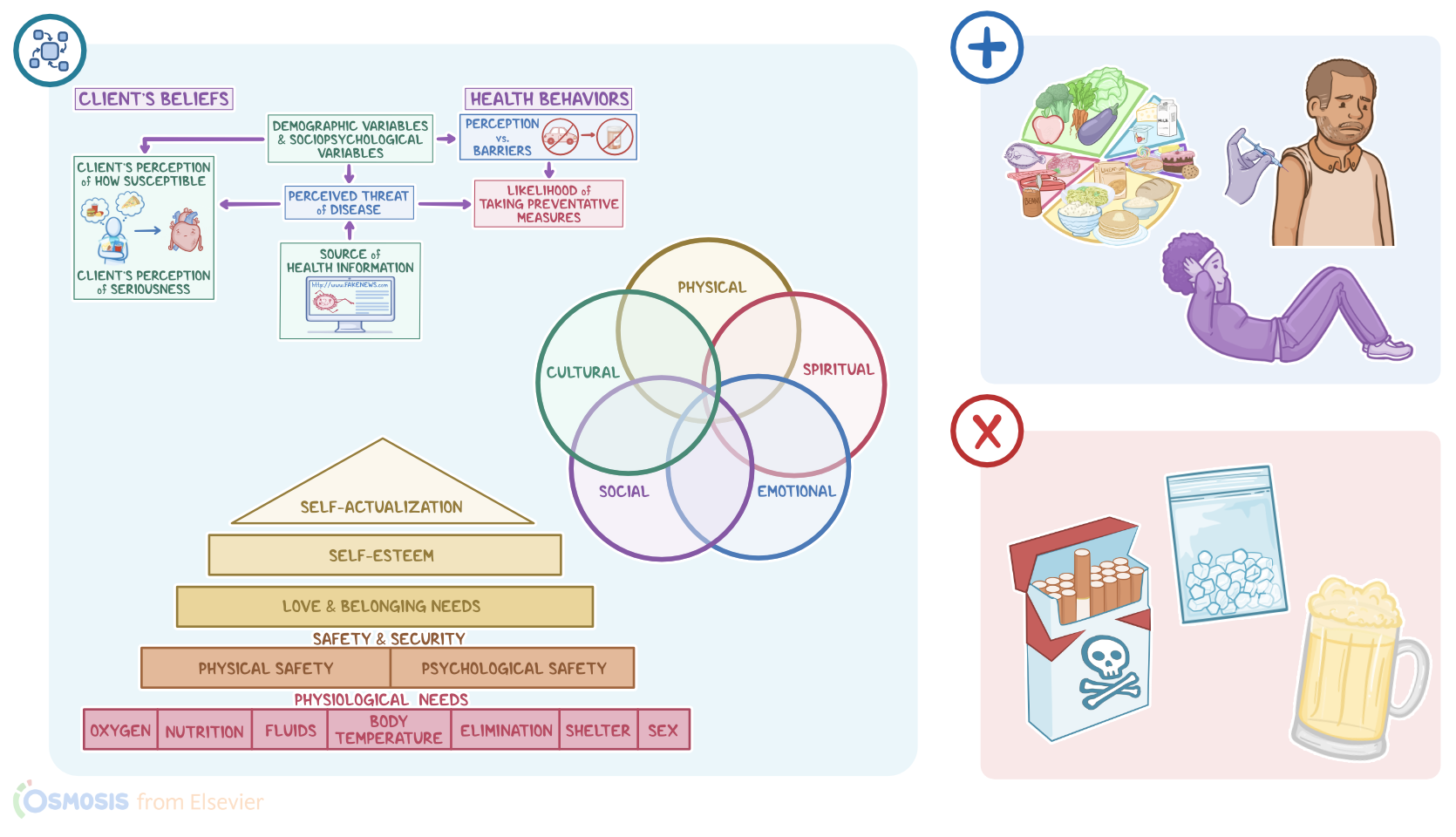
First, the Health Belief Model helps clinicians comprehend the relationship between a client’s beliefs and their health behaviors.
This model looks at a client’s perception of how susceptible they are to an illness, like how much their diet can contribute to developing heart disease; the client’s perception of the seriousness of the illness, which depends on where they get their health information, like through media sources, a medical professional, or advice from family and friends; and lastly, the likelihood that a client will take preventative measures against an illness, which can be affected by their perception of the illness as well as any barriers they may have to taking action.
For example, if a client doesn’t own a vehicle, this could be a barrier to picking up their prescriptions despite the fact that they perceive their illness as serious and preventable.
Next is Maslow’s Hierarchy of Needs which is a model that can help us understand how meeting basic human needs is necessary for survival and well-being.
Maslow organized these needs into a hierarchy with physiological needs, such as oxygen, nutrition, and water (as well as others) at the bottom, and more advanced needs, such as self-esteem and self-actualization, closer to the top.
In most situations, clients must meet the needs at the bottom of the hierarchy before meeting needs higher up, however, every client is unique.
Therefore, when applying this model, care should be focused on the client rather than strict adherence to the hierarchy.
For example, Nurse Bintou has learned that, right now, Helen’s need for self-esteem, love, and belonging have taken priority over her physiological need for pain control.
Then there’s the Holistic Health Model which considers the interactions among the emotional, spiritual, social, cultural, and physical components of a client’s health.
This model recognizes that client’s are at the center of their own care, and by empowering them to engage in their own health behaviors, clinicians can support clients to take responsibility for their own health outcomes.
In conjunction with traditional medical interventions, clients may choose to partake in holistic treatment strategies such as meditation, prayer, or acupuncture.
A nurse using the holistic health model may administer a client’s intravenous medication while having the client apply their own topical essential oils to promote relaxation.
Okay, now you know about some health and illness models that help nurses to better understand their client’s attitudes about their healthcare.
Since a client’s health beliefs influence their healthcare choices, they can negatively or positively impact their health.
The Nurse Role in Health and Illness Models4:29–6:15
Positive health behaviors promote health and prevent illness, such as immunizations, eating healthy, and exercising, whereas negative health behaviors can increase the risk for illness, like smoking, or drug, and alcohol consumption.
In order to empower clients to make positive health decisions, it’s important for you to understand each client’s motivation and values, so you can individualize their care.
Remember that a client is unlikely to take part in a plan of care which goes against their health beliefs, so you should address these beliefs when providing care, and allow clients to make lasting changes in their health and well-being.
Let’s check back in with Nurse Bintou, who has spent time addressing Helen’s needs for self-esteem, love, and belonging.
Nurse Bintou addressed these needs by allowing Helen to express her feelings openly and offering her support and compassion.
Nurse Bintou also requested that the hospital counselor visit Helen the following morning. Nurse Bintou then documents this information in the EHR to update Helen’s plan of care.
Helen says, “Thank you for not making assumptions about how I was feeling. I appreciate you treating me as an individual.” Nurse Bintou responds, “You’re welcome.
Everyone is different and it’s my job to recognize that when providing care.” All right, as a quick recap… Health is a state of complete physical, mental and social well-being which is different for each person based on their values and beliefs; whereas, illness is the subjective experience of physical or mental symptoms which usually accompanies a disease.
Summary6:15–6:58
There are several health and illness models, but the ones that are commonly used in nursing are The Health Belief Model, Maslow’s Hierarchy of Needs, and The Holistic Health Model.
These models allow for nurses to understand their client’s attitudes about their healthcare. Since a client’s health beliefs influence their healthcare choices, they can negatively or positively impact their outcomes.
Therefore, it’s important for the nurse to understand each client’s motivation and values to best individualize their care.
choices they can negatively or positively impact their outcomes Therefore it's important for the nurse to understand each client's
| HEALTH AND ILLNESS MODELS | ||
| KEY POINTS | NOTES | |
| DEFINITION |
| |
| HEALTH AND ILLNESS MODELS |
| |
| NURSING IMPLICATIONS |
| |
No notes for this video yet
Try adding a note below