Health history: Nursing
Introduction0:00–1:09
Collecting a client’s health history provides the nurse with information about their perceived health and factors that can impact their health.
It should be completed as part of a comprehensive client assessment, like upon admission to the hospital, during a medical office visit, or as part of a focused exam.
Typically, the health history includes subjective data, or information the client is experiencing, such as when a client states, “I become nauseous after most meals.” This can guide the nurse to focus the physical assessment on the gastrointestinal system, as well as client education and the plan of care.
Although the client is the preferred source of subjective data, if they’re unable to communicate a secondary data source can be used, such as a family member or caretaker.
In addition, if the client doesn’t speak the same language as the nurse, an institutionally-approved medical interpreter should be used.
Okay, let’s review how to conduct a health history. Now, you’ll want to collect your client’s health history in a private, quiet, and comfortable setting free from environmental distractions or interruptions.
Getting Started1:09–1:33
Also remember that as the nurse, you are responsible for collecting and documenting your client’s health history. And since it involves assessment and nursing judgment, the health history shouldn’t be delegated to another member of the healthcare team, like unlicensed assistive personnel.
Conducting the Health History1:33–3:06
Begin by establishing rapport with your client. You can do this by introducing yourself, including your name and role, and asking them how they would like to be addressed or if they have a preferred nickname.
If there is someone accompanying your client, ask their name and relationship to your client. As you collect data, remember to look at them, and avoid focusing your attention on the electronic health record, or EHR.
This will help avoid the impression that you’re not listening to them or that you are rushed. With each question, allow them the time they need to answer fully, and avoid interrupting them.
If you’re unsure what they mean, take time to seek clarification. You can be mindful of your own professional time constraints, as well; so if they stray from the topic, redirect them or ask questions such as, “Of everything you’ve described, which is your most pressing concern?” Now, keep in mind, there are sensitive issues which may be difficult for your client to discuss, such as sexuality, drug or alcohol consumption, palliative care, or death.
Also, use language that’s understandable to your client rather than technical terms or medical jargon. Lastly, like all components of an assessment, accurate documentation is essential, so take thorough notes and use their exact words in quotation marks when appropriate.
Components of the Health History3:06–7:29
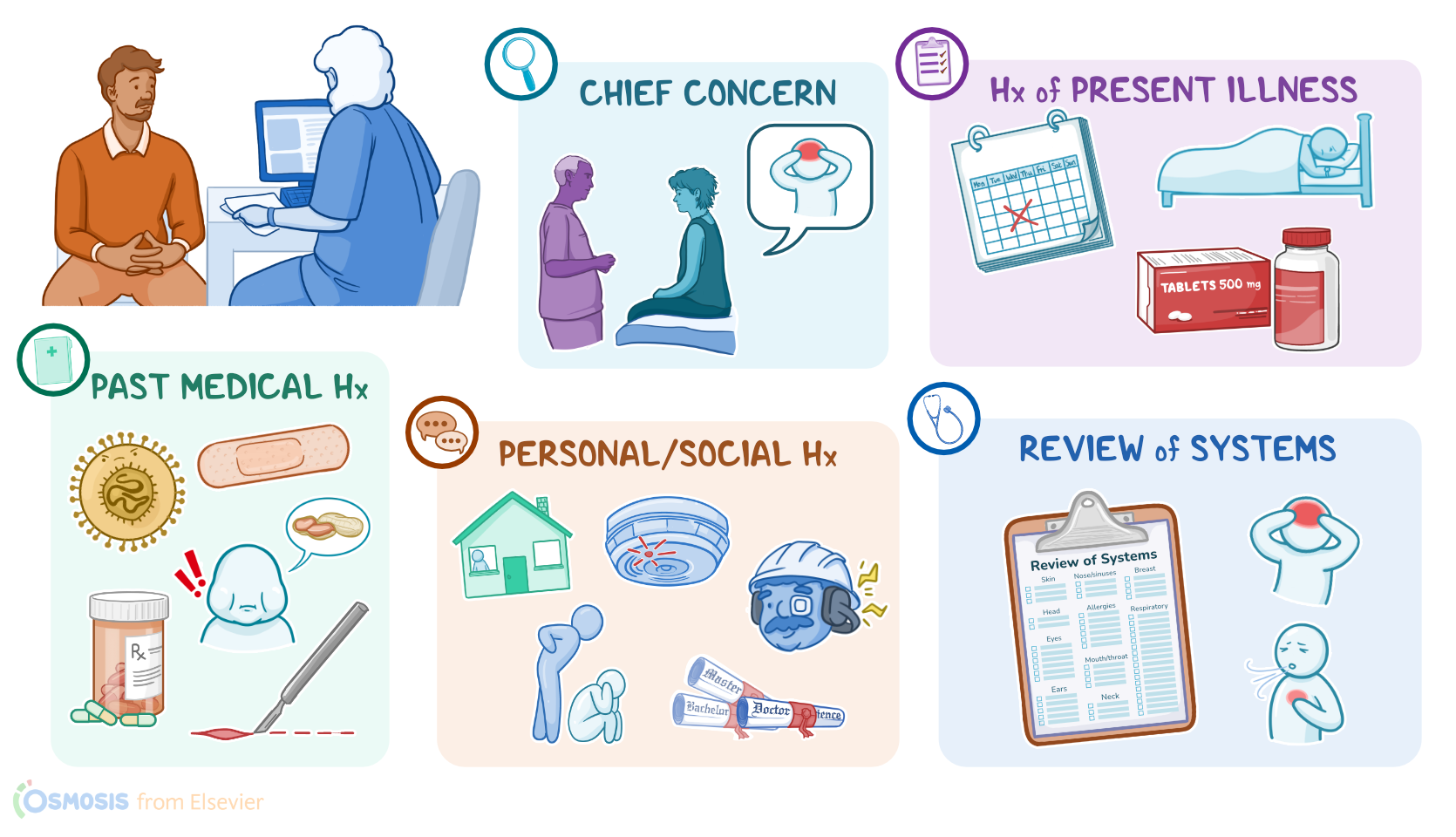
So, there are several components of a health history, including client identifiers, chief concern, history of present illness, past medical history, family history, personal and social history, and the review of systems.Start with identifying your client by asking for their name, date of birth, gender identity, and preferred pronouns.
Next, ask about their chief concern, which is usually a brief sentence about why they are seeking healthcare. For example, they might say “I’m here for my yearly physical” or “I’ve been experiencing abdominal pain for the last week.” The chief concern will lead to the next segment known as the history of present illness, or HPI.
In this portion of the health history, you should ask for information regarding when their symptoms started, characteristics of the symptoms, the impact of the illness on daily life, duration of illness, as well as any treatments they have sought out thus far, such as medications or alternative and complementary treatments such as herbal supplements or acupuncture.
At the end of the HPI, make sure to summarize your client’s concerns with them to ensure you didn’t miss any information.
Next, you’ll obtain your client’s past medical history, or PMH. During this part of the assessment, ask them about any significant childhood and adult illnesses as well as any surgical history.
In addition, ask about immunizations, injuries, current medications, and known allergies. You should also ask about their past procedures, screenings, dental and vision check-ups, and history of blood transfusions.
Then you’ll move to the family history. A thorough family history can provide information about your client’s risk for certain diseases.
One way to document this information is by constructing a three-generation pedigree to trace possible genetic risk factors for disease.
You should ask them about the health and presence of diseases or illnesses of family members, such as parents, children, and siblings as well as grandparents, grandchildren, aunts, uncles, cousins, nieces, and nephews.
The information you gather should also include the cause and age of death of family members when indicated. Next, ask about your client’s personal and social history, which includes information regarding their home environment; education level; occupation; including any occupational hazards; and sources of stress.
Ask about safety issues, including if they have smoke and carbon monoxide detectors installed. Also ask if they feel safe at home or if they experience any abuse.
You should also assess their daily habits, such as diet, exercise, and sleeping patterns, and about the frequency and amount of caffeine, tobacco products, and recreational drug use.
Next, obtain a sexual history by asking about specific sexual practices, number of partners, protection against sexually transmitted infections, or STIs, and mode of birth control if indicated.
Lastly, be sure to include questions about social determinants of health, or SDOH, which are conditions and environments that can impact health like insurance, prescription coverage, food availability, housing, availability of transportation, and employment.
Finally, complete a review of systems, or ROS, which includes the presence or absence of specific issues within each body system.
You can start the ROS asking about general symptoms such as pain, fever, fatigue, and malaise; then move onto specific issues within each body system, and assess for problems like bruising, bleeding, changes in weight.
Keep in mind that you may focus the ROS based on your findings in your client’s chief concern and HPI. For example, if they mention specific issues related to their chest and lungs, you may ask more questions related to those body systems.
All right, as a quick recap…. Collecting a client’s health history provides the nurse with information about their subjective health information prior to completing an objective physical examination.
Review7:29–8:11
The health history should be completed as part of a comprehensive client assessment, like upon admission to the hospital, during a medical office visit, or as part of a focused exam.
There are several components to gather during the health history, such as client identifiers, chief concern, history of present illness, past medical history, family history, personal and social history, and the review of systems.
As the nurse, it’s your responsibility to correctly assess, interpret, report, and document your assessment findings.
| HEALTH HISTORY | ||
| KEY POINTS | NOTES | |
| DEFINITION |
| |
| GETTING STARTED |
| |
| PROCEDURE |
| |
| COMPONENTS |
| |
No notes for this video yet
Try adding a note below