Hemolytic uremic syndrome: Nursing
Hemolytic uremic syndrome, or HUS for short, is a condition characterized by the triad of microangiopathic hemolytic anemia, or breakdown of red blood cells inside small blood vessels, thrombocytopenia, or low platelets, and acute kidney injury.
Alright, now first, let’s quickly review the physiology behind hemostasis or clotting. Hemostasis starts as a response to an injury of the endothelium, which is the inner lining of blood vessels, and it can be divided into primary and secondary hemostasis. In primary hemostasis, platelets form a “plug” at the site of the damaged blood vessel to stop the bleeding. In secondary hemostasis, proteins called coagulation factors start to activate each other eventually leading to formation of a fibrin mesh around the platelet plug to stabilize it.
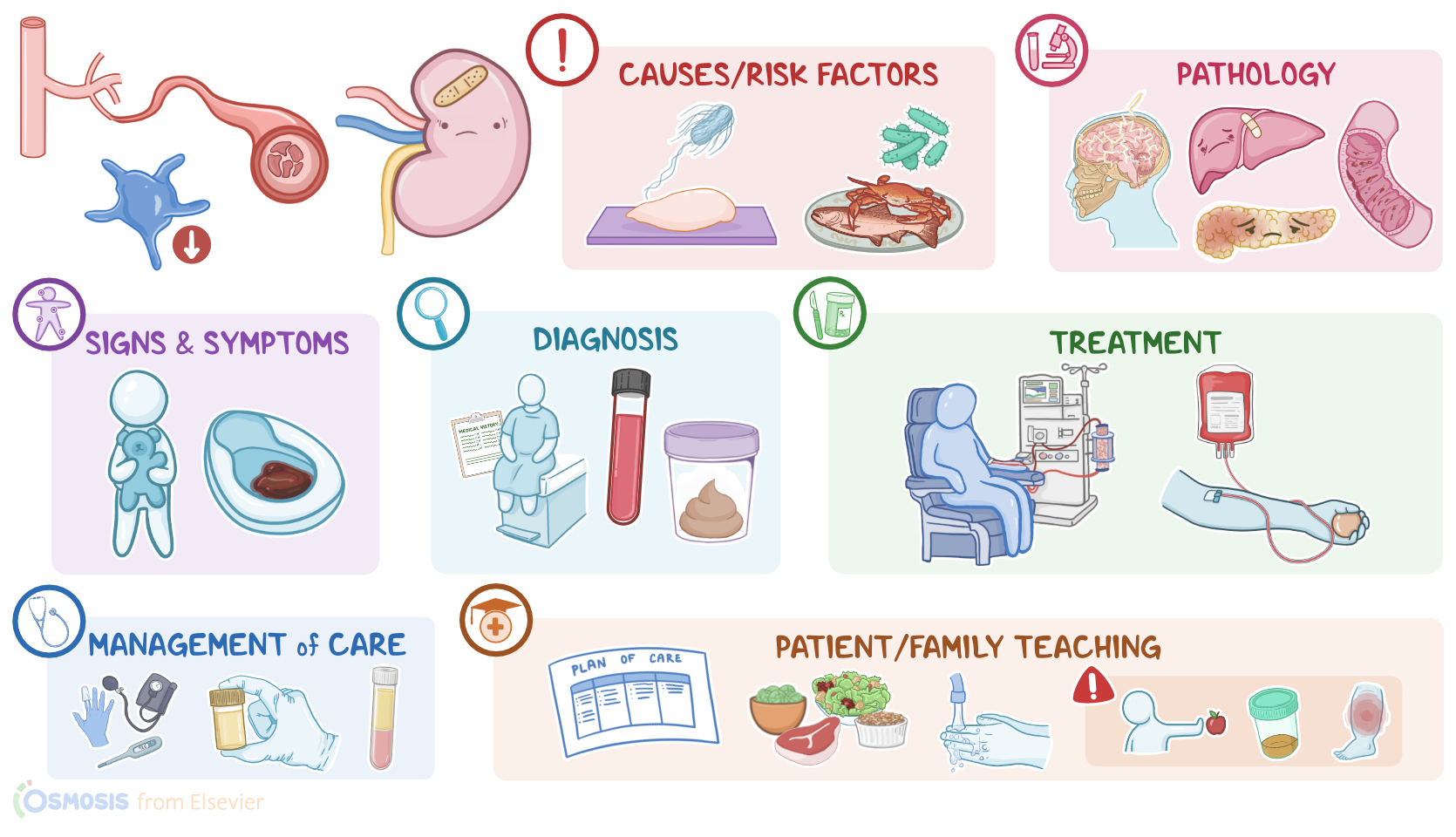
Now, the causes of HUS vary, so it can be classified as typical or atypical. Typical HUS is caused by bacterial toxins, including Shiga-like toxin which is produced by some strains of Escherichia coli, most commonly enterohemorrhagic E. coli or EHEC, serotype O157:H7, and Shiga toxin which is secreted by Shigella dysenteriae. These bacteria typically affect children, who become infected through contaminated food or drink, like contaminated beef, raw leafy vegetables, or unpasteurized milk from an infected cow; or by swimming in pools or lakes contaminated with feces. Rarely, typical HUS may also be caused by other bacteria, such as Streptococcus pneumoniae.
On the other hand, atypical HUS is typically non-infectious. It is caused by dysregulation of the complement system, which is part of the immune system, and can be genetic or acquired. The main risk factors for atypical HUS are being above 65 years of age, or having a weakened immune system.
| HEMOLYTIC UREMIC SYNDROME | ||
| KEY POINTS | NOTES | |
| DEFINITION |
| |
| PHYSIOLOGY |
| |
| CAUSES AND RISK FACTORS |
| |
| PATHOPHYSIOLOGY |
| |
| SIGNS AND SYMPTOMS |
| |
| DIAGNOSIS |
| |
| TREATMENT |
| |
| MANAGEMENT OF CARE |
| |
| PATIENT AND FAMILY TEACHING |
| |
No notes for this video yet
Try adding a note below