Herpes simplex virus (HSV): Nursing
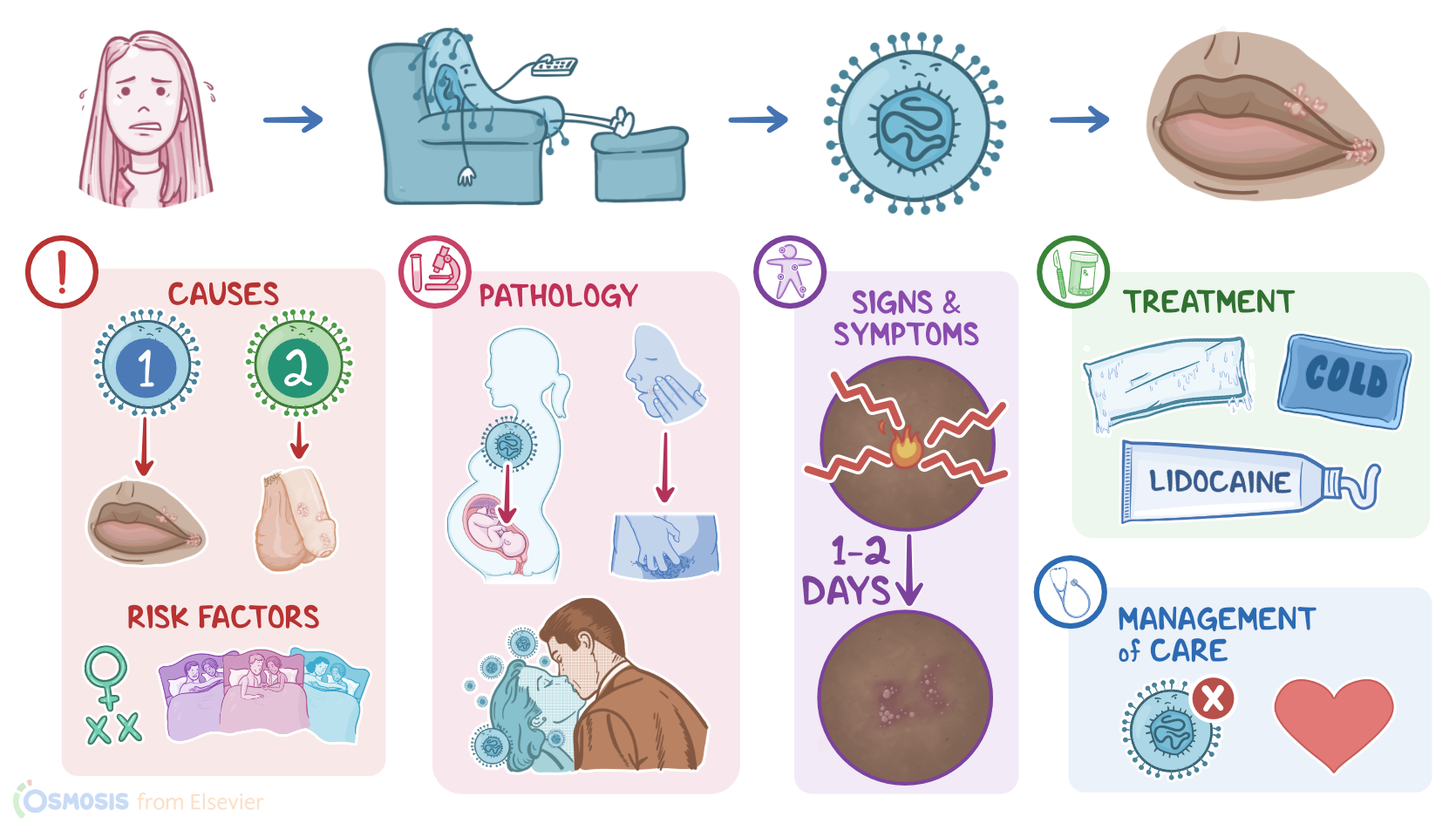
Herpes simplex is a highly contagious infection caused by herpes simplex viruses. There are two types of herpes simplex virus. Herpes simplex virus 1, HSV-1, tends to cause infections above the waist, typically affects the lips, and that’s called herpes labialis; while HSV-2 tends to cause infections below the waist, involving the genitals, and that’s herpes genitalis.
During the primary infection, both types also infect nearby sensory neurons and travel up their axon to sensory ganglia where they can lay dormant for life causing recurrent infections from time to time.
Okay first, let’s quickly review the physiology of the nervous system. The central nervous system consists of the brain and spinal cord, while the peripheral nervous system includes all the nerves that connect the central nervous system to the skin, muscles, and other organs.
Cranial nerves are peripheral nerves that originate from the brain, and they’re mostly in charge of motor and sensory innervation of the head and neck.
A specific cranial nerve, cranial nerve V, is the trigeminal nerve and it’s responsible for the sensation in the face. Its sensory neurons create a nerve cell cluster called the trigeminal ganglion, located in the bones on the side of the face between the eyes and ears.
On the flip side, the peripheral nerves that originate from the spinal cord are called the spinal nerves.
Each nerve is formed by a dorsal root that contains sensory information, like touch, temperature, pain, and pressure from the skin and other tissues, and a ventral root that contains neurons that carry motor innervation from the spinal cord to the muscles.
| HERPES SIMPLEX VIRUS | ||
| KEY POINTS | NOTES | |
| DEFINITION |
| |
| PHYSIOLOGY |
| |
| CAUSES AND RISK FACTORS |
| |
| PATHOPHYSIOLOGY |
| |
| SIGNS AND SYMPTOMS |
| |
| DIAGNOSIS |
| |
| TREATMENT |
| |
| MANAGEMENT OF CARE |
| |
| PATIENT AND FAMILY TEACHING |
| |
No notes for this video yet
Try adding a note below