Immobility - Positioning and alignment: Nursing skills
A client’s position refers to how their body is situated. For a nurse, it’s important to know what position promotes comfort and recovery. Furthermore, a variety of special positions are needed for people with specific conditions, undergoing certain procedures, or doing certain activities. Nurses need to know these positions and when they’re used. In certain situations, you might need to position the client in a certain way to prepare for a procedure or to help them recover from one. You can also use positioning to help encourage client comfort or reduce pain.
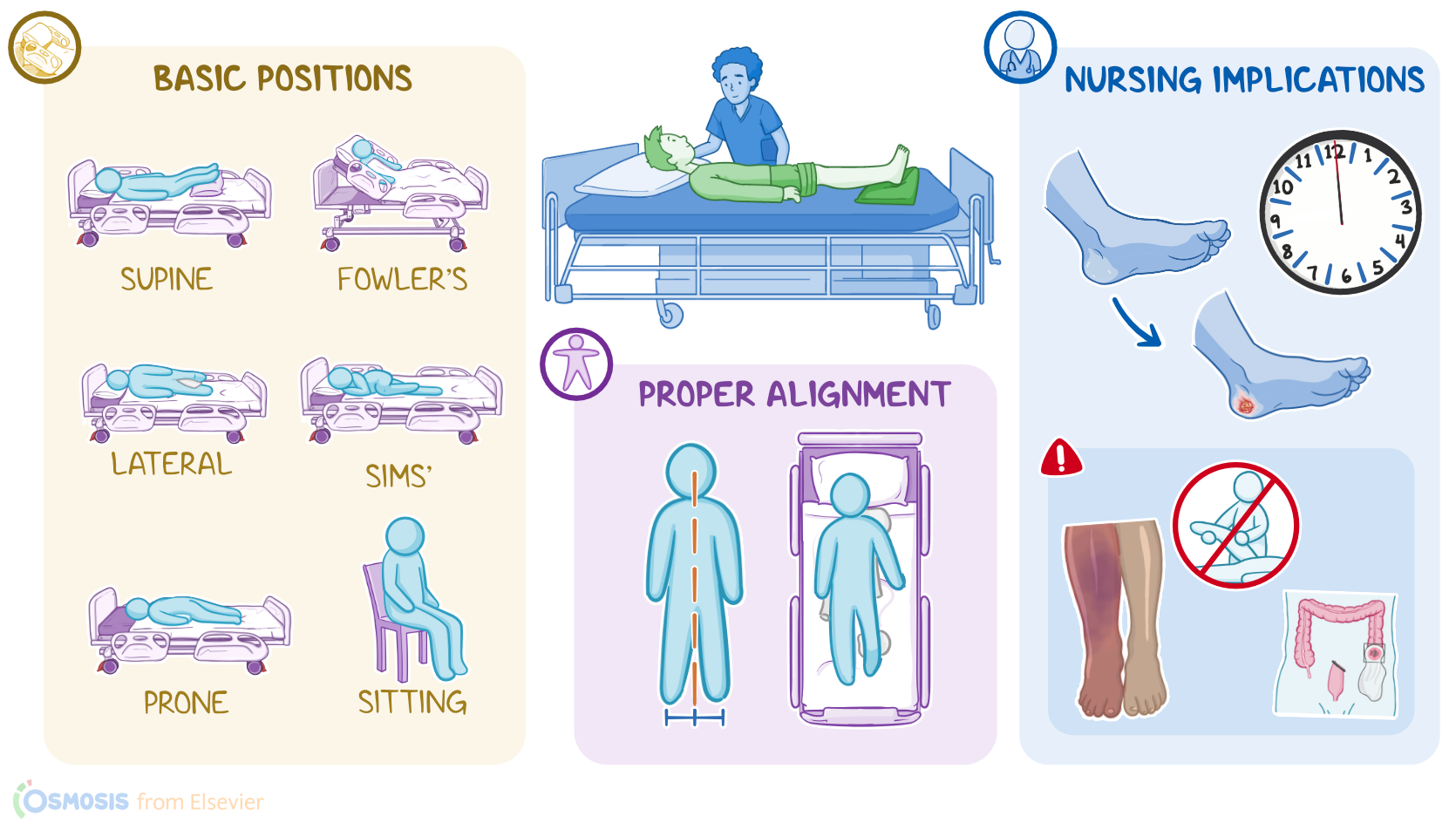
Supine position, or the dorsal recumbent position, is where a person is lying on their back on a flat bed with a pillow under their head, and another pillow can be placed under the calves to prevent pressure injuries on the heels.Next is Fowler’s position this is the same as the supine position, except the head of the bed is elevated. Fowler's is 45-60 degrees; low Fowler’s, or semi Fowler’s, is 30-45 degrees; and high Fowler’s is 60-90 degrees. A pillow can be placed under the calves for support and comfort. The semi Fowler’s position is great if they want to watch TV or read. It’s also helpful if they have difficulty breathing in the supine position; if they have a feeding tube; or if they have gastroesophageal reflux disease, or GERD. The high Fowler’s is useful when the person is eating because it prevents choking.
Let’s move on to the lateral position, where the client is lying on their side. The left lateral position is when the client’s lying on their left side, while right lateral is the opposite. A pillow can be placed behind the back and under the arm and leg that are on top. This position is great for people with back pains because the back isn’t pressed into the bed for long periods of time. It’s also preferred for people in body casts. So, a modified version of the lateral position is the Sims’ position, or lateral recumbent position. Here, they are on their side, but rotated, so they’re almost on their stomach or in the prone position. So let’s say they’re lying on their left side, their head is facing the right side of the body, the left arm is behind the back, the left leg can be straight or slightly bent while the right leg is sharply bent and the right arm is bent and rests palm down by the face.
This position is used for rectal exams and for administering enemas. It’s also good for preventing pressure injuries on the sides of the hips and tailbone region. Now, the prone position is when the person is lying on their stomach, and their head is facing left or right. This position helps the lungs expand and improve oxygenation, so it’s used for certain types of ventilation. This position, however, is not comfortable for prolonged periods of time. For comfort, a pillow can be placed under the feet and another one under the abdomen to give the lungs enough room to expand during breathing. Appropriate sitting position is when the lower back and buttocks are touching the back of the seat, the knees are bent 90 degrees and away from the edge of the seat, and the feet are flat on the floor or footrest if they’re in a wheelchair. A person who can’t maintain this posture might need a postural support device. A pillow can be placed behind the lower back for comfort but do not do this if they are restrained.
| IMMOBILITY - POSITIONING AND ALIGNMENT | ||
| KEY POINTS | NOTES | |
| DEFINITION |
| |
| BASIC POSITIONS |
| |
| PROPER ALIGNMENT |
| |
| NURSING IMPLICATIONS |
| |
No notes for this video yet
Try adding a note below