Laryngeal cancer: Nursing
Introduction0:00–0:11
Laryngeal cancer is a malignant tumor that originates from the larynx, which is the part of the throat used for swallowing and talking.
Physiology0:11–1:17
Now, the larynx can be divided into three main parts. The upper part, or the supraglottis, is located below the base of the tongue and includes the epiglottis, which closes off during swallowing, preventing food and liquids from entering the airway.
Next is the middle part, or glottis, which contains the vocal cords. When these are closed, air pressure builds up below them, causing them to vibrate and produce sound when we speak.
Finally, the lower part, or subglottis, extends between the vocal cords and the start of the trachea. Now, the larynx is lined with a stratified squamous epithelium which then transitions into a pseudostratified ciliated columnar epithelium.
This contains goblet cells, which produce mucus to trap small foreign particles; as well as columnar cells, which have cilia, or tiny little hair-like projections that move mucus up the respiratory tract so it can be coughed out.
All right, now, laryngeal cancer occurs when any of these epithelial cells acquire mutations, which can arise due to a variety of risk factors.
Causes & risk factors1:17–2:04
Modifiable risk factors include exposure to irritants, such as tobacco smoke, alcohol, asbestos, coal dust, and ionizing radiation.
Other modifiable risk factors include obesity, infection with human papillomavirus, or HPV, as well as a history of gastrointestinal reflux disease, where acid from the stomach goes all the way up the esophagus into the pharynx.
From there, the acid can contact and irritate the larynx. As for non-modifiable factors, few clients with a family history of laryngeal cancer are genetically predisposed to develop this type of cancer even without the presence of environmental risk factors.So, chronic exposure to irritants can cause the normal columnar cells to undergo dysplasia, or abnormal growth.
Pathology2:04–2:49
Depending on how much of the epithelium is affected by dysplasia, it can be divided into three grades. The higher the grade, the more likely the lesion will evolve into cancer.
Eventually, if the irritation persists, dysplasia can evolve into carcinoma in situ, which affects the entire thickness of the epithelium.
Finally, carcinoma in situ can progress to invasive laryngeal carcinoma, which is when cancerous cells break through the epithelial basement membrane into the underlying stroma, and may even spread to nearby lymph nodes or metastasize to distant organs, such as the lung, bones or liver.All right, now the main signs and symptoms of laryngeal cancer include persistent voice hoarseness, sore throat, and dysphagia, because the mass may compress the esophagus, which can also lead to unintentional weight loss.
Clinical manifestations2:49–3:17
Clients may also complain of pain or ringing in the ears, feeling a lump in the throat and hemoptysis. In late stages, the tumor can obstruct the airway, causing shortness of breath or impossible breathing altogether, which requires an emergency tracheostomy.Now, the diagnosis of laryngeal cancer involves the client's history and physical assessment, followed by laryngoscopy to visualize the tumor.
Diagnosis3:17–3:51
CT, or MRI scans of the larynx and the surrounding tissues can be used to stage the tumor in the TNM system, where T stands for tumor location and local spread; N stands for lymph node involvement; and M for whether or not the tumor has metastasized.
Once a suspicious lesion is found on imaging, a biopsy is needed to confirm the diagnosis.Treatment of laryngeal cancer depends on the size of the tumor and how much it has spread.
Treatment3:51–4:27
There are various types of surgical interventions that can be done, including vocal cord resection, and partial or total laryngectomy.
In addition to surgery, clients could be treated with chemotherapy, immunotherapy, or radiotherapy. Also, any involved nearby lymph nodes should be resected.
Finally, if part or all of the larynx has been surgically removed, voice rehabilitation therapy or some devices, like an electrolarynx or a pneumatic larynx, can be used to facilitate communication.
Management and care4:27–7:51
All right, let’s look at the nursing care you’ll provide for a client with laryngeal cancer. Priority goals include maintaining a patent airway, ensuring adequate nutritional intake, providing postoperative care, and providing comfort and emotional support to promote quality of life.
First, assess your client’s vital signs and oxygen saturation, as well as their respiratory status. If your assessment reveals any indications of respiratory distress, such as dyspnea or a decreased oxygen saturation, report these findings to the healthcare provider.
Assist them into a high Fowler position and administer supplemental oxygen. Then, assess their pain level including quality, location, severity, and timing, as well as relieving and provoking factors.
Assist your client into a comfortable position, provide comfort measures, and administer analgesic medications as prescribed.Next, perform a nutritional assessment by noting your client’s current weight, swallowing pattern, gag and cough reflexes.
Immediately report to the healthcare provider if your client experiences coughing, signs of aspiration, shortness of breath, or chest discomfort.
Now, if you are caring for a client after a vocal cord resection or partial or total laryngectomy, implement routine post-operative interventions, and monitor them closely for complications related to the procedure.
Be sure to monitor their respiratory status, and ensure they have a patent airway and adequate oxygenation. Position your client in a semi-Fowler position and encourage them to cough, deep breathe, and use their incentive spirometer while awake.
If your client has a tracheostomy in place, provide frequent suctioning and tracheostomy care, and ensure your client has adequate fluid intake by administering ordered IV fluids.
Also, be sure emergency tracheostomy supplies and a resuscitation bag are available at the bedside and report to the healthcare provider immediately if your client shows symptoms of respiratory distress.
If your client is receiving postoperative radiation therapy, assess your client for pain related to sores in the mouth and throat, decreased salivation, and dry mouth.
Provide gentle oral care and administer the prescribed analgesics. Finally, be sure to assess your client’s psychosocial needs, such as anxiety, depression, and changes in self-perception as they adjust to speech changes, as well as changes to how they eat.
Ask them about their expectations for treatment, and encourage them to discuss their concerns. Coordinate care with the case manager and social worker for voice rehabilitation services or planning for an electrolarynx or pneumatic larynx device to facilitate communication.
Immediately report if your client exhibits signs of depression or suicidal ideation, and be sure to refer them to counseling services as needed.All right, moving onto client and family teaching.
General client and family teaching7:51–9:36
Begin by reviewing their diagnosis, treatments, and plan of care. Review communication strategies such as an erasable whiteboard, picture board, tablets, or other electronic devices, as well as a pen and paper; and remind them to keep their appointments for voice rehabilitation.Next, talk to them about the importance of maintaining adequate nutrition.
Encourage them to consume small and frequent meals that are rich in protein and easy to swallow, such as soups, puddings, well-cooked vegetables, and protein shakes.
Remind them to avoid foods that can irritate their mouth and throat, such as alcoholic beverages, acidic fruits and juices, or spicy foods.
Ensure a referral for swallowing therapy and nutritional counseling is in place to support their unique nutritional needs.Also, remind them that their treatments can cause decreased saliva production that can put them at risk for tooth decay.
Emphasize the importance of staying well-hydrated, rinsing their mouth as directed with the prescribed mouth rinse, paying close attention to dental hygiene, and keeping their appointments with their dentist to maintain dental health.Finally, emphasize the importance of keeping their follow-up appointments for ongoing monitoring.
Refer them to counseling for smoking cessation as needed, and provide them with community resources and support groups. Instruct them to immediately contact their healthcare provider if they experience any new symptoms such increased pain, trouble swallowing, new sores in their oral cavity, fever, or changes in their mental status; and to seek immediate emergency care if they experience swelling in their throat and trouble breathing.All right, as a quick recap….
Review9:36–10:46
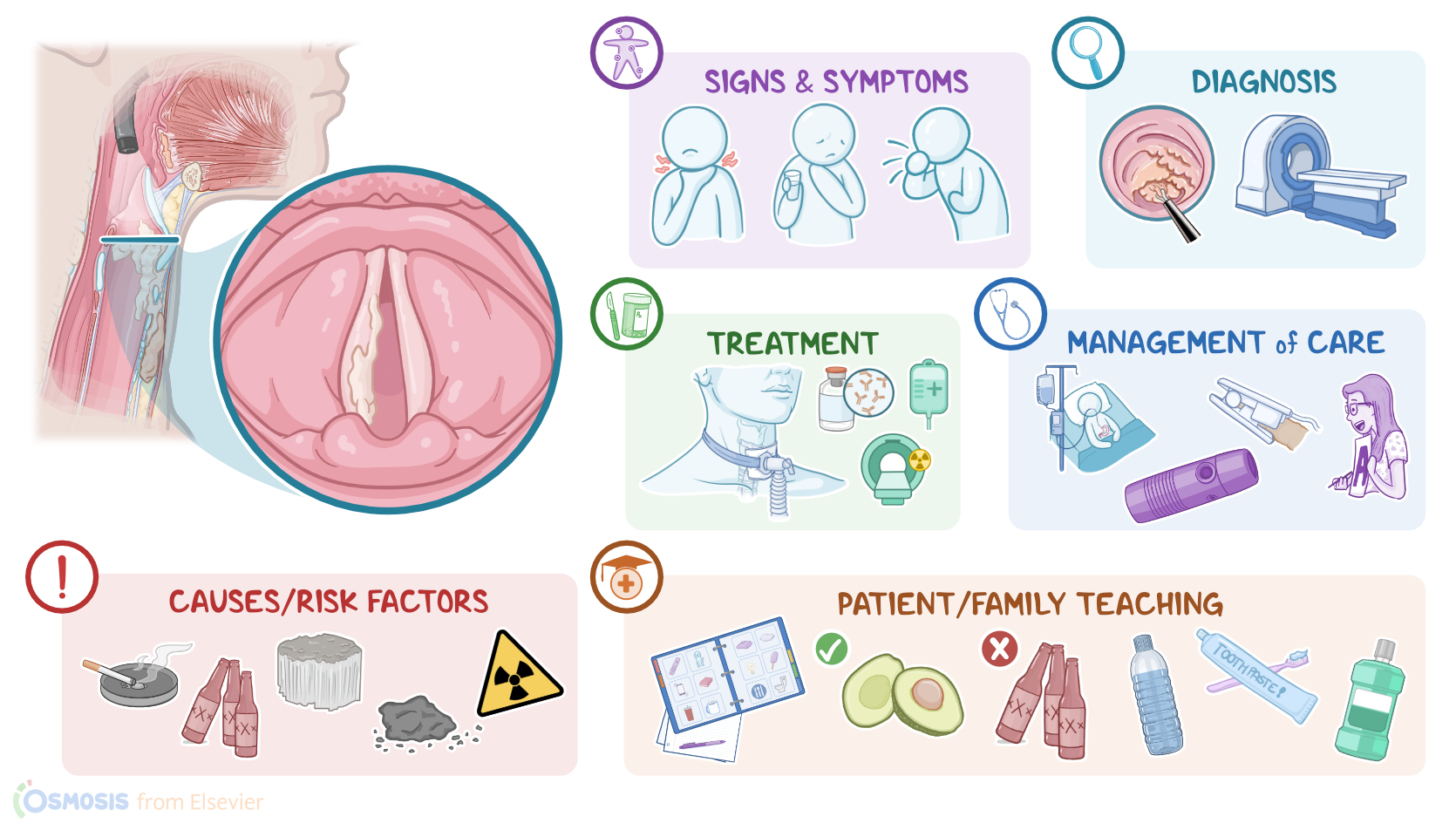
Laryngeal cancer is a malignant tumor in the larynx. Risk factors include tobacco smoke, alcohol, coal dust, asbestos, ionizing radiation, HPV, gastrointestinal reflux disease, and family history of laryngeal cancer.
Clinical manifestations include persistent voice hoarseness, sore throat, dysphagia, unintentional weight loss, pain or ringing in the ears, feeling a lump in the throat, and hemoptysis.
Diagnosis involves performing a history and physical assessment, laryngoscopy, CT or MRI as well as a biopsy to confirm the diagnosis.
Treatment options depend on the size and extent of the cancer and can include surgical intervention, chemotherapy, immunotherapy, and radiotherapy.
Priority goals of nursing care include maintaining a patent airway, ensuring adequate nutritional intake, providing postoperative care, and providing comfort and emotional support to promote quality of life.
Client teaching is focused on communication strategies, self-care after treatment, and when to contact the healthcare
| LARYNGEAL CANCER | ||
| KEY POINTS | NOTES | |
| DEFINITION |
| |
| PHYSIOLOGY |
| |
| CAUSES AND RISK FACTORS |
| |
| PATHOPHYSIOLOGY |
| |
| SIGNS AND SYMPTOMS |
| |
| DIAGNOSIS |
| |
| TREATMENT |
| |
| MANAGEMENT OF CARE |
| |
| PATIENT AND FAMILY TEACHING |
| |
No notes for this video yet
Try adding a note below