Legal issues: Nursing
Introduction0:00–0:37
Defining Common Legal Terms in Healthcare0:37–1:35
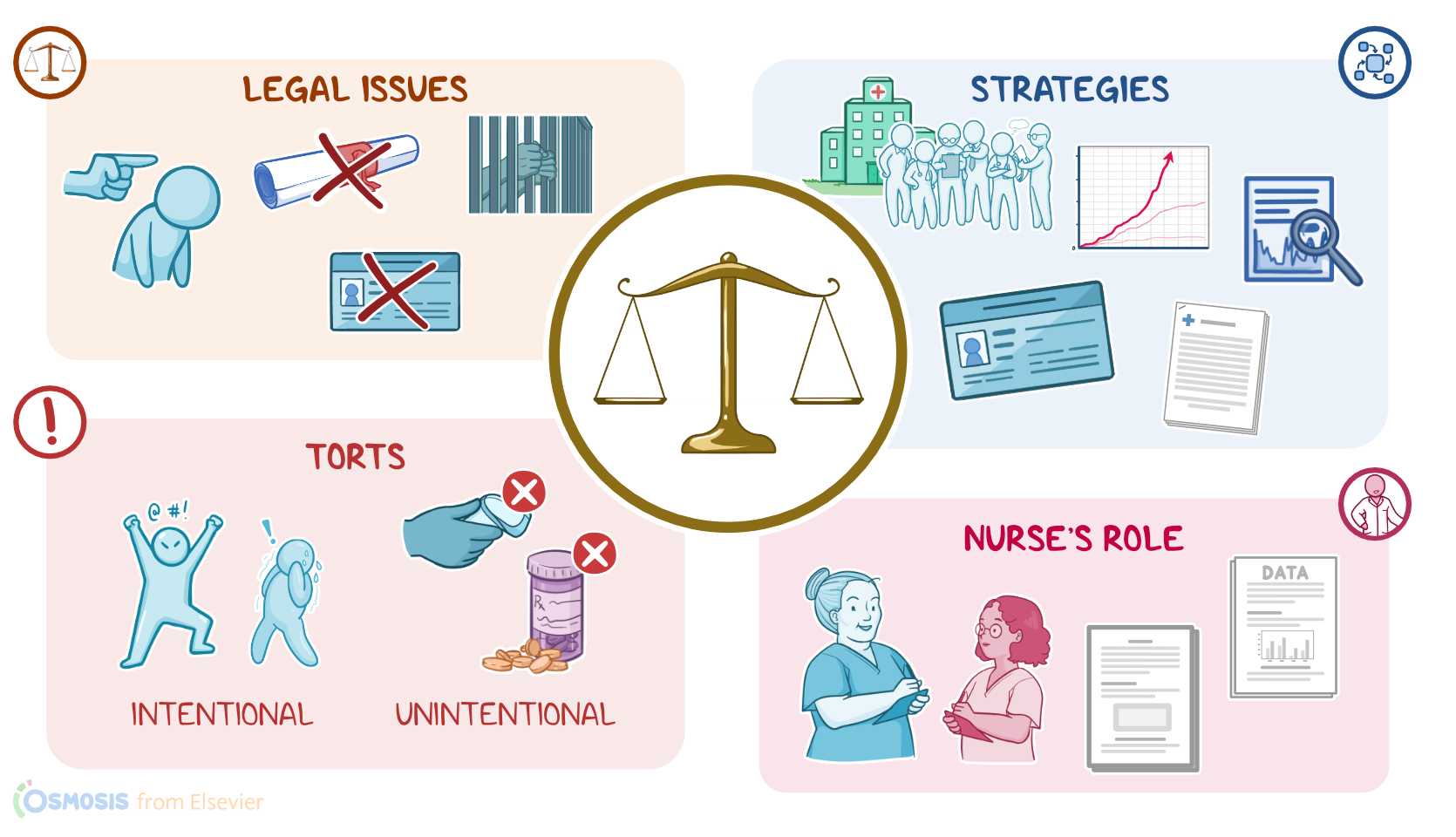
It is important to understand the legal issues that nurses can face in order to avoid potential consequences like disciplinary action by your employer, loss of credentials or certification, loss of your nursing license, and even criminal charges or jail time.
To recognize legal issues in nursing, it is important to appreciate how legal terms, like liability and tort, guide professional nursing practice.
Liability means that someone is responsible for some wrongdoing according to the law. Another important term is tort, which is a wrongful act or omission against another person or their property that causes injury or harm.
Alright, torts can be classified as intentional or unintentional. Intentional torts are deliberate acts against a person or their property that cause harm, such as battery or assault.
Different Types of Torts1:35–4:15
Battery is when a person physically harms another person, like a slap or kick, and assault is when a person threatens to hurt another person causing fear.
An intentional tort can also occur if there is a lack of informed consent for procedures. Nurses often act as a witness when a healthcare provider obtains informed consent for a client procedure, like surgery.
When a nurse signs for informed consent, they are vouching that the client was mentally capable of giving voluntary consent.
Failure to obtain consent for invasive procedures, other than in emergencies, can result in a claim of battery since the clinician purposely denies the client the right to decide what is done to their body.On the other hand, unintentional torts are acts that inadvertently cause a person or their property harm and are the most common type of tort in nursing.
Typical causes of unintentional torts are negligence and malpractice. So negligence occurs when there is an unintended breach of duty that caused harm to another person, even if the person causing harm did not mean to.
One specific type of negligence is malpractice, which occurs when a healthcare professional fails to uphold standards of care.
For nurses, standards of care come from the individual states’ Nurse Practice Acts, the healthcare facility policies and procedures, and professional nursing organizations.
In Nurse Brynn’s case, if she harms a client by administering the incorrect medication, she would be liable for malpractice because she’s a professional who failed to follow the facility’s standard of care by not scanning the designated barcodes.
One of the most common ways this can happen is when a nurse fails to provide the client’s bedside handoff report at the end of a shift.
This nurse will be responsible for any injuries the client suffers. One more example of malpractice is improper delegation, which can happen if a nurse delegates a task to another staff member that violates one or more of the 5 rights of delegation: right task, right circumstance, right person, right supervision, and right communication.
So a nurse could be liable for malpractice if they delegated an IV insertion to a nursing student but the facility doesn’t allow nursing students to perform IV insertions.
Now, there are some common strategies that healthcare facilities and nurses in particular use to reduce legal risk. For healthcare facilities, a risk management team can help reduce legal risks.
Strategies to Reduce Legal Risk4:15–6:25
Risk managers aim to reduce a hospital and its staffs’ liability by working together with clinicians to monitor for potential policy or procedure compliance issues.
One way to do this is through incident reporting, which is a voluntary process to gather information from clinicians about client safety occurrences.
Another way to help nurses avoid legal liability is to keep up-to-date with the newest standards of care and following the facility’s policies and procedures.
Next, nurses should understand their strengths and weaknesses and ask for assistance when completing tasks or procedures that they are not familiar with.
It’s also important for nurses to obtain very clear orders and never treat a client without an order, and always practice within the scope of their license.
To become even more knowledgeable and involved, a nurse can join professional nursing organizations and committees to learn about current legal issues in healthcare.
The risk manager is able to collect data from all of the incident reports on medication administration and the medication scanning system.
By using this data, along with suggestions from the staff nurses, the team alters the medication scanning system to make it faster and easier to use.
In addition, the nurse educators hold training sessions on each of the units to emphasize the importance of the scanning system to ensure client safety.
Review6:25–7:05
The most frequent source of legal liability for nurses are torts, which can be classified as intentional, like assault or battery; or unintentional, like negligence or malpractice.
In order to reduce risk of legal liability, many healthcare facilities use risk management programs, which include incident reporting.
Nurses can reduce their legal risks by knowing and following the standards of care, asking for help with new and unfamiliar tasks, obtaining clear orders, and practicing within the scope of
| LEGAL ISSUES | ||
| KEY POINTS | NOTES | |
| INTRODUCTION |
| |
| DEFINITIONS |
| |
| TYPES OF TORTS |
| |
| STRATEGIES TO REDUCE LEGAL RISK |
| |
No notes for this video yet
Try adding a note below