Managing change: Nursing
Introduction0:00–0:49
Nurse Jack is the manager of an outpatient surgical clinic. This clinic has just announced that some traditional telephone communication between healthcare team members will now take place through an instant messenger application on the computer.
Nurse Manager Jack recognizes that there is some resistance within the nursing staff about this change so he speaks to the unit charge nurse, Nurse Taylor.
Nurse Manager Jack says, “The other staff nurses respect your opinion, so I’m wondering if you can assist with the transition by adopting the change to act as an example for the rest of the staff.” Nurse Taylor responds, “I know that instant telehealth communication between clinicians can improve continuity of care and client safety; I’d be happy to help!” Nurse Manager Jack and Nurse Taylor will work together with the other staff nurses to manage this change.
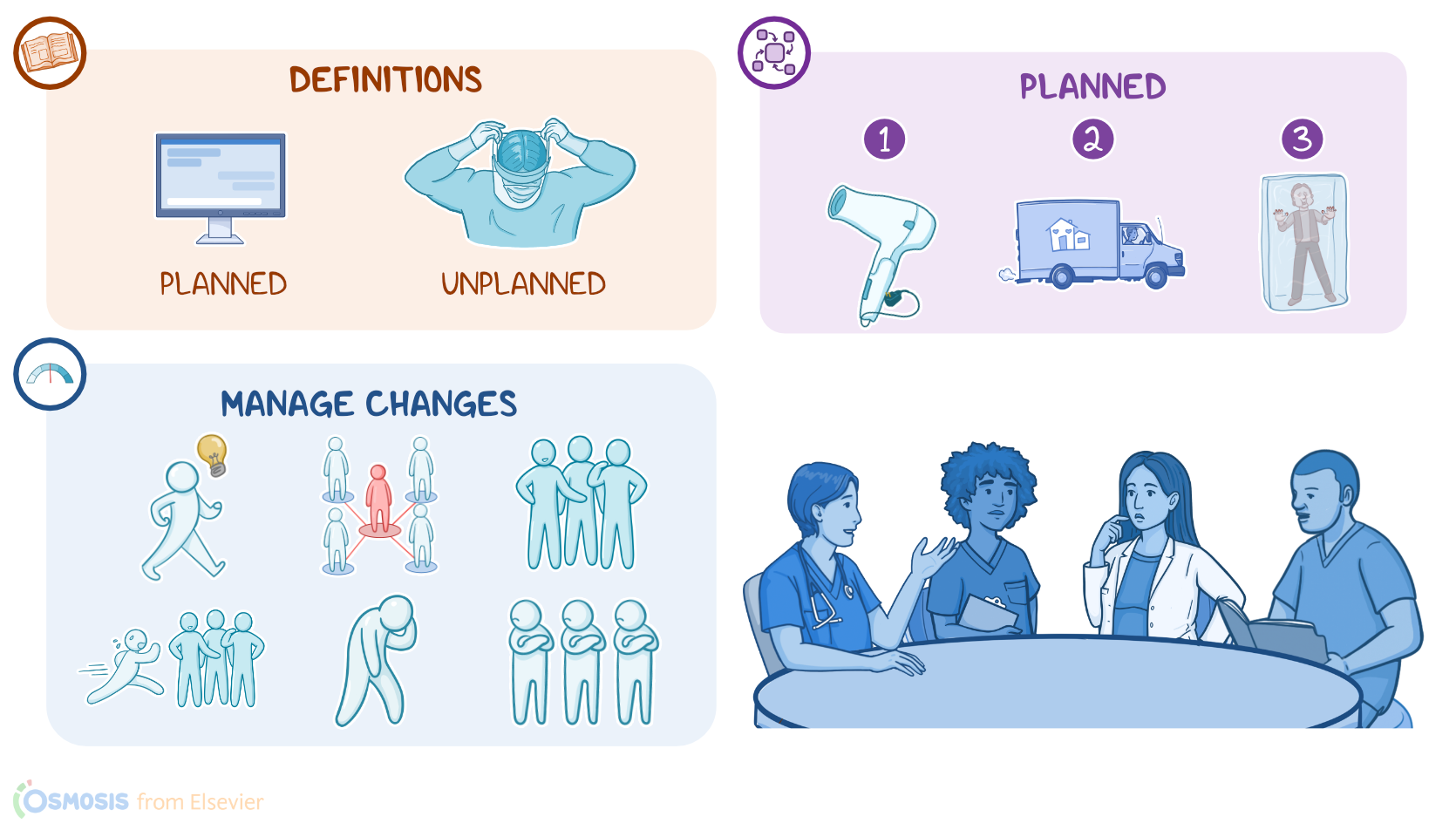
Change is a complex process that involves making an alteration or modification to something that already exists. Change can be planned or unplanned, also known as first order and second order change, respectively.
Different Types of Change0:49–1:31
Planned, or first order change, is a deliberate and organized process which has the goal of making improvements over time, such as transitioning to an instant messaging communication system.
On the other hand, unplanned, or second order change, is usually unanticipated. This type of change involves completely disrupting how things are normally done in order to adapt quickly to developing situations.
An example of this is when healthcare facilities had to quickly implement COVID-19 precautions during the onset of the pandemic.
Okay, so whether a change is planned or unplanned, it’s important to understand the change process so change can be effectively managed.
The Process of Change1:31–2:47
One way to approach planned change is to break it into 3 stages: unfreezing, moving, and refreezing. Just as you would defrost a frozen meal before cooking it, change must go through the initial step of unfreezing, which is when individuals warm up to the idea that change is needed.
Now, the most important thing during the unfreezing step is effective communication and creating motivation; so, Nurse Manager Jack completes this step by helping his staff understand the problems caused by traditional telephone communication and announcing the switch to the instant messaging application during unit huddles.
He also placed informative fliers in the unit breakroom about the benefits of the instant messenger application. The next step is moving, which involves the implementation of change.
This is generally the hardest step to overcome as individuals because effort is needed to learn new behaviors and ways of thinking.
Nurse Taylor assists in this step by demonstrating how to use the messaging application with the staff and then guiding them as they complete it on their own.
The last step of planned change is refreezing, which is when the new changes are integrated into the culture of the clinic and become the norm in everyday practice.In order to manage change, it’s important to recognize that every person has a different response to change.
Response to Change2:47–3:30
Innovators are those who enjoy change and thrive on it. These will typically be the very first people to adopt the change.
Early adopters adopt change quickly and are respected by their peers so they should be sought out for advice and insight about changes, like Nurse Taylor.
Early majority describes those who prefer the old way of doing things, but will eventually accept change, whereas those in the late majority openly oppose the change but will accept it once others have accepted it first.
Lastly, laggards work to keep old ways of doing things by resisting the change, while rejectors actively oppose the change and do their best to sabotage the process altogether.
So, regardless of an individual's responses to change, the change process affects everyone involved by shifting established roles and responsibilities.
Managing Change3:30–5:00
One person integral to the change is the change leader, who is a formal leader who uses strategies to manage change. Nurse Manager Jack is the change leader for adopting the communication application.To be successful in guiding change, change leaders must be proactive in initiating change and be compassionate with others since change can be difficult.
Next, they should be willing to look inward to transform their own mindset before leading others. The change leader should also listen to staff members' feedback and provide reinforcement for those who need additional support during this process.
Nurse Manager Jack acts as a change leader by holding focus groups where the staff nurses can ask questions and offer suggestions about the new instant messaging communication process.
He also works with Nurse Taylor and the Nurse Educator to reinforce teaching on this topic. Another person who is integral to the change process is the change agent, which is an informal leader who encourages and facilitates change, like Nurse Taylor.
Effective change agents are creative thinkers who are committed to quality improvement and go beyond their role to ensure the change occurs successfully.
Change agents demonstrate empathy, humor, and respect to support those involved in the change process. Nurse Taylor acts as a change agent by stepping outside of her charge nurse role to educate the other nurses on using the instant messaging system and provide feedback to assist them in adjusting to the change.
Alright, as a quick recap…. Managing change is a responsibility for all nurses since the healthcare environment is constantly undergoing planned and unplanned changes.
Review5:00–5:32
Planned, or first order change, can occur in three main steps, unfreezing, moving, and refreezing. The nurse should consider that there are common players in the change process who can act as facilitators, such as innovators and early adopters, or act as barriers, such as laggards and rejectors.
Change agents and change leaders are individuals who are essential to the change process by using strategies
| MANAGING CHANGE | ||
| KEY POINTS | NOTES | |
| INTRODUCTION |
| |
| TYPES OF CHANGE |
| |
| PROCESS OF CHANGE |
| |
| RESPONSE TO CHANGE |
| |
| MANAGING CHANGE |
| |
No notes for this video yet
Try adding a note below