Managing conflict: Nursing
Introduction0:00–0:49
He will use conflict resolution techniques to determine the best course of action. A conflict occurs when a person experiences a disagreement in values or beliefs within themselves or with other people.
Definition of Conflict0:49–1:22
Conflicts can occur between any member of the healthcare team, such as nurses, nursing students, and physicians, as well as clients and their family members.
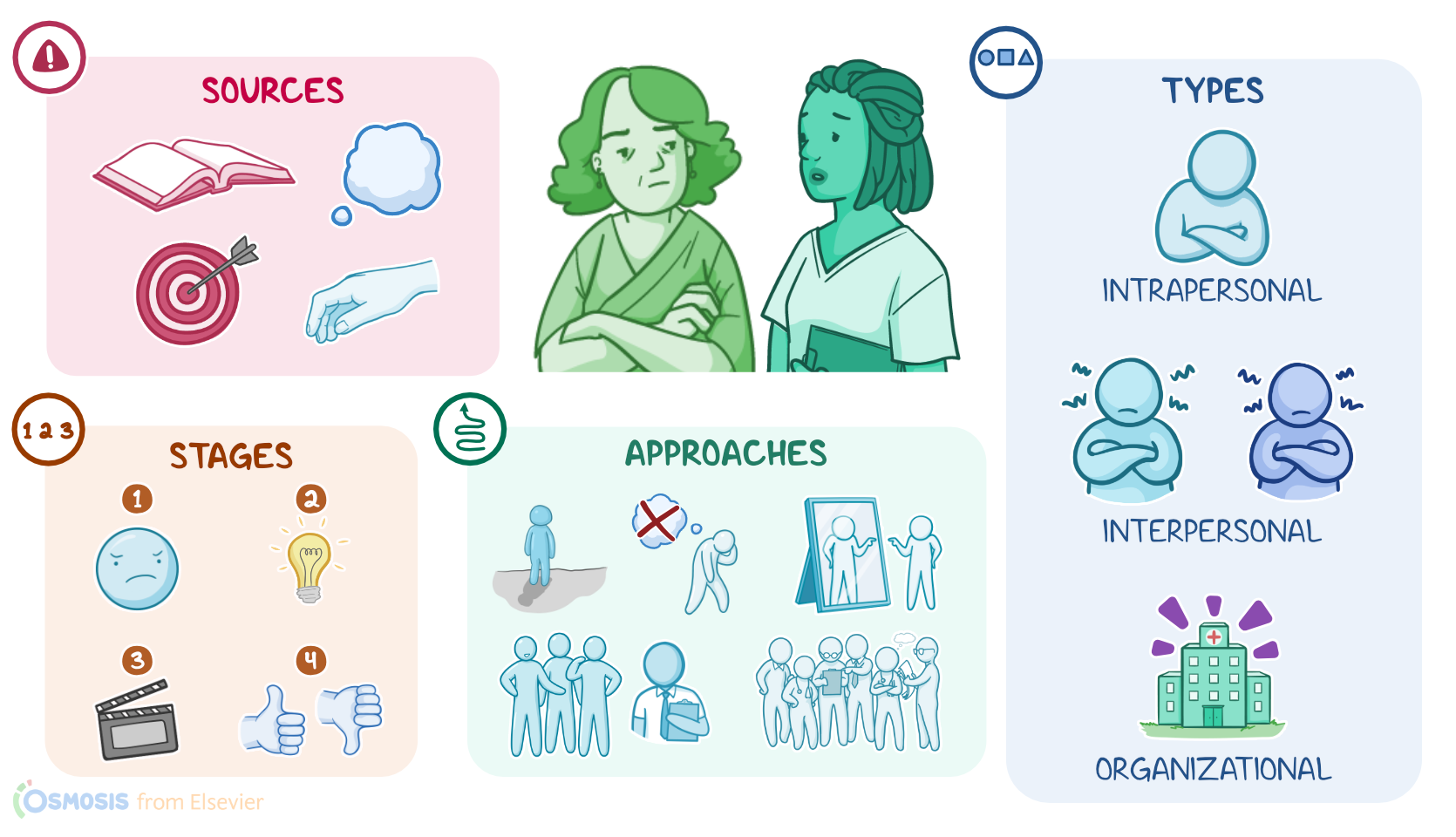
In today’s complex healthcare environment, resolving conflicts, such as the one between Nurse Matt and Nurse Monica, is important in order to provide optimal client care and facilitate healthcare team performance.Alright, conflict can be categorized into three main types: intrapersonal, interpersonal, and organizational.
Types of Conflict1:22–2:39
Intrapersonal conflict occurs within oneself and is a result of a person being confronted with ways of thinking which are different from what they are used to.
Lastly, organizational conflict is when there are disagreements throughout a team or large organization, like a hospital.
These can arise due to certain policies, procedures, or patterns of communication. An example would be if funds to purchase new equipment became available at a hospital and one group believed that new laboratory equipment was needed most but another group believed new physical therapy equipment was most important.
Now, conflict can happen for a variety of reasons and it is helpful for you to understand these sources of conflict in order to help resolve them.
Sources of Conflict2:39–4:19
Conflicts arise from discrepancies in four main areas: facts, values, goals, and approaches. Fact-based conflicts occur due to a disagreement over information that can be proven factually, such as a nurse disagreeing with the pharmacy technician over a medication dose.
By reading the healthcare provider’s order, the discrepancy can easily be resolved. Values-based conflicts occur when individuals have a difference in beliefs and opinions regarding a topic.
Unlike fact-based conflict, this is not so easily resolved since both parties are passionate about their stances. An example of this is when a client who is diagnosed with stage IV cancer wants to enter hospice care, but their spouse wants them to aggressively treat the cancer instead.
There are also goal-based conflicts that happen as a result of competing priorities, such as the nurse wanting to allow the client to have uninterrupted rest time, but also needing to turn the client every two hours to prevent a pressure injury.
Stages of Conflict4:19–5:26
First, there is frustration, which happens due to the intense emotions experienced by the individuals involved in the conflict.
Lastly, the outcomes stage is where positive or negative consequences can result, depending on the type of conflict resolution used by the nurse.
When a conflict occurs, it is important to understand how to respond using conflict resolution. Conflict resolution is the process of resolving a dispute by addressing the needs and interests of both sides involved.
Definition of Conflict Resolution5:26–6:06
The benefits of effective conflict resolution are positive client outcomes and safety, improved healthcare team performance, as well as reduced nursing burnout and stress.
If, instead, a conflict is not resolved, it can increase in intensity or last longer than necessary causing dissatisfaction among all health care team members involved in the conflict.
Now, five distinct approaches are commonly used to resolve conflict: avoiding, accommodating, competing, compromising, and collaborating.
Approaches to Conflict Resolution6:06–8:59
One approach to conflict resolution is avoiding, which is when one person withdraws completely and chooses not to deal with the conflict at all.
This can cause the conflict to last longer than necessary. If Nurse Matt chooses to use this approach, he would ignore the situation and take no action.Another approach is accommodating which is when a person neglects their own needs to cooperate with those around them.
This approach may end the conflict, but it does not solve the problem.Avoiding and accommodating are the most common approaches used by nurses and nursing students.
On the other hand, competing is when a person pursues their own needs without taking the needs of others into consideration.
This approach leads to a quick resolution, but may create animosity between those involved.Next, there is compromising, which is when everyone involved in the conflict negotiates and cooperates to find a solution.
The last approach is collaborating which is the most meaningful, but is also the most time consuming. Collaboration involves analyzing situations at a higher level to identify shared goals and commitment.
A culture that supports collaborative behavior among nurses and other members of the healthcare team is necessary to improve client outcomes and promote employee satisfaction.
Now, keep in mind that there are pros and cons to using each type of conflict resolution. So, when faced with a conflict, you may use more than one or a combination of several approaches.
Application of Conflict Management8:59–10:49
In order to diffuse the situation and avoid frustration, Nurse Matt pauses to listen to Nurse Monica without judgment. After he allows Nurse Monica to explain how she feels, Nurse Matt offers comments such as, “It sounds like you really value the way you perform client care,” and “I can tell you have pride in how you perform dressing changes.” Nurse Matt nods as Nurse Monica talks and makes eye contact to help convey that he is listening.
She smiles saying, “I’m sorry I got so upset. Sometimes it is hard for me to learn new things and it makes me defensive.
Alright, as a quick recap… Conflicts are inevitable within healthcare environments and can arise due to disagreements in facts, goals, approaches and values.
Review10:49–11:49
Conflicts can occur within oneself, called intrapersonal conflict; between two or more people, called interpersonal conflict; or within an organization or a team, called organizational conflict.
Once a conflict occurs, it tends to pass through several stages including frustration, conceptualization, and action before coming to an outcome.
There are different ways in which nurses can resolve conflict, but the most creative and effective way is through collaboration.
During collaboration, the individuals work together to examine a conflict at a higher level to identify shared goals and outcomes.
It is important for nurses to practice conflict resolution to encourage a positive work environment and promote client safety.
| MANAGING CONFLICT | ||
| KEY POINTS | NOTES | |
| INTRODUCTION |
| |
| DEFINITION |
| |
| TYPES OF CONFLICTS |
| |
| SOURCES OF CONFLICT |
| |
| STAGES OF CONFLICT |
| |
| CONFLICT RESOLUTION |
| |
| APPROACHES TO CONFLICT RESOLUTION |
| |
No notes for this video yet
Try adding a note below