Medication administration - Insulin: Nursing pharmacology

Last updated: April 24, 2024

Medication administration - Insulin: Nursing pharmacology

Pharm

Pharm

Gastric mucosal protective agents: Nursing pharmacology
Histamine H2 antagonists: Nursing pharmacology
Treatment for Helicobacter pylori: Nursing pharmacology
Antiglaucoma medications: Nursing pharmacology
Geriatric considerations - Medications: Nursing
Substance use disorder - Medications and illicit drugs: Nursing
Medications to control airway secretions: Nursing pharmacology
Oral antidiabetic medications - Sulfonylureas and meglitinides: Nursing pharmacology
Oral antidiabetic medications - Biguanides and thiazolidinediones: Nursing pharmacology
Proton pump inhibitors (PPIs): Nursing pharmacology
Corticosteroids - Inhaled: Nursing pharmacology
Immunosuppressants for autoimmune diseases: Nursing pharmacology
Using an inhaler: Information for patients and families
Non-biologic disease-modifying antirheumatic drug (DMARD) therapy: Nursing pharmacology
Biologic agents: Nursing pharmacology
Medications for Alzheimer disease: Nursing pharmacology
Medications for growth hormone disorders: Nursing pharmacology
Glaucoma: Nursing process (ADPIE)
Geriatric considerations - Respiratory: Nursing
Antihyperlipidemics - Statins: Nursing pharmacology
Antihyperlipidemics - Bile acid sequestrants and cholesterol absorption inhibitors: Nursing pharmacology
Medication labels: Nursing pharmacology
Medications for thyroid disorders: Nursing pharmacology
Medication administration - Insulin: Nursing pharmacology
Antidepressants - SSRIs and SNRIs: Nursing pharmacology
Antidepressants - Tricyclic antidepressants (TCAs) and monoamine oxidase inhibitors (MAOIs): Nursing pharmacology
Insulin: Nursing pharmacology
Oral antidiabetic medications - Alpha-glucosidase inhibitors: Nursing pharmacology
Case study - Wound infection: Nursing
Medication administration - Heparin: Nursing pharmacology
Case study - Healthcare-associated infection (HAI): Nursing
Antibiotics - Fluoroquinolones: Nursing pharmacology
Stimulant medications for attention-deficit hyperactivity disorder (ADHD): Nursing pharmacology
Medication orders: Nursing pharmacology
Medication administration - Safety principles: Nursing pharmacology
Antiepileptics: Nursing pharmacology
Antibiotics - Carbapenems and monobactams: Nursing pharmacology
Cholinergic therapy (GU): Nursing pharmacology
Pharmacodynamics: Nursing pharmacology
Analgesics: Nursing pharmacology
Mood stabilizers: Nursing pharmacology
Antipsychotics: Nursing pharmacology
Anxiolytics and sedative-hypnotics: Nursing pharmacology
Antiemetics: Nursing pharmacology
Medications for acne vulgaris: Nursing pharmacology
Respiratory stimulants: Nursing pharmacology
Ergot alkaloids: Nursing pharmacology
Antibiotics - Penicillins: Nursing pharmacology
Antitumor antibiotics: Nursing pharmacology
Antibiotics - Macrolides: Nursing pharmacology
Antacids: Nursing pharmacology
Antihistamines: Nursing pharmacology
Laxatives: Nursing pharmacology
Prostaglandins: Nursing pharmacology
Antiarrhythmics: Nursing pharmacology
Thrombolytics: Nursing pharmacology
Antiprotozoals: Nursing pharmacology
Medications for migraines: Nursing pharmacology
Antispasmodics (GU): Nursing pharmacology
Iron preparations: Nursing pharmacology
Leukotriene modifiers: Nursing pharmacology
Nitrates: Nursing pharmacology
Beta-adrenergic blockers: Nursing pharmacology
Direct-acting vasodilators: Nursing pharmacology
Angiotensin-converting enzyme (ACE) inhibitors: Nursing pharmacology
Diuretics - Thiazide, thiazide-like, loop, and potassium-sparing diuretics: Nursing pharmacology
Cardiac glycosides: Nursing pharmacology
Antivirals for herpesviruses: Nursing pharmacology
Corticosteroids - Topical: Nursing pharmacology
Antibiotics - Metronidazole: Nursing pharmacology
Pancreatic enzyme replacements: Nursing pharmacology
Disease-modifying therapy for multiple sclerosis: Nursing pharmacology
Calcium-channel blockers: Nursing pharmacology
Anticoagulants - Warfarin: Nursing pharmacology
Anticoagulants - Heparin: Nursing pharmacology
Vaccines: Nursing pharmacology
Electrolyte balance - Overview: Nursing
Arterial blood gas (ABG) - Respiratory acidosis: Nursing
Antibiotics - Tetracyclines and glycylcyclines: Nursing pharmacology

Notes

MEDICATION ADMINISTRATION - INSULIN

KEY POINTS
NOTES
DEFINITION
  • Insulin
    • Hormone
    • Secreted by beta cells of pancreas
    • Helps glucose enter cells
  • Diabetes
    • Insulin not produced or cells are resistant to insulin
  • Exogenous insulin
    • Helps regulate glucose levels
    • Typically subcutaneous injection
    • High-alert medication

SUBCUTANEOUS INSULIN PREPARATIONS
  • Vial or pre-filled pen
  • Prescribed and measured in units, not milliliters
  • Always use insulin syringe
  • Rapid-, short-, intermediate-, and long-acting formulations
  • Pre-mixed solutions
    • 70/30
  • Most are clear except for NPH which is cloudy

EXAMPLE 1 - VIAL AND SYRINGE
  • Sliding scale insulin aspart for subcutaneous injection
  • Glucose: 289 mg/dL (16 mmol/L)
    • 8 units insulin aspart
  • Vial: 100 units per milliliter
  • Insulin syringe
    • Fill with 8 units of air
    • Inject air into vial
    • Draw up 8 units of insulin
    • Verify order, vial, and syringe 

EXAMPLE 2 - MIXING INSULINS
  • Insulin regular 5 units and insulin NPH 5 units subQ once at 1400
  • Both vials contain 100 units per milliliter
  • Regular is clear
  • NPH is cloudy
  • Confirms regular and NPH can be mixed
  • CLEAR before CLOUDY
  • Insulin syringe
    • Inject 5 units of air into NPH vial
    • Inject 5 units of air into the regular insulin vial
    • Withdraw 5 units of regular insulin
    • Withdraw 5 units of NPH insulin
    • Verify order, vials, and syringe

EXAMPLE 3 - INSULIN PEN
  • Insulin lisper 3 units subQ three times daily before meals
  • Insulin pen 100 units per milliliter 
    • Place needle on pen
    • Turns dial to #2 in dose window
    • Inject insulin into sink or air to prime the needle
    • Turn dial to #3 in dose window
    • Verify order, pen, and dosage

Transcript

Watch video only

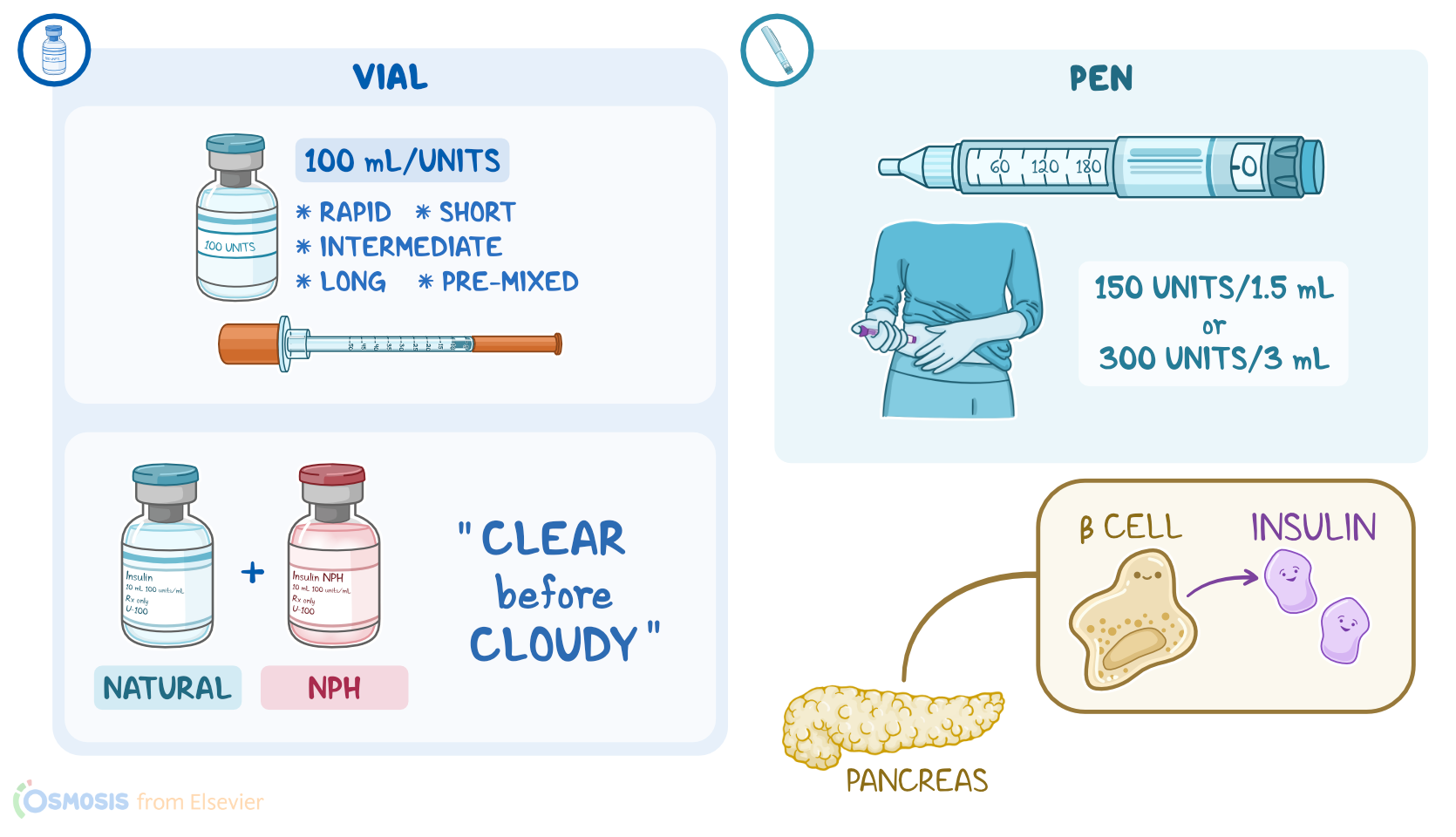
Insulin is a hormone secreted by beta cells in the pancreas that helps glucose enter the body’s cells, so it can be used for energy. In diabetes mellitus, insulin is either not produced at all, like in type I diabetes; or cells are resistant to insulin, like in type II diabetes. In either type, glucose can't be utilized by the body’s cells, so it builds up in the bloodstream.   

Exogenous insulin, or synthetic insulin, can be administered to help regulate glucose levels, and is most often administered by subcutaneous, or SUBQ injection. It’s a commonly used, high-alert medication, meaning there’s an increased risk of patient harm if administered in error. This is because insulin can cause potentially dangerous hypoglycemia, or low blood glucose levels

Alright, so insulin typically comes in either a vial or a pen. Most insulin vials contain a concentration of 100 units of insulin per milliliter. It’s important to note that insulin doses are prescribed and measured in units, not milliliters so you’ll always use an insulin syringe, which measures increments of insulin in units. Insulin vials can include rapid-, short-, intermediate-, or long-acting insulins as well as pre-mixed solutions like 70/30 preparations, which contain 70 percent intermediate-acting insulin and 30 percent rapid-acting insulin. Most insulins are clear, but a type of insulin called NPH, which is short for neutral protamine Hagedorn is cloudy because a protein called protamine is added to prolong its action in the body over an extended period. 

There are also pre-filled insulin pens, which contain either 150 units of insulin per 1.5 milliliters or 300 units of insulin per 3 milliliters. These devices can be used for multiple injections for one patient. Before administering the insulin, a small disposable needle is placed on the end of the pen and the indicator dial is turned to the correct insulin dose. Following administration, the dose indicator returns to zero and the needle is removed from the skin and discarded.  

Now, let’s review some calculations for subcutaneous insulin using a vial and syringe.   Nurse Nathan works in a long-term care facility and is caring for Alice, an 89-year-old woman with type 2 diabetes. Nurse Nathan checks the electronic health record, or EHR, and sees that Alice is ordered a sliding scale of insulin aspart for subcutaneous injection. He also sees that 10 minutes ago Alice’s blood glucose was 289 mg/dL. According to the sliding scale, Nathan will administer 8 units of insulin aspart. 

Next, Nurse Nathan checks the label of the insulin vial and sees that the vial contains 100 units of insulin per milliliter 

Nurse Nathan then selects an insulin syringe, making sure it’s measured in units.  

Since he needs to withdraw 8 units of insulin from this vial, he first fills the syringe with 8 units of air and injects the air into the vial. This keeps a vacuum from forming so the medication can easily enter the syringe. Then he draws up 8 units of insulin into the syringe. Before administering the dose, Nurse Nathan asks another nurse to check the order, the vial, and the syringe to ensure he’s prepared the correct amount. 

Sources

  1. "Calculate with confidence. (8th ed.)" Elsevier (2022)
  2. "Calculation of drug dosages: A work text. (12th ed.)" Elsevier (2023)
  3. "Clinical calculations: With applications to general and specialty areas. (10th ed.)" Elsevier (2022)
  4. "Gray Morris's calculate with confidence, Canadian edition. (2nd ed.)" Elsevier (2022)
  5. "Mulholland's: The nurse, the math, the meds. (5th ed.)" Elsevier (2023)