Medication administration - Intravenous: Nursing pharmacology
Introduction0:00–1:03
The intravenous, or IV, route is a common route for the administration of medications and solutions. Some common ones are antibiotics, electrolytes, and fat emulsions.
IV medications can be administered through a peripheral intravenous catheter, or PIV, or a central venous catheter, or CVC.
They can be inserted at sites such as the internal jugular vein, subclavian vein, or femoral vein; and terminate at the junction of the superior or inferior vena cava and right atrium.
If a central line is inserted peripherally, like in the basilic or brachial vein, it's called a peripherally inserted central catheter, or PICC.
Now, medications can be administered in 3 different ways: direct injection, continuous infusion, or intermittent infusion.
First, medications given by direct injection are often referred to as IV push. This route uses the patient’s intravenous line to administer a small volume of medication directly into the bloodstream.
Direct Injection1:03–1:51
When administering medications via direct injection, first, ensure the patency and status of the IV site by flushing with saline before use and assessing for redness, swelling, or pain at the site.
Be sure to note the medication’s push rate, or the time spent administering the medication through the IV, since some medications should be pushed slowly, like furosemide, while other medications should be pushed quickly, like adenosine.
Finally, if your patient is receiving multiple medications through their IV, ensure the medications and any fluids are compatible.
As the nurse, you’ll perform calculations to ensure the correct dose of an IV medication is administered. To calculate a dose using the Dimensional Analysis, or DA, method, the three components you need are D, for the Desired dose, or dose ordered by the health care provider; H, for Have, or the dosage you have available; and V, for Vehicle or the form and amount in which the medication comes, like tablets or liquid.
General Dosage Calculation1:51–2:21
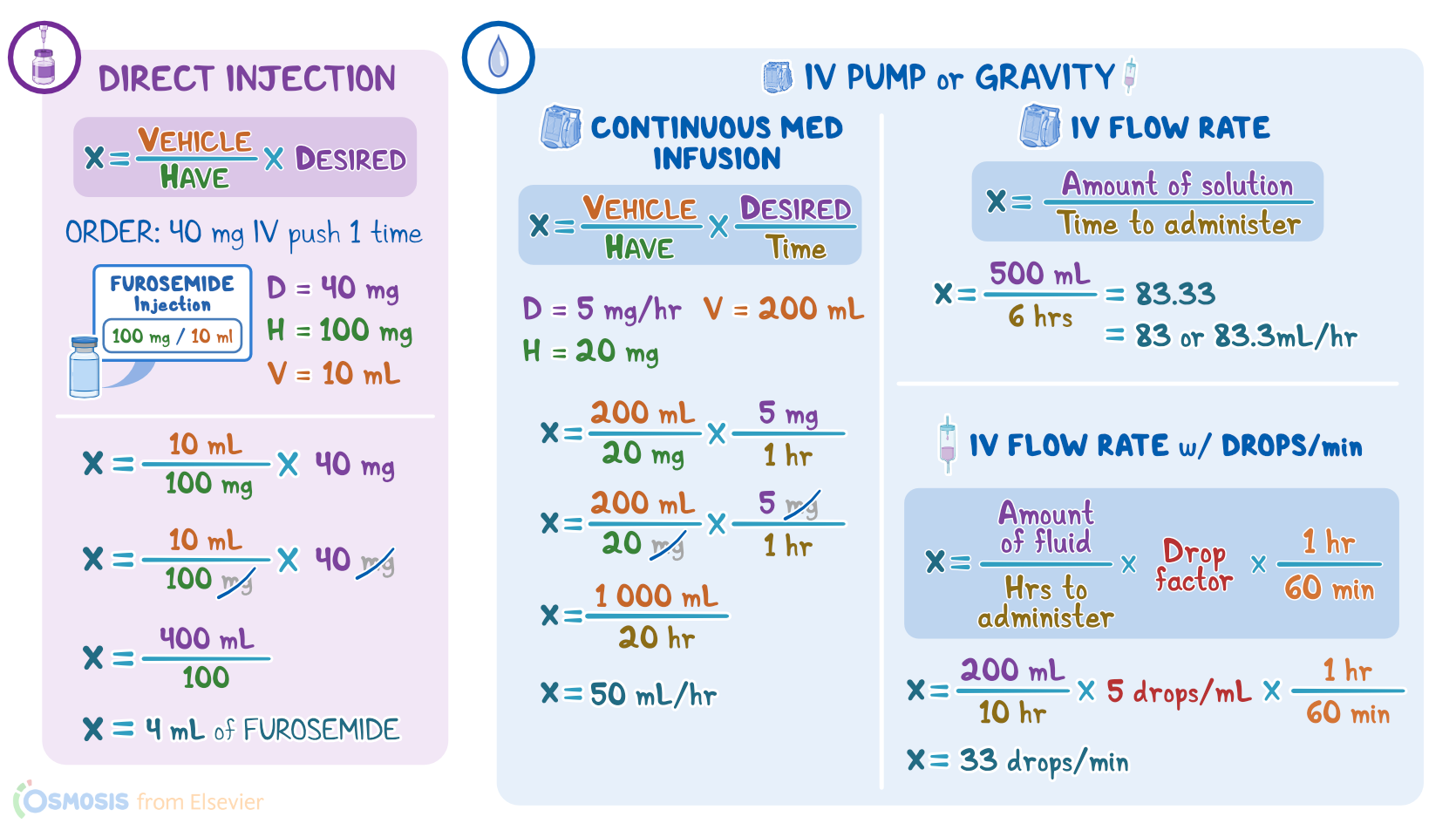
Let’s calculate the dosage of an IV push medication. First, you’ll read the order, which is: furosemide 40 mg IV push one time.
Example 1 - IV Push2:21–4:12
Then, check the medication label: Since the medication comes in 100 mg per 10 mL, you’ll calculate how many mLs you should administer to achieve the Desired dose.
To do this, first identify your components, Desired, Have, and Vehicle. In this case, D is 40 mg, which was obtained from the health care provider’s order.
H is 100 mg, which was obtained from the medication label. And V, is 10 mL, which was also obtained from the label.
Next, you’ll determine if a conversion factor is required. To determine this, compare the units of D with the units of H, and if they’re the same, no conversion factor is needed.
Because both D and H are in milligrams, no conversion factor is needed. Now, set up the equation, where X is the dose you’ll administer in milliliters, written out like this: X volume of milliliters equals Vehicle over Have multiplied by Desired.
Now, plug in the values for the components to get X equals 10 milliliters multiplied by 40 milligrams divided by 100 milligrams.
Remember, you can cross out any duplicate units of measurement because they cancel out. Now you’ll multiply 10 by 40 to get 400 divided by 100.
The answer is 4 mL, meaning you'll administer 4 mL of furosemide to achieve the ordered dose of 40 mg. To verify the rate at which to push this dose, you can refer to the package insert or your facility policy.
Typically, this medication is administered at a rate of 1 mL per minute, so you'll administer 4 mL of furosemide over 4 minutes.
Now, when medications are prescribed intravenously over a period of time, they can be given either intermittently or continuously.
Infusions4:12–5:01
Intermittent infusions can be given at various intervals, from multiple times per day, per week, or per month, and infused for a specific amount of time from minutes to several hours.
On the other hand, continuous infusions are given without breaks between infusions and require the patient to be attached to the IV infusion until the infusion is complete.
Now, both types of infusions can be administered by gravity or with the use of an IV pump. An IV pump should be used whenever available, because they infuse the medications at an accurate rate and have special safety functions to help prevent medication errors.Let’s look at how to calculate a continuous medication infusion that will be administered through an IV pump.
Example 2 - Continuous Medication Infusion5:01–6:57
First, you’ll read the order, which is: nicardipine 5 mg per hour continuous IV infusion. Then, check the medication label: Since the medication is available in a concentration of 20 mg in 200 mL, you’ll calculate how many milliliters per hour to infuse.
To do this, first identify your components, Desired, Have, and Vehicle. In this case, D is 5 mg per hour, which was obtained from the health care provider’s order.
H is 20 mg, which was obtained from the medication label. And V is 200 mL, which was also obtained from the label.
Next, you’ll determine if a conversion factor is required. To do this, compare the units of D with the units of H.
Because both D and H are in milligrams, no conversion factor is needed. Now, set up the equation, where X is the dose you’ll administer, written out like this: X number of milliliters per hour equals Vehicle over Have multiplied by Desired.
And since there’s a time component, we also have T, for Time. Now, plug in the values for the components to get X equals 200 milliliters multiplied by 5 milligrams divided by 20 milligrams multiplied by one hour.
Remember, you can cross out any duplicate units of measurement because they cancel out. Now you’ll multiply the numbers in the numerator and then the denominator of the equation to get 1000 divided by 20.
The answer is 50 mL/hr, meaning you'll program the IV pump to deliver 50 mL of nicardipine over 1 hour to achieve the ordered dose of 5 milligrams per hour.
Now let’s look at some examples where you’ll calculate an infusion rate for intravenous fluids. First, you’ll read the order which is 5% dextrose in 0.9% normal saline 500 mL over 6 hours.
Example 3 - IV Flow Rate6:57–8:43
Then, check the solution bag to ensure you have the correct IV fluids: Since you are calculating an infusion rate to program into the intravenous infusion pump, rather than a medication dose to administer, you’ll calculate how many mL per hour you should administer to achieve the Amount of solution in the correct Time to administer.
In this case, the Amount of solution is 500 mL, which was obtained from the health care provider’s order and the Time to administer is 6 hours which was also obtained from the health care provider’s order.
Next, you’ll determine if a conversion factor is required. Since the infusion rate to be programed into the infusion pump is in mL per hour and the Time to administer is also in hours, no conversion factor is needed.
Now, set up the equation, where X is the infusion rate in mL per hour, written out like this: Now, plug in the values for the components to get X equals 500 mL divided by 6 hours.
Now you’ll divide 500 by 6 to get 83.33 mL per hour. This gives you the final answer of 83.33 mL per hour.
If your IV pump is calibrated by whole numbers, you'll round to the nearest whole number and program your pump to 83 mL per hour.
But if your pump is calibrated by tenths, you’ll round to the nearest tenth and program the IV pump at 83.3 mL/hr. Now, let’s look at another example where you’ll calculate an infusion rate but this time there is no infusion pump available.
Example 4 - IV Flow Rate with Drops per Minute8:43–11:36
If the IV infusion is delivered by gravity rather than though an infusion pump, then you’ll adjust the hourly rate manually using the roller clamp and by counting the number of drops that pass into the drip chamber during a certain amount of time.
The drop factor, or the number of drops per milliliter, will be printed on the package of the infusion set and found on top of the drip chamber.
Infusion sets that deliver large drops, like 10 to 20 drops per milliliter, are referred to as macrodrip sets; and those that deliver small drops, or 60 drops per milliliter, are called microdrip or minidrip sets.
First, you’ll read the order, which is: Lactated Ringer’s 1000 milliliters continuous IV over 10 hours. Then, check the infusion set package for the drop factor which is 20 drops per milliliter.
Since the order is to administer 1000 milliliters in 10 hours and you do not have an infusion pump available, you will calculate the number of drops per minute to administer.
To do this, first identify your components, Amount of solution, Time to administer, and the Drop factor. In this case, the Amount of solution is 1000 mL, which was obtained from the health care provider’s order, the Time to administer is 10 hours, which was also obtained from the health care provider’s order, and the Drop factor is 20 drops/mL, which was obtained from the infusion set.
Next, you’ll determine if a conversion factor is required. Since the Time to administer is in hours but the Drop factor is in minutes, you’ll use the following conversion factor for hours to minutes: 1 hour equals 60 minutes Now, set up the equation where X is the drops per minute you will administer, written out like this: X drops per minute equals Amount of fluid over Hours to administer multiplied by the Drop factor multiplied by the Conversion factor for hours over the Conversion factor for minutes.
Now, plug in the values for the components to get X equals 1000 mL multiplied by 20 drops/mL multiplied by 1 hour divided by 10 hours multiplied by 60 minutes.Remember, you can cross out any duplicate units of measurement because they cancel out.
Now you’ll multiply the numerators and then the denominators of the equation to get 20000 divided by 600. This gives you an answer of 33.3 drops per minute which is rounded to 33 drops per minute.
This means that you’ll adjust the roller clamp until 33 drops fall into the drip chamber over one minute to achieve the ordered dose and rate.
Alright, as a quick recap... Intravenous, or IV, administration is a route for medication administration that delivers medication directly into the bloodstream.
Review11:36–11:58
IV medications can be administered through direct IV injection, or IV push; and continuous or intermittent infusion. Infusions can either be administered with an infusion pump
| MEDICATION ADMINISTRATION - INTRAVENOUS (IV) | ||
| KEY POINTS | NOTES | |
| DEFINITION |
| |
| DIRECT INJECTION |
| |
| GENERAL DOSAGE CALCULATION |
| |
| EXAMPLE 1 - IV PUSH |
| |
| INFUSIONS |
| |
| EXAMPLE 2 - CONTINUOUS MEDICATION INFUSION |
| |
| EXAMPLE 3 - INTRAVENOUS FLOW RATE |
| |
| EXAMPLE 4 - INTRAVENOUS FLOW RATE with DROPS per MINUTE |
| |
- "Calculate with confidence. (8th ed.)" Elsevier (2022)
- "Calculation of drug dosages: A work text. (12th ed.)" Elsevier (2023)
- "Clinical calculations: With applications to general and specialty areas. (10th ed.)" Elsevier (2022)
- "Gray Morris's calculate with confidence, Canadian edition. (2nd ed.)" Elsevier (2022)
- "Mulholland's: The nurse, the math, the meds. (5th ed.)" Elsevier (2023)
No notes for this video yet
Try adding a note below