Medication administration - Intravenous labor and delivery: Nursing pharmacology
The administration of IV medications used during labor and delivery requires the nurse to calculate medication concentrations, infusion rates, and titration factors, along with close monitoring of how both the pregnant patient and the fetus respond to the medication.
Some medications used in this setting, like magnesium sulfate and oxytocin, are considered high-alert medications, meaning they can cause significant harm if administered incorrectly.
These medications are always delivered through an IV pump to ensure accuracy. To calculate a dose using the Dimensional Analysis, or DA method, the three components you need are V, for Vehicle or the form and amount in which the medication comes, like tablets or liquid, H, for Have, or the dosage you have available; and D, for the Desired dose, or dose ordered by the health care provider; and since there’s a time component, we also have T, for Time.
Magnesium sulfate is a medication used as tocolytic to slow contractions in preterm labor or to reduce the risk of seizures in patients with preeclampsia.
It's typically administered starting with a loading dose, or a higher dose given over a shorter duration, so the desired therapeutic effect is achieved more quickly.
After the loading dose is administered, a maintenance dose, or a slower rate of administration is administered to maintain a therapeutic level.
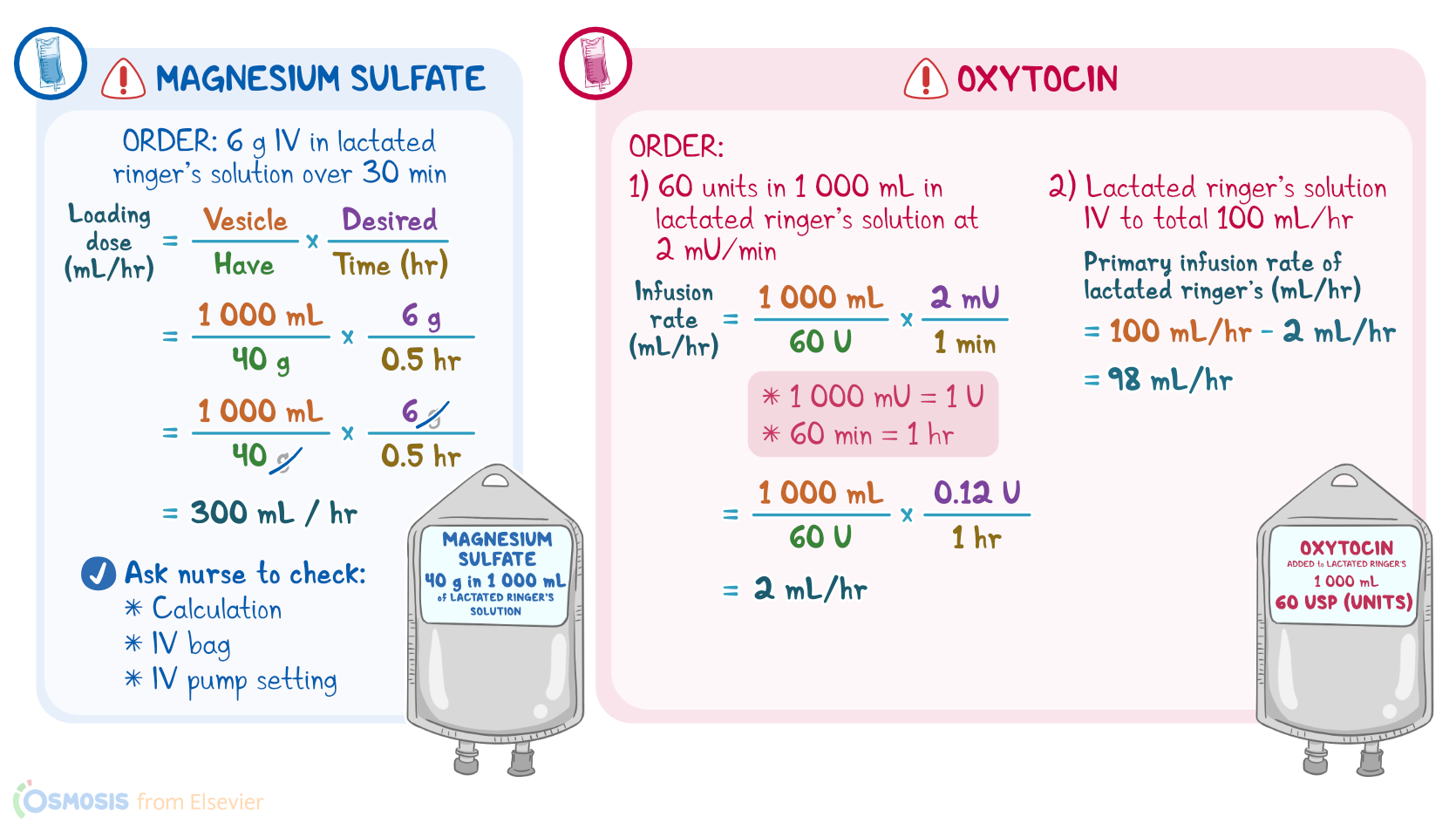
Let’s look at how to calculate a loading dose of magnesium sulfate in mL/hr. First, you’ll read the order, which is: magnesium sulfate 6 g IV in Lactated Ringer’s solution over 30 minutes.
Then, check the medication label: The medication is available in a concentration of 40 g in 1000 mL of Lactated Ringer’s solution.
In this case, D is 6 g, which was obtained from the health care provider’s order; H is 40 g, which was obtained from the medication label; V is 1000 mL, which was also obtained from the label; and T is 30 minutes, which was obtained from the health care provider’s order.
Next, you’ll determine if a conversion factor is required. To determine this, compare the units of D with the units of H.
Because both D and H are in grams, no conversion factor is needed for the dose. However, since T is in minutes and the infusion rate you’re calculating is in mL/hr, a conversion factor is needed.
In this case you’ll use the following conversion factor for minutes to hours: 60 minutes = 1 hour Now, set up your equation, where X is the infusion rate in mL per hour, written out like this: X milliliters per hour equals Vehicle over Have multiplied by Desired Dose over Time, multiplied by the conversion factor.
Now, plug in the values to get X equals 1000 mL multiplied by 6 grams multiplied by 60 minutes divided by 40 grams multiplied by 30 minutes multiplied by 1 hour.
Remember, you can cross out the units of the numerator that match the units in the denominator because they cancel out. Now you’ll multiply the numbers in the numerator and then the numbers in the denominator to get 360000 mL divided by 1200 hrs.
Next, divide 360000 mL by 1200 hrs to solve for X. The answer is 300 mL/hr, meaning you'll program the IV pump to infuse the loading dose of magnesium sulfate at 300 mL/hr for 30 minutes to achieve the ordered dose.
Before beginning the loading dose, be sure to ask another nurse to check your calculation, the IV bag, and the IV pump setting to ensure you’ve prepared the correct amount.
The overall flow rate is then adjusted to maintain the prescribed volume of fluids infusing per hour. Let’s look at how to calculate an oxytocin dose in mL/hr with the corresponding maintenance fluid infusion rate in mL/hr.
First, you’ll read the order, which is: 1 Oxytocin 60 units in 1000 mL Lactated Ringer’s IV at 2 milliunits per minute 2 Lactated Ringer’s solution IV to total 100 mL/hr Next, check the medication label.
The medication is available in a concentration of 60 units of oxytocin in 1000 mL of Lactated Ringer’s solution. In this case, D is 2 milliunits and T is 1 minute, which was obtained from the health care provider’s order; H is 60 units, which was obtained from the medication label; and V is 1000 mL, which was also obtained from the label.
Next, you’ll determine if a conversion factor is required. To determine this, compare the units of D with the units of H.
Because D is in milliunits and H is in units, a conversion factor is needed. In this case, you’ll use the following conversion factor for milliunits to units: 1000 milliunits = 1 unit Also, because T is in minutes, and the infusion rate you’re calculating is in mL/hr, a conversion factor is needed here too.
In this case, you’ll use the following conversion factor for minutes to hours: 60 minutes = 1 hour Now, set up your equation, where X is the infusion rate in mL per hour, written out like this.
X milliliters per hour equals Vehicle over Have multiplied by Dose over Time, multiplied by the conversion factors Now, plug in the value for the components.
This gives you 1000 mL multiplied by 2 milliunits multiplied by 60 minutes multiplied by 1 unit; divided by 60 units multiplied by 1 minute multiplied by 1 hr multiplied by 1000 milliunits.
Remember, you can cross out the units of the numerator that match the units in the denominator because they cancel out. Then, you’ll multiply the numbers in the numerator and then the numbers in the denominator of the equation to get 120000 milliliters divided by 60000 hours.
Next, divide 120000 mL by 60000 hr to solve for X. This gives you the final answer of 2 mL/hr.
To do this, set up your equation, where X is the primary line infusion rate of Lactated Ringer’s solution, written out like this.
Also, ask another nurse to check your calculation, the IV bags, and the IV pump settings to ensure you’ve prepared the correct amount.
Alright, as a quick recap...When administering IV medications used during labor and delivery, you’ll calculate medication concentrations, infusion rates, and titration factors, along with close monitoring of how both the pregnant patient and the fetus respond to
| MEDICATION ADMINISTRATION - INTRAVENOUS (IV) LABOR AND DELIVERY | ||
| KEY POINTS | NOTES | |
| DEFINITION |
| |
| DOSAGE CALCULATION |
| |
| EXAMPLE 1 - MAGNESIUM SULFATE |
| |
| EXAMPLE 2 - OXYTOCIN |
| |
- "Calculate with confidence. (8th ed.)" Elsevier (2022)
- "Calculation of drug dosages: A work text. (12th ed.)" Elsevier (2023)
- "Gray Morris's calculate with confidence, Canadian edition. (2nd ed.)" Elsevier (2022)
- "Mulholland's: The nurse, the math, the meds. (5th ed.)" Elsevier (2023)
- "Clinical calculations: With applications to general and specialty areas. (10th ed.)" Elsevier (2022)
No notes for this video yet
Try adding a note below