Stages of labor: Nursing
Introduction0:00–0:24
Labor is the process at the end of pregnancy during which the baby passes through the birth canal. It occurs spontaneously, usually between 37 and 42 weeks of pregnancy.
First stage0:24–2:33
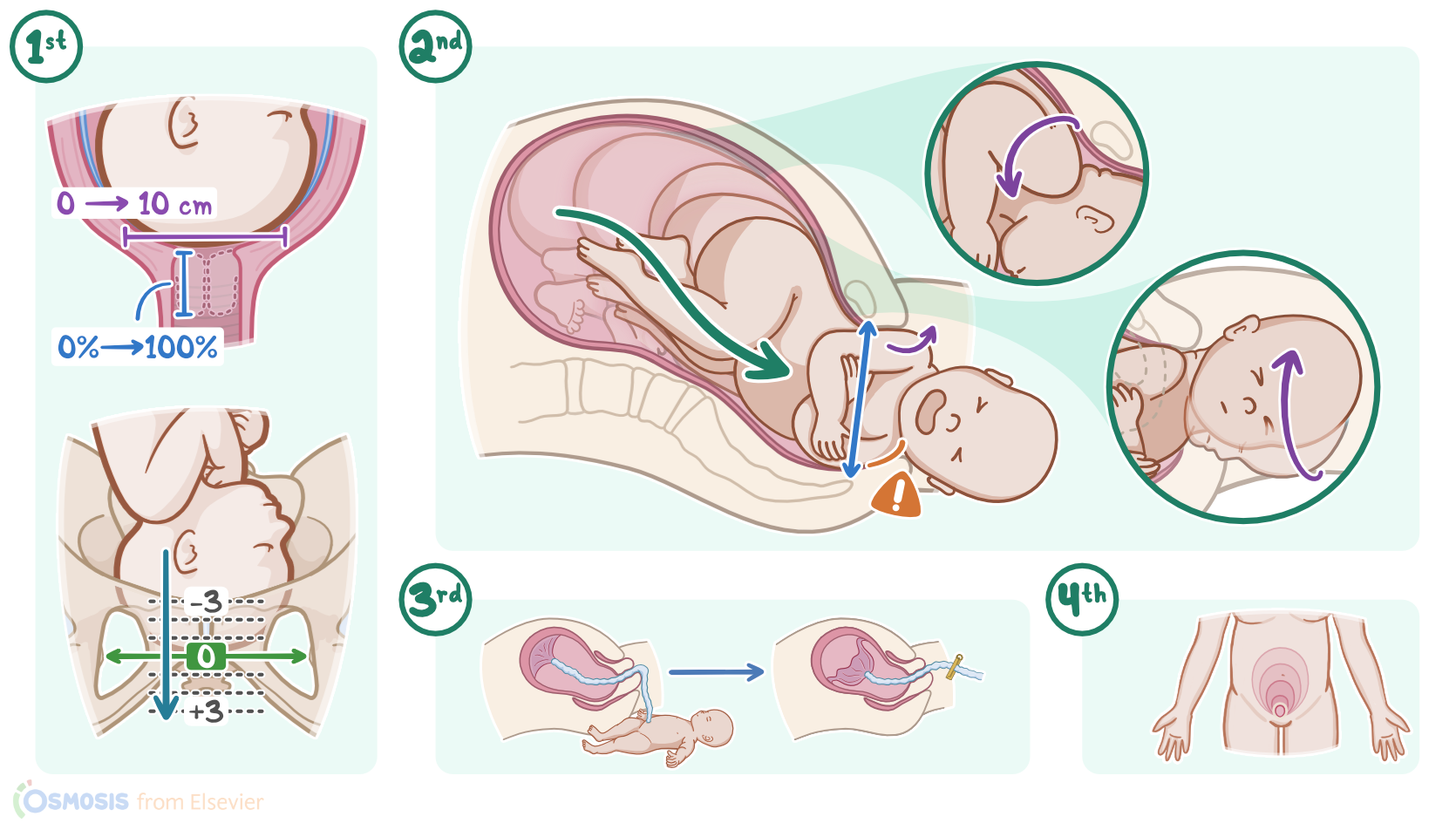
Now, the first stage can further be subdivided into a latent phase, an active phase, and a transitional phase. The latent phase starts with the beginning of regular contractions, which usually start out as mild, and then increase in frequency, duration, and intensity.
Cervical dilation progresses from 0 to 3 cm and effacement progresses from 0% to 40%. Also during this phase, the fetal membranes usually rupture spontaneously, if they haven’t ruptured already.
The length of the latent phase is typically much longer in nulliparous individuals, meaning those who have never previously given birth, then for multiparous individuals, who have previously given birth.Next, during the active phase, the frequency, duration, and intensity of contractions continues to increase, and the rate of cervical dilatation and effacement accelerates, expanding from 4 to 7 cm, along with an effacement of 40% to 80%.The fetus starts to descend, and is usually between stations − 2 to 0.
Remember that the fetal stations represent the number of centimeters that the fetal presenting part is above or below the ischial spines of the maternal pelvis; so essentially, they measure fetal descent through the birth canal.
Finally, during the transition phase, the frequency, duration, and intensity of contractions continues to increase, cervical dilation progresses from 8 to 10 cm, effacement progresses from 80% to 100%, and the fetus descends from -1 station to +1 station.
This is also a time of increased anxiety for the client, who can be irritable or agitated and will need increased encouragement and support.Once the cervix is 10 centimeters dilated and 100% effaced, the second stage of labor, sometimes also called the “pushing stage”, begins, and it ends with the delivery of the baby.
Second stage2:33–3:18
During the second stage of labor, uterine contractions are strong, 2 to 3 minutes apart and each lasts 60 to 90 seconds.
Additionally, the fetal presenting part, which is usually the head, starts pushing on the pelvic floor, which urges the mother to push.
The duration of this stage can last from a few minutes to hours, and it’s faster for multiparous mothers, but slower for those on epidural anesthesia.
Cardinal movements3:18–4:27
Initially there is descent, which is the downward movement of the fetus to the pelvic inlet. The fetus moves from the pelvic inlet down to the ischial spines, and this position’s called engagement.
Then there’s flexion, where the fetal chin presses against its chest as its head meets resistance from the pelvic floor.
Next there’s internal rotation, where the fetal shoulders internally rotate by 45 degrees so the widest part of the shoulders are in line with the widest part of the pelvic inlet.
And finally there’s expulsion, where the anterior shoulder slips under the symphysis pubis, followed by the posterior shoulder, and then finally followed by the rest of the body.Next, there’s the third stage of labor, which starts with the expulsion of the fetus and ends with the expulsion of the placenta.Here, the uterus firmly contracts to clamp down on exposed blood vessels from where the placenta was implanted, which prevents hemorrhage after the expulsion of the placenta.
Third Stage4:27–4:55
The mother can feel slight cramps and discomfort as the placenta is passed. In contrast to other stages of labor, the third stage lasts for only six minutes.
Finally, the fourth stage of labor starts after the placenta is delivered, and lasts for one to four hours after delivery.
Fourth Stage4:55–5:18
Review5:18–6:30
During this stage, the fetus starts to descend through the birth canal. To make it through the birth canal, the fetus makes 6 positional changes which are called cardinal movements or mechanisms of labor.
starts after the placenta is delivered. And during this stage, the mother's body begins to return
| STAGES OF LABOR | ||
| KEY POINTS | NOTES | |
| DEFINITION |
| |
| FIRST STAGE |
| |
| SECOND STAGE |
| |
| THIRD STAGE |
| |
| FOURTH STAGE |
| |
No notes for this video yet
Try adding a note below