Medication administration - Oral: Nursing pharmacology
Notes
| MEDICATION ADMINISTRATION - ORAL | ||
| KEY POINTS | MY NOTES | |
| DEFINITION |
| |
| DOSAGE CALCULATION OVERVIEW |
| |
| DOSAGE CALCULATION - TABLETS |
| |
| DOSAGE CALUCLATION - CAPSULES |
| |
| DOSAGE CALCULATION - SUSPENSION |
| |
| DOSAGE CALCULATION - SUSPENSION (NASOGASTRIC TUBE) |
| |
Transcript
Enteral medications are administered through the GI tract, either orally, rectally, or by a nasogastric or gastrostomy tube. Oral medications are available in tablets, capsules, and liquids, which can be either solutions or suspensions, and are the most commonly prescribed form of enteral medications for patients who are able to swallow.
As the nurse, you’ll perform medication calculations to ensure the correct dose of an enteral medication is administered.
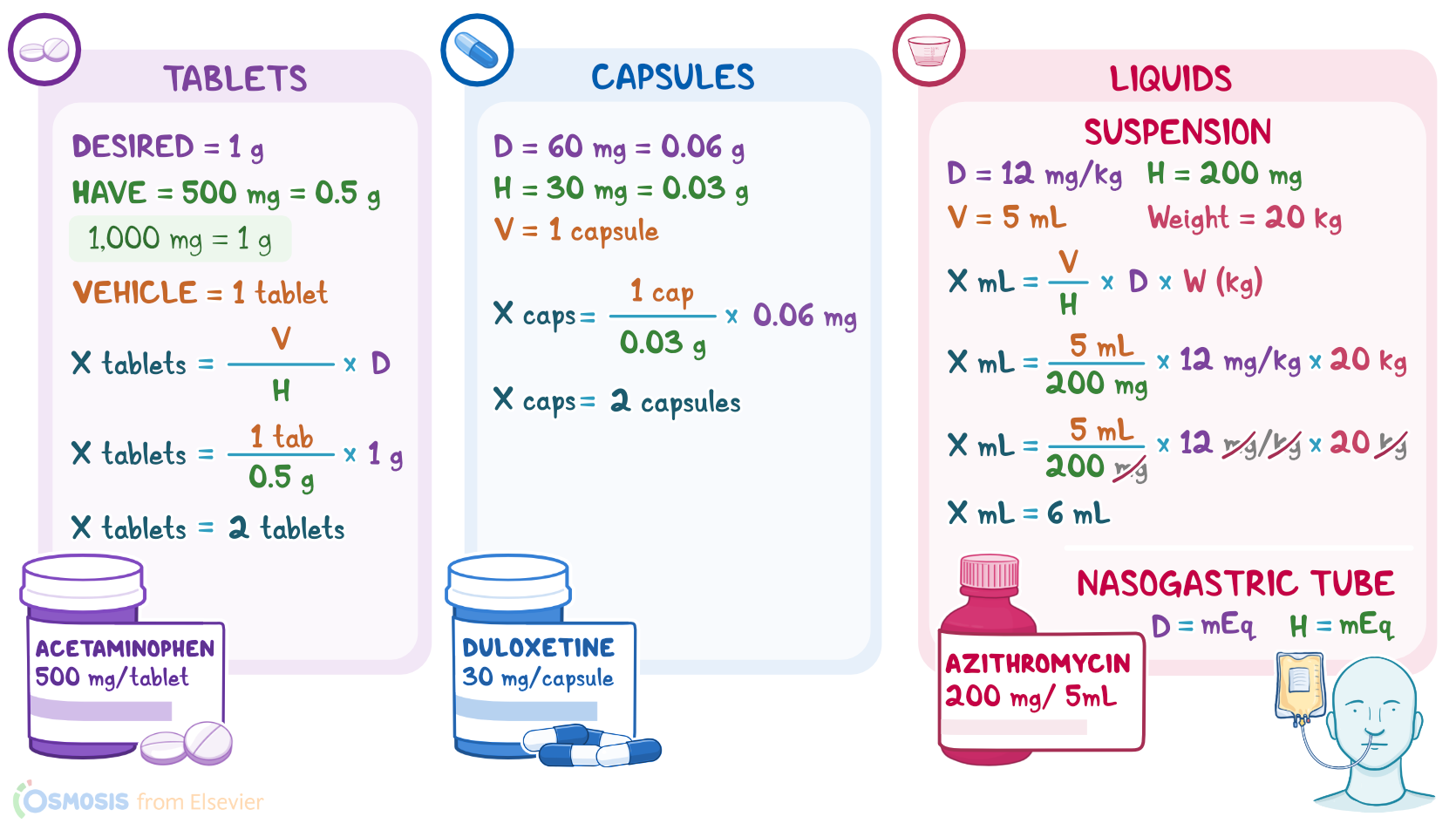
To calculate a dosing using the Dimensional Analysis, or DA, method, the three components you need are D, for the Desired dose, or dose ordered by the health care provider; H, for Have, or the dosage you have available; and V, for Vehicle or the form and amount in which the medication comes, like tablets or liquid. First, you’ll read the order, which is: acetaminophen 1 gram PO every 6 hours.
Then, look at the medication label.
Since the medication comes in 500 mg per tablet, you’ll calculate how many tablets you should administer to achieve the desired dose. To do this, first identify your components, Desired, Have, and Vehicle.
In this case, D is 1 gram, which was obtained from the health care provider’s order. H is 500 mg, which was obtained from the medication label. And V, is 1 tablet, which was also obtained from the label.
Next, you’ll determine if a conversion factor is required. To determine this, compare the units of D with the units of H, and see if they’re the same. Because D and H are in different units, a conversion factor is needed. In this case, you’ll use the following conversion factor from grams to milligrams:
1 gram equals 1000 mg
Now, set up your equation, where X is the dose you'll administer in tablets, written like this:
X number of tablets equals Vehicle over Have multiplied by Desired multiplied by the conversion factor for grams to milligrams.
Remember, you should put the units you’re trying to convert to as the denominator so you can cancel, or cross out, “mg” and “grams.”
Now, plug in the values for the components to get X tablets equals 1 tablet multiplied by 1 gram multiplied by 1000 milligrams divided by 500 milligrams multiplied by 1 gram.
Remember, you can cross out any duplicate units of measurement because they cancel out.
Now you’ll multiply the numerators and then the denominators of the equation to get 1000 tablets divided by 500.
This gives you a final answer of 2 tablets, meaning you should administer 2 tablets of acetaminophen to achieve the prescribed dose of 1 gram.
Let’s look at another example.
First, you’ll read the order which is: duloxetine delayed release capsule 60 mg PO every evening.
Now let’s look at the medication label.
Since the medication comes in 30 mg per 1 capsule, you’ll calculate how many capsules you should administer to achieve the desired dose. To do this, first identify your components, Desired, Have, and Vehicle.
In this case, D is 60 mg, which was obtained from the health care provider’s order. H is 30 mg, which was obtained from the medication label, and V is 1 capsule, which was also obtained from the label.
Next, you’ll determine if a conversion factor is required. To do this, compare the units of D with the units of H. Because both D and H are in milligrams, no conversion factor is needed.
Now, set up your equation, where X is the dose you’ll administer, written out like this:
X number of capsules equals Vehicle over Have, multiplied by Desired
Now, plug in the values for the components to get X capsules equals 1 capsule multiplied by 60 milligrams divided by 30 milligrams.
Remember, you can cross out any duplicate units of measurement because they cancel out.
Now you’ll multiply the numerator to get 60 capsules divided by 30.
The answer is 2 capsules, meaning you should administer 2 capsules of duloxetine to achieve the prescribed dose of 60 mg.
Sources
- "Calculate with confidence. (8th ed.)" Elsevier (2022)
- "Calculation of drug dosages: A work text. (12th ed.)" Elsevier (2023)
- "Clinical calculations: With applications to general and specialty areas. (10th ed.)" Elsevier (2022)
- "Gray Morris's calculate with confidence, Canadian edition. (2nd ed.)" Elsevier (2022)
- "Mulholland's: The nurse, the math, the meds. (5th ed.)" Elsevier (2023)