Medication administration - Pediatric: Nursing pharmacology
Introduction0:00–0:31
Physiological differences between children and adults alter the way medications are absorbed, distributed, metabolized, and eliminated, which means children require different dosages of medications and special techniques for administration.
Most pediatric medications are dosed according to the patient’s current weight using either a prescribed dosage per kilogram of body weight or body surface area, known as BSA.
Now, oral medications for pediatric patients are often formulated in a liquid or suspension. When measuring the quantity of a medication, be sure to use the measuring device supplied with the medication, like a dropper, oral syringe, spoon, or cup as these are calibrated to allow accurate measurement of a specific medication.
Oral Medications0:31–0:53
As the nurse, you’ll perform medication calculations to ensure the correct dose of medication is administered. To calculate a dose using the Dimensional Analysis, or DA method, the three components you need are D, for the Desired dose, or dose ordered by the health care provider; H, for Have, or the dosage you have available; and V, for Vehicle or the form and amount in which the medication comes, like tablets or liquid.
Dosage Calculation0:53–1:23
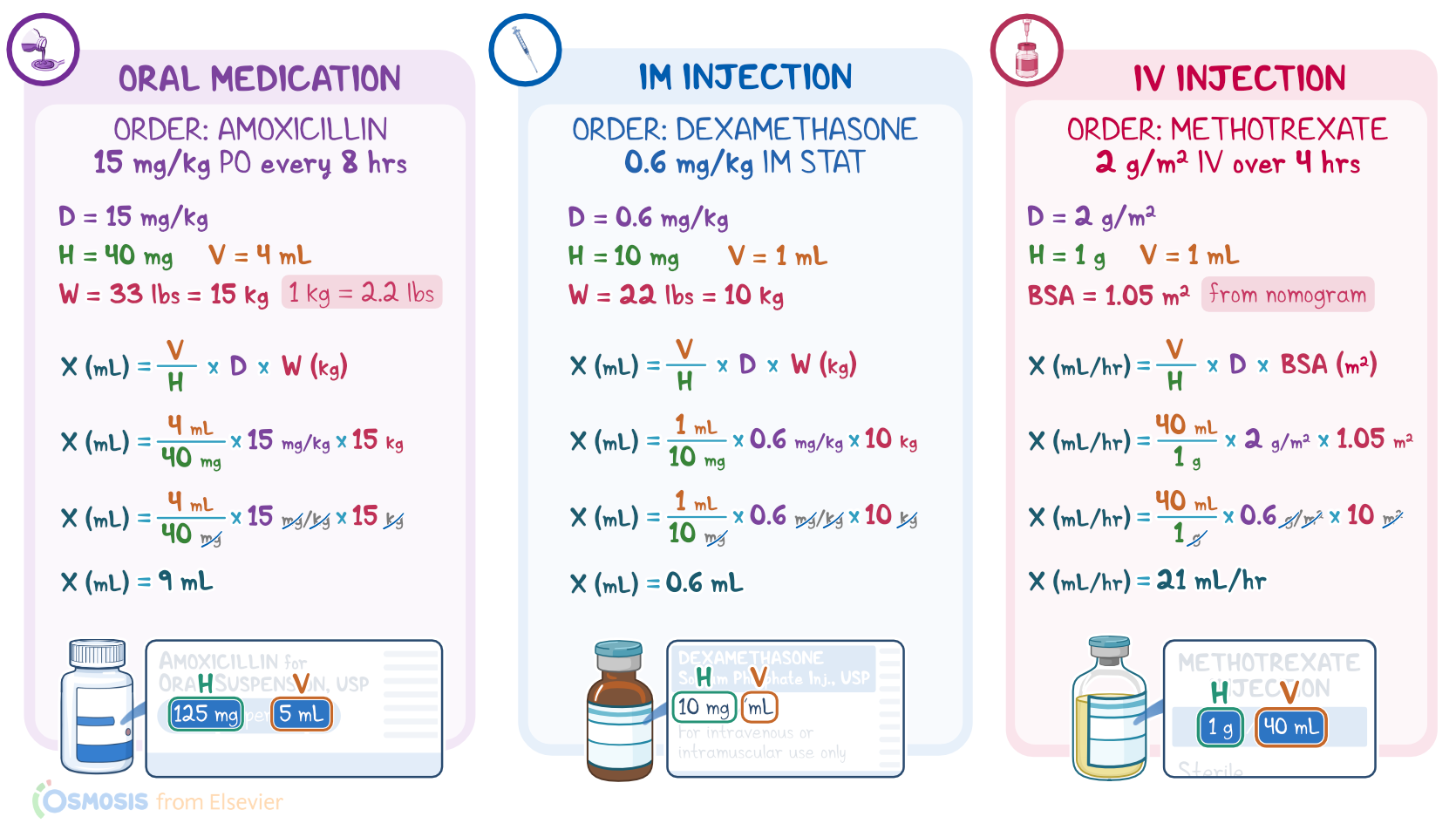
Let’s look at a pediatric oral dosage calculation where a weight-based calculation is required. First, you’ll read the order which is: amoxicillin 15 milligrams per kilogram PO every 8 hours.
Dosage Calculation - Example 1 - PO Weight-based Calculation1:23–4:20
Then, check the medication label.Since the medication comes in 125 milligrams per 5 milliliters, you’ll calculate how many milliliters you should administer to achieve the Desired dose.
To do this, first identify your components, Desired, Have, and Vehicle. In this case, D is 15 milligrams per kilogram, which was obtained from the health care provider’s order.
H is 125 milligrams, which was obtained from the medication label. And V is 5 milliliters, which was also obtained from the medication label.
You also need to know the patient’s weight, which is 33 pounds. Next, you’ll determine if a conversion factor is required.
Since the ordered dose is in milligrams per kilogram and your patient’s weight is in pounds, a conversion factor is needed.
In this case, you’ll use the following conversion factor for kilograms to pounds: 1 kilogram equals 2.2 pounds Now, you can convert the patient’s weight to kilograms before completing the rest of the calculation, which looks like this: X volume in milliliters equals Vehicle over Have multiplied by Desired multiplied by Weight in kilograms.
Or you can place the conversion into the equation which looks like this: X volume in milliliters equals Vehicle over Have multiplied by Desired multiplied by Weight in pounds multiplied by the Conversion factor for kilograms over the Conversion factor for pounds.
Now, plug in the values for the components. Since the Desired dose is 15 milligrams per 1 kilogram, the 1 kilogram is placed in the denominator of the equation.
This gives you X equals 5 milliliters multiplied by 15 milligrams multiplied by 33 pounds multiplied by 1 kilogram divided by 125 milligrams multiplied by 1 kilogram multiplied by 2.2 pounds.
Remember, you can cross out the units of the numerator that match the units of the denominator, because they cancel out.
Now you’ll multiply the numbers in the numerator and then the numbers in the denominator to get 2475 milliliters divided by 275.
Next, divide 2475 milliliters by 275 to solve for X. X = 9 mL This gives you the final answer of 9 milliliters meaning you should administer 9 milliliters of amoxicillin to achieve the prescribed dose of 15 milligrams per kilogram.
Intramuscular, or IM injection is another route of medication administration in pediatric patients. IM injections can cause pain and anxiety in children.
Intramuscular Medications4:20–5:28
Measures like breastfeeding, topical anesthetics, oral sucrose, or distraction during the injection may minimize your patient’s pain and anxiety.
After the injection, comfort measures should be implemented. Also be sure to consider the medication type, volume, and size of your patient when choosing the appropriate injection site such as the vastus lateralis and the rectus femoris muscles of the thigh, the dorsal and ventrogluteal muscles of the buttocks, and the deltoid muscle of the upper arm.
The typical needle length used in pediatric patients is between 5/8 and 1 inch long, and gauge ranges from 22 to 27. Okay, now let’s look at an IM dosage calculation where a weight-based calculation is required.
Dosage Calculation - Example 2 - IM Weight-based Calculation5:28–7:55
First, read the order which is: dexamethasone 0.6 milligrams per kilogram intramuscular injection STAT. Then, check the medication label.
Since the medication comes in 10 milligrams per milliliter, you’ll calculate how many milliliters you should administer to achieve the Desired dose.
To do this, first identify your components, Desired, Have, and Vehicle. In this case, D is 0.6 milligrams per kilogram, which was obtained from the health care provider’s order.
H is 10 milligrams, which was obtained from the medication label. And V is 1 milliliter, which was also obtained from the label.
You also need to know the patient’s weight, which is 22 pounds. Next, you’ll determine if a conversion factor is required.
Since the ordered dose is in milligrams per kilogram and your patient’s weight is in pounds, a conversion factor is needed.
In this case, you’ll use the following conversion factor for kg to pounds: 1 kg = 2.2 pounds Now, let’s set up the equation, where X is the dose in milliliters you'll administer, written out like this: X volume in milliliters equals Vehicle over Have multiplied Desired multiplied by Weight in pounds, multiplied by the Conversion factor for kg over the Conversion factor for pounds.
Now, plug in the values for the components and place the weight portion of the Desired dose in the denominator to get X milliliters equals 1 milliliter multiplied by 0.6 milligrams multiplied by 22 pounds multiplied by 1 kilogram divided by 10 milligrams multiplied by 1 kilogram multiplied by 2.2 pounds.
Remember, you can cross out the units of the numerator that match the units of the denominator, because they cancel out.
Now you’ll multiply the numbers in the numerator and then the numbers in the denominator of the equation to get 13.2 milliliters divided by 22.
This gives you the final answer of 0.6 milliliters meaning you should administer 0.6 milliliters of dexamethasone to achieve the prescribed dose.
Intravenous Medications7:55–8:29
Fluid balance in pediatric patients is different than adults because their bodies are proportionally made of a higher amount of water.
This means you must closely monitor their fluid status to prevent fluid overload. It’s important to use a syringe pump, or an infusion pump with IV tubing that has a calibrated cylinder to ensure appropriate dosing and administration of IV fluids and medication.
Okay, let’s look at an intravenous dosage calculation where a BSA is required. First, you’ll read the order which is: methotrexate 2 grams per meter squared IV over 4 hours.
Dosage Calculation - Example 3 - IV BSA-based Calculation8:29–10:42
Then, check the medication label. Since the medication comes in 1 gram per 40 milliliters, you’ll calculate how many milliliters per hour you should administer to achieve the Desired dose.
To do this, first identify your components, Desired, Have, and Vehicle. In this case, D is 2 grams per meter squared, which was obtained from the health care provider’s order.
H is 1 gram, which was obtained from the medication label. And V is 40 milliliters, which was also obtained from the label.
You also need to know the patient’s BSA, which is 1.05 meter squared. Next, you’ll determine if a conversion factor is required.
To determine this, compare the units of D with the units of H. Because both D and H are in grams, no conversion factor is needed.
Now, let’s set up the equation, where X is the dose in milliliters per 4 hours, written out like this: X volume in milliliters over 4 hours equals Vehicle over Have multiplied by Desired multiplied by the BSA.
Now, plug in the values for the components to get X equals 40 milliliters multiplied by 2 grams multiplied by 1.05 meters squared divided by 4 hours multiplied by 1 meter squared multiplied by 1 gramRemember, you can cross out any duplicate units of measurement because they cancel out.
Now, multiply the numbers in the numerator and then the numbers in the denominator to get X equals 84 milliliters divided by 4 hours.
Next, divide 84 milliliters by 4 hours to solve for X. X = 21 mL/hr This gives you a final answer of 21 milliliters per hour, meaning you will program the infusion pump to infuse 21 milliliters per hour for 4 hours to achieve the total prescribed dose.
Review10:42–10:58
To calculate safe doses, weight-based calculations or calculations based on
| MEDICATION ADMINISTRATION - PEDIATRIC | ||
| KEY POINTS | NOTES | |
| DEFINITION |
| |
| ORAL MEDICATIONS |
| |
| DOSAGE CALCULATION |
| |
| DOSAGE CALCULATION -EXAMPLE 1 - PO WEIGHT-BASED CALCULATION |
| |
| INTRAMUSCULAR INJECTIONS |
| |
| DOSAGE CALCULATION -EXAMPLE 2 - IM WEIGHT-BASED CALCULATION |
| |
| INTRAVENOUS MEDICATIONS |
| |
| DOSAGE CALCULATION - EXAMPLE 3 - IV BSA-BASED CALCULATION |
| |
- "Calculate with confidence. (8th ed.)." Elsevier (2022)
- "Calculation of drug dosages: A work text. (12th ed.)." Elsevier (2023)
- "Clinical calculations: With applications to general and specialty areas. (10th ed.)." Elsevier (2022)
- "Gray Morris's calculate with confidence, Canadian edition. (2nd ed.)." Elsevier (2022)
- "Mulholland's: The nurse, the math, the meds. (5th ed.)." Elsevier (2023)
No notes for this video yet
Try adding a note below