Nutrition - Enteral: Nursing skills
Introduction0:00–0:32
Enteral nutrition provides fluids and nutrients directly into the gi tract through a feeding tube. As a healthcare professional, you'll be responsible for caring for patients receiving enteral nutrition.
Now, enteral nutrition might be especially helpful for patients who have difficulty chewing or swallowing as a result of head or neck trauma surgery, coma, dementia nervous system disorders, or tumors of the head, neck or esophagus.
Enteral nutrition0:32–3:08
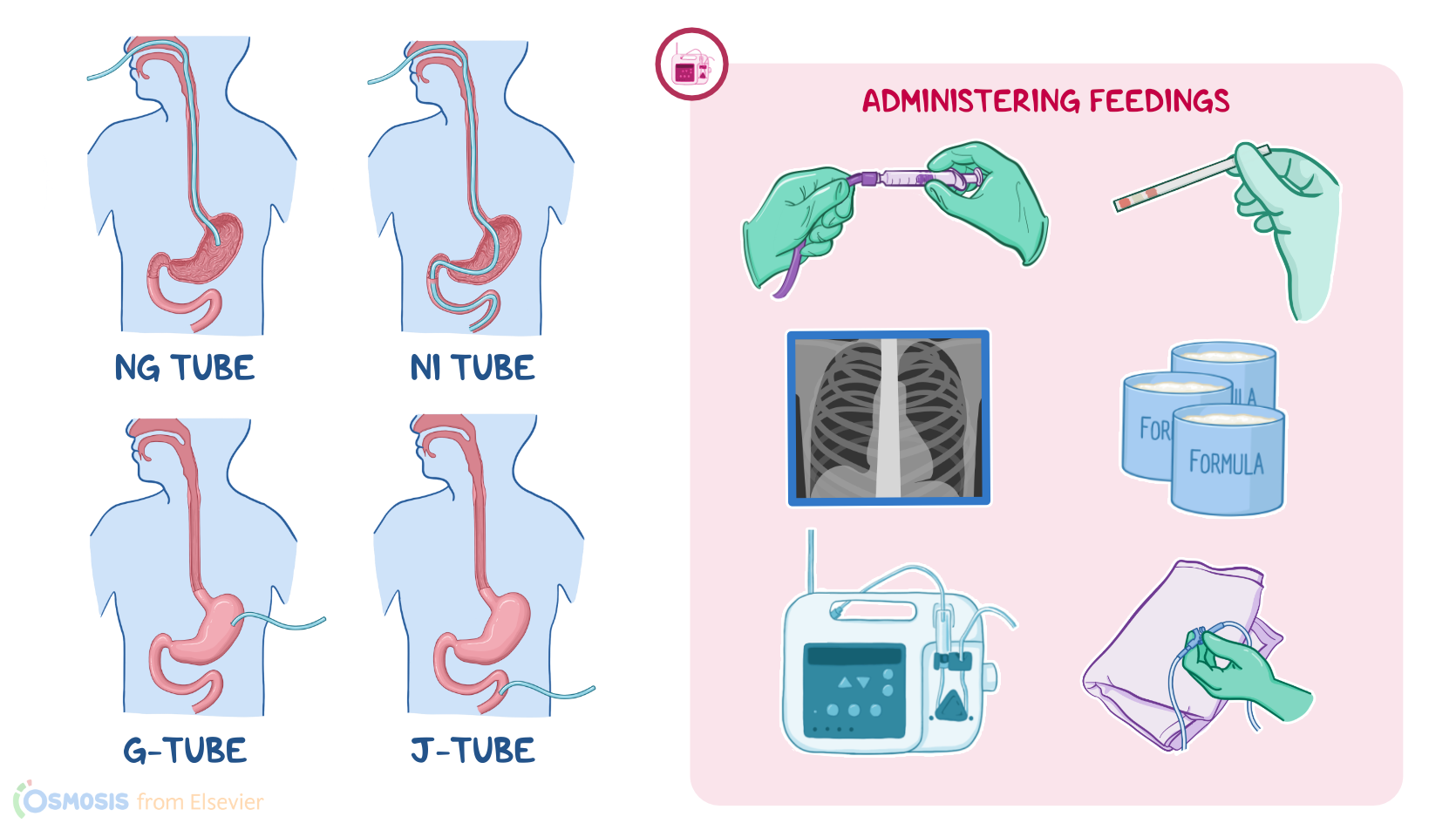
Now, there are various ways a feeding tube can go into the gi tract. The most common one is a nasogastric or NG tube that goes through the nose and then down into the stomach.
A nasointestinal or an I tube also goes through the nose, but it ends in the small intestines. Tubes can also be inserted through a surgical opening or stoma in the abdominal wall and into the stomach, known as a gastrostomy tube or G tube.
A common type of gastrostomy tube is a percutaneous endoscopic gastrostomy tube or peg tube for short, that's inserted directly into the stomach percutaneously with endoscopic guidance.
Finally, tubes can also be inserted into a part of the small intestine called the Jejunum known as a jejunostomy tube or J tube.
J tubes. G tubes and peg tubes are usually inserted if long term tube feedings are anticipated and are typically used for more than six weeks.
Whereas NG and N I tubes are mostly preferred when tube feedings are needed for a short period of time. Typically a few days or up to six weeks.
Once the feeding tube is inserted, its placement is confirmed by X ray. After that, your patient can start receiving enteral nutrition through the tube.
There are different types of nutritional formulas that can be ordered depending on your patient's needs. When you first start a feeding, you'll usually begin feeding slowly while you watch for nausea, abdominal pain or diarrhea, that could indicate feeding intolerance if the initial rate and amount of feeding is tolerated, the feedings can be increased to the desired amount.
Now, enteral nutrition is commonly administered using an infusion pump. In this case, administration schedules can be either continuous or intermittent.
A continuous feeding is when a patient has feedings running through their feeding tube throughout the day. On the flip side, if feedings are scheduled at intervals over the course of the day, this is called an intermittent feeding before starting a feeding.
First review. The patient's chart, collect your supplies and make sure you have the correct formula.
Identify your patient, inform them about the procedure and answer any questions related to the procedure, then perform hand hygiene and apply clean gloves.
Now keep in mind that sometimes the tip of the feeding tube can move to a different location like from the stomach to the intestines or esophagus or from the intestines to the stomach.
Feeding Schedules3:08–4:27
So you'll need to verify the tube's position before starting the feeding by checking the appearance and ph of fluid aspirated through the tube.
Appearance, gastric fluid can range in color from clear and colorless or pale yellow or green. If your patient has been fasting for at least four hours.
If there's still formula in the stomach, the fluid will look like curdled milk. Intestinal fluid is often stained by bile.
So color can range from golden yellow to greenish brown. Next test the PH by applying a few drops of fluid onto a ph indicator strip or you can dip the strip into the medicine cup.
Use a color chart to determine the ph for gastric fluid. A ph of 0 to 4 is normal.
If your patient has been fasting for at least four hours. A ph 5 to 6 may occur if they're receiving continuous feedings.
And a ph, more than six means the tube is in the esophagus lung or small intestines. If the PH does not match the desired location of the tube.
Administering Enteral Feedings4:27–9:03
The feeding should be held until the tube is replaced or placement is confirmed with imaging. Once tube placement is confirmed, prepare to administer the feeding for feedings that will run through an enteral feeding pump.
You'll use either an open or closed system. If you're using an open system, you'll need cans of the prescribed formula and administration bag and an administration set.
First check the expiration date, then shake the cans and cleanse the tops before opening them, attach the tubing to the bag, clamp it to prevent the formula from running through the tube and pour the formula into the bag.
Or if you're using a closed ready to hang system, you'll need a prefilled formula container and an administration set check the expiration date.
Shake the container, remove protective cover from the top of the container and spike the container with administration set tubing after you've prepared the formula, raise the head of your patient bed 30 to 45 degrees or as tolerated to prevent aspiration.
Then adjust the feeding pump pole to ensure the formula container is about 31 centimeters or 12 inches above your patient's head and hang the container on the pole, prime the tubing and insert it into the feeding pump.
Then cleanse the end of your patient's tube and flush it with 30 mL of water or per protocol. Next cleanse the connection port on the administration set and connect it to your patient's tube program, the infusion pump to the prescribed rate, unclamp the tubing and start the pump, ensure there are no obstructions to the flow of formula.
If the pump alarms, make sure to check the tubing hasn't kinked or become blocked. Then after the feeding is concluded, disconnect the administration set from your patient's tube, flush it with 30 mL of water or per protocol and cap the tube.
Remember to keep your patient upright for at least one hour afterwards to prevent aspiration. Now, the formula can also be delivered passively through the feeding tube.
Instead of being pushed forward by the pump, the rate can be controlled using the roller clamp on the tubing. These feedings are usually a slower way to administer formula and might be better tolerated for some patients.
With this method, you'll pour the appropriate amount of formula into a graduated cylinder and then deliver the feeding by gravity through the enteral syringe.
Sometimes to ensure your patient is digesting the enteral nutrition properly. The gastric residual volume can be checked to measure the degree of gastric emptying or how well the stomach digests the tube feeding and moves it to the small intestine to do this.
The end of your patient's tube is connected to an enteral feeding syringe and the plunger is gently retracted to aspirate the stomach contents, then the amount of residual is noted and documented.
A gastric residual of more than 250 mL could be a sign of feeding intolerance and may increase the risk of aspiration. The gastric contents that have been removed typically are replaced to prevent malnutrition or electrolyte disturbances.
Now, when providing enteral nutrition, monitor your patient closely and take steps to prevent complications if your patient has either an NG or N I tube, remember that these tubes can irritate your patient's nasal mucosa.
The insertion site for GI and N I tubes can also become irritated. So be sure to keep the area clean and watch for erythema tenderness or pain at the site.
A protective skin barrier can also be applied to the site. Additionally, be sure to maintain the patency of the tube by flushing it with water.
According to your facility policy, which helps prevent the tube from being clogged. Be sure to look for problems like if fluid is leaking around the insertion site of the G tube, J tube or peg tube, if you were unable to confirm tube placement, or if you measure a gastric residual volume that exceeds the desired amount.
Nursing Implications9:03–9:57
Also report if you observe any signs of aspiration, like coughing, choking, gagging or difficulty breathing during or after the feeding as well as signs or symptoms of intolerance like abdominal pain, nausea, abdominal distension or an elevated gastric residual volume.
Finally, it's important that internal nutrition is never delivered through an intravenous catheter as this can lead to serious consequences including death.
So be sure to use N fit connectors for all enteral feeding sets, syringes and feeding tubes which have a unique design that's incompatible with other nonenteral devices like IV lines.
Review9:57–10:49
All right. As a quick recap, many patients require enteral nutrition to ensure they receive adequate nutrients.
Once the tube is placed, the tube location is confirmed by X ray. Then before feeding can begin, you'll confirm placement through ph testing and visual inspection of the gastric aspirate.
Finally, remember to document your observations along with the care you provided.
| NUTRITION - ENTERAL | ||
| KEY POINTS | NOTES | |
| DEFINITION |
| |
| FEEDING SCHEDULES |
| |
| ADMINISTERING ENTERAL FEEDINGS |
| |
| CLINICAL IMPLICATIONS |
| |
Notes
| NUTRITION - PARENTERAL | ||
| KEY POINTS | NOTES | |
| DEFINITION |
| |
| PARENTERAL NUTRITION |
| |
| ADMINISTRATION |
| |
| NURSING IMPLICATIONS |
| |
- "Clinical nursing skills & techniques (11th ed.). ISBN 978-0-443-10718-4 " Elsevier (2025)
- "Fundamentals of nursing (12th ed.). " Elsevier (2026)
- "Alexander’s Nursing Practice: Hospital and Home. 5th edition. ISBN: 978-0-7020-6230-8 " Elsevier (2019)
- "Clinical Nursing Skills and Techniques - E-Book. 10th ed. ISBN 978032379653 " Elsevier Health Sciences (2021)
- "Fundamentals of Nursing. 11th edition. ISBN: 978-0-323-81034-0 " Elsevier (2022)
- "A guide to enteral nutrition in intensive care units: 10 expert tips for the daily practice. 25(1):424. Published 2021 Dec 14. " Crit Care (2021)
- "Krause and Mahan’s Food and the Nutrition Care Process. 16th edition. ISBN: 978-0-323-81025-8 " Elsevier Canada (2022)
- "Critical Care Nursing: Diagnosis and Management. 9th edition. ISBN: 978-0-323-64295-8 " Elsevier (2021)
No notes for this video yet
Try adding a note below