Physical assessment - Eyes: Nursing

1,090views

Notes

PHYSICAL ASSESSMENT - EYES

KEY POINTS
NOTES
DEFINITION
  • Completed as part of comprehensive or focused assessment 
  • Gives information about vision and eye health
  • Identifies ocular problems early

GETTING STARTED
  • Supplies
    • Snellen/Sloan chart
    • Rosenbaum/Jaeger near vision card
    • Penlight
    • Eye cover 
  • Preparation
    • Adequate light
    • Ensure patient comfort
    • Explain procedure
    • Answer questions
    • Obtain verbal consent 
    • Hand hygiene 
    • Collect supplies
    • Provide privacy

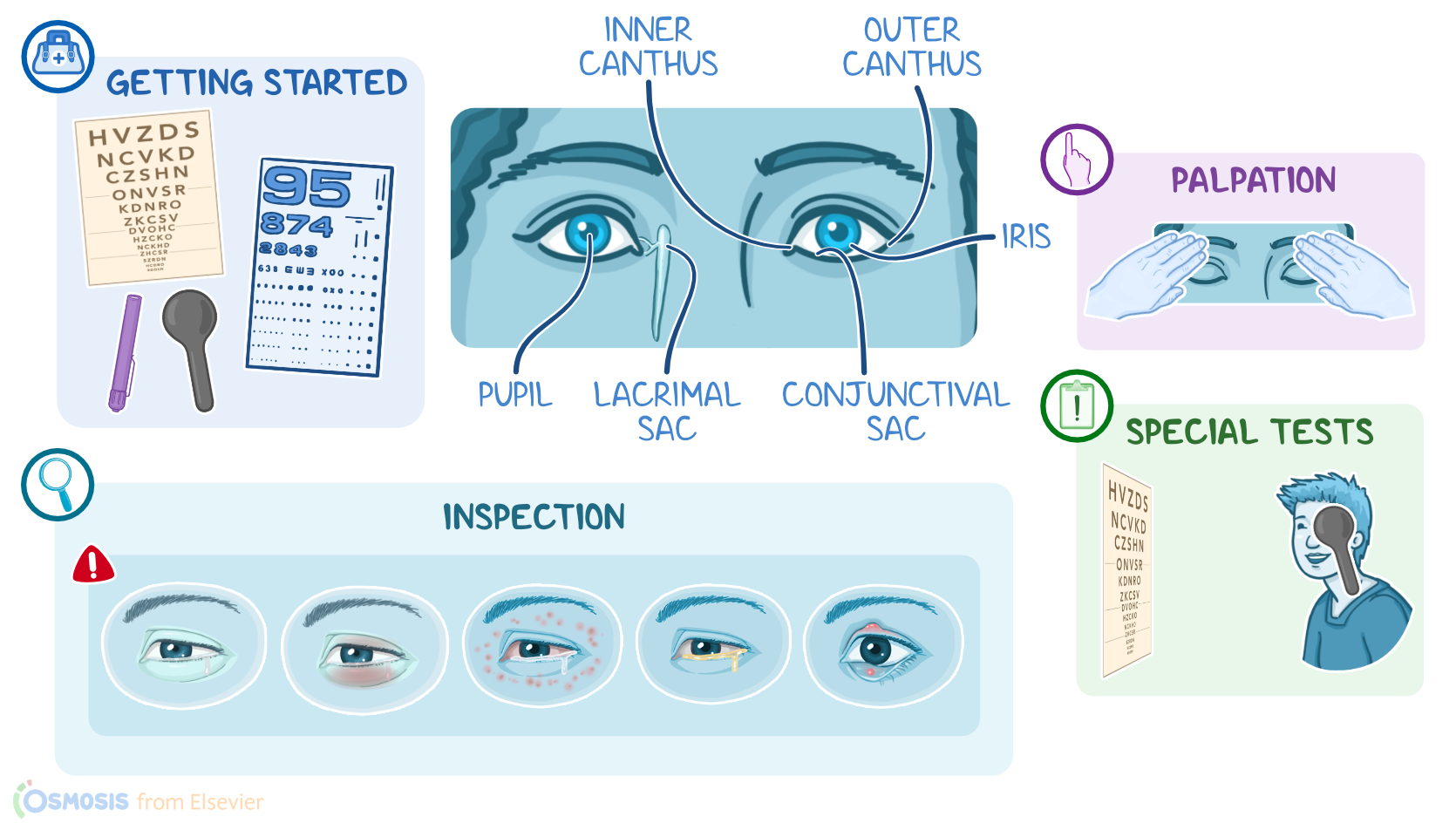
ANATOMICAL LANDMARKS
  • Upper eyelids
  • Lower eyelids
  • Eyebrows
  • Inner canthus
  • Outer canthus
  • Pupil
  • Lacrimal sac
  • Conjunctival sac
  • Iris

METHODS OF ASSESSMENT
  • Inspection
  • Palpation
  • Special tests

INSPECTION
  • External eyes
    • Begin at eyebrows and move downward 
    • Eyelashes and eyebrows should be even 
    • Eyelids should open and close fully 
    • Upper eyelids should cover eyes equally 
    • Abnormal findings 
      • Drooping upper eyelid (ptosis)
        • May result from neuromuscular weakness 
        • Can be linked to cranial nerve three damage 
  • Surrounding structures 
    • Should be free of edema or puffiness 
    • No lesions drainage or nodules present 
    • Xanthelasma  
      • May indicate abnormal lipid metabolism 
  • Sclera and conjunctiva 
    • Sclera should normally appear white 
      • Yellow sclera may suggest liver disease 
    • Conjunctiva should be clear and moist 
      • Redness may indicate conjunctivitis 
  • Iris and lens 
    • Iris should be round and evenly colored 
    • Shine penlight to view lens clarity 
      • Cloudy lens may indicate cataracts 
  • Pupils 
    • Pupils should be round and equal bilaterally 
    • Dim lights to allow pupil dilation 
    • Shine penlight into one eye 
      • Observe for direct constriction 
      • Check for consensual constriction in other eye 
    • Pupil abnormalities 
      • Miosis is abnormal pupil constriction 
        • Often caused by opioid use 
      • Anisocoria is unequal pupil size 
        • Can be normal or disease related 
  • Extraocular muscle strength 
    • Tests cranial nerves III, IV, & VII
      • Ask patient to follow finger with eyes 
      • Move through 6 cardinal gaze fields 
      • Pause at each extreme for one to two seconds 
      • Watch for smooth symmetrical eye movement 
      • Nystagmus  
        • May be normal or indicate muscle weakness 
  • Cover-uncover test 
    • Patient looks at fixed point ahead 
    • Cover one eye and observe other 
      • Uncovered eye should stay focused 
    • Remove cover and observe again 
      • Gaze should remain steady 
    • Strabismus is eye deviation inward 
      • Caused by weak extraocular muscles

PALPATION
  • Palpate 
    • Eyelids
    • Surrounding structures 
  • Feel for nodules, warmth, or discomfort
  • Eyes should be soft, gently pushed on w/o discomfort
  • Resistant to palpation
    • Possible glaucoma or tumor

SPECIAL TESTS
  • Visual acuity  
    • Tests function of cranial nerve II
    • Use Snellen or Sloan chart for distance vision 
    • Patient stands 20 ft from chart 
    • Cover one eye and read letters 
    • Repeat with other eye 
    • Record vision as a fraction 
      • Top number is patient distance from chart 
      • Bottom number is normal reading distance 
    • Larger denominator means worse visual acuity 
    • Vision worse than 20/200 is blindness 
  • Near vision testing 
    • Use Rosenbaum or Jaeger handheld card 
    • Hold card 14 inches from eyes 
    • Patient reads letters or numbers aloud 
    • Stop when letters become too small

NURSING IMPLICATIONS
  • Assess
  • Interpret
  • Document
  • Report abnormal findings to HCP
  • Monitor patient progress and changes from baseline

Transcript

Watch video only

Assessment of the eyes should be completed as part of a comprehensive client assessment or as part of a focused exam when a client is experiencing ocular issues, such as eye pain or blurred vision. This assessment gives the nurse information about vision and general eye health while helping to identify ocular problems at an early stage, such as glaucoma or cataracts. Assessment of the eyes includes several tests which will examine the eye itself as well as screen for ocular diseases or systemic diseases that manifest through the eye, like diabetes or liver disease. Let’s review the process of completing an eye assessment.

Okay, the supplies you’ll need for the eye assessment include a Snellen or Sloan chart, a Rosenbaum or Jaeger near vision card, a penlight, and an eye cover. You should prepare for the eye exam by ensuring you have adequate light, and that your client is comfortable in either a standing or sitting position.

Before getting started, explain the procedure to your client and be sure to answer any questions they might have before obtaining verbal consent. Then, perform hand hygiene and collect your supplies.

Now, locating the anatomical landmarks of the eyes and surrounding tissue will help guide your assessment. These landmarks include the upper eyelids and lower eyelids, eyebrows, the inner canthus and the outer canthus, pupil, lacrimal sac, conjunctival sac, and iris.

Alright, the methods of ocular assessment include inspection and palpation as well as a series of visual tests.

First, you should inspect the external eyes and the surrounding structures, starting at the eyebrows and moving downward. Eyelashes and eyebrows should be evenly distributed. Eyelids should be able to close and open all the way, and upper eyelids should extend equally over both eyes.

If an upper eyelid droops and partially covers the eye, ptosis is present, which may be due to neuromuscular weakness from conditions such as myasthenia gravis or damage to cranial nerve III.

The surrounding structures of the eyes should be without edema, puffiness, lesions, drainage or nodules.

Raised, misshaped, yellow lesions on the surrounding eye tissue, called xanthelasma, may indicate abnormal lipid metabolism.

You’ll also inspect the sclera and conjunctiva for redness and vascularity. The sclera should normally be white but it can appear yellow in clients with liver disease. The conjunctiva should be translucent, but can become pinkish-red in clients with conjunctivitis.

The iris should be round with an even distribution of color. When shining your penlight into the eye, the lens should be transparent; but if it appears cloudy, this can indicate cataracts.