Postmortem care and considerations: Nursing
Nurse Molly works in a skilled nursing facility and is caring for a client, Santiago, at the end of his life. Santiago suffered a heart attack and subsequent stroke, and his extended family is at the bedside. Nurse Molly recognizes that Santiago is nearing the end of his life because his heart rate has slowed down, his skin is blotchy with a purplish tint, and his respirations have become noisy and irregular. Nurse Molly lets Santiago’s family know these clinical manifestations are expected and gives them some privacy during the last moments of his life. Later, Santiago’s daughter, Lucia, approaches the nurse’s station saying, “Please come, I think my dad’s soul has left his body.” Nurse Molly enters Santiago’s room to find his family openly weeping and praying at the bedside. She listens to Santiago’s chest with her stethoscope and does not hear breathing or a heartbeat. Nurse Molly says, “Santiago has passed away. I’m going to let the doctor know. I’m so sorry for your loss.” Lucia grabs Nurse Molly’s hand and says, “I know my dad is no longer in his body but I can’t help but worry about what happens to the body now. He was always a rather private and proud person.”
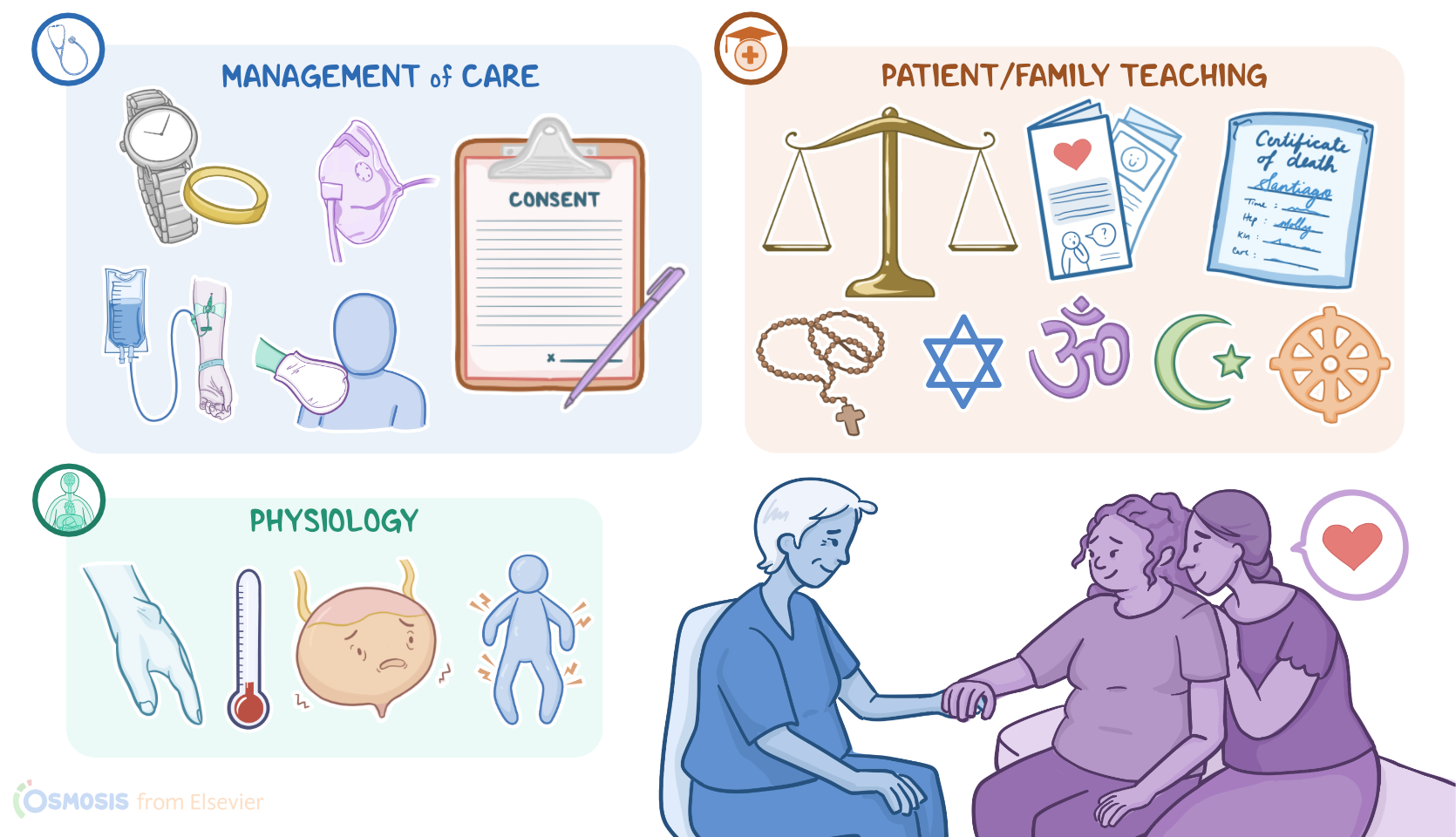
Nurse Molly looks into Lucia’s eyes and responds, “I’ll be here for you and your family and treat your father’s body with dignity and respect. Take as much time as you need and I will be in later to check on you.” Lucia smiles and thanks her. Nurse Molly will use what she knows about postmortem care to help bring comfort to Santiago’s family during this time. So, postmortem care is the care of a client’s body after death. It should be performed in a manner consistent with state law and facility policies as well as the client’s religious or cultural beliefs. The death of a family member can be stressful and confusing for the client’s loved ones, so after the death of a client, the nurse is responsible for providing the client’s family with education and support, completing appropriate documentation, and practicing cultural humility while providing postmortem care.
The nurse can provide education and support to the client’s loved ones by reinforcing and clarifying new information, such as the legal process for organ donation and autopsy. Tissue and organ donation is a complex issue and, in some cultures, it is not allowed or met with reluctance. Due to the sensitive nature of making requests for organ donation, in most cases, professionals educated in this topic will take the responsibility of speaking with the family, rather than the nurse. However, it’s up to the nurse to notify the facility’s organ procurement organization in a timely manner when a client’s death is imminent. The nurse may also need to educate the client’s family on the consent for an autopsy, which is the surgical dissection of a body after death to help determine the cause of death. In cases such as Santiago’s, an autopsy isn’t necessary since his death was caused naturally by a heart attack and stroke.
| POSTMORTEM CARE AND CONSIDERATIONS | ||
| KEY POINTS | NOTES | |
| DEFINITION |
| |
| MANAGEMENT OF CARE |
| |
No notes for this video yet
Try adding a note below