Prenatal screening: Nursing
Introduction0:00–0:17
Prenatal screening can be done to identify the likelihood that a certain fetal disorder or condition is present. Screening is typically completed during the first and second trimesters and can be followed by diagnostic testing to confirm if the fetus is affected.
Alright, so first trimester screenings are done between 11 to 14 weeks of gestation to look for evidence of chromosomal abnormalities, including aneuploidies, which means there’s an abnormal number of chromosomes.
Prenatal Screening: 1st Trimester0:17–1:58
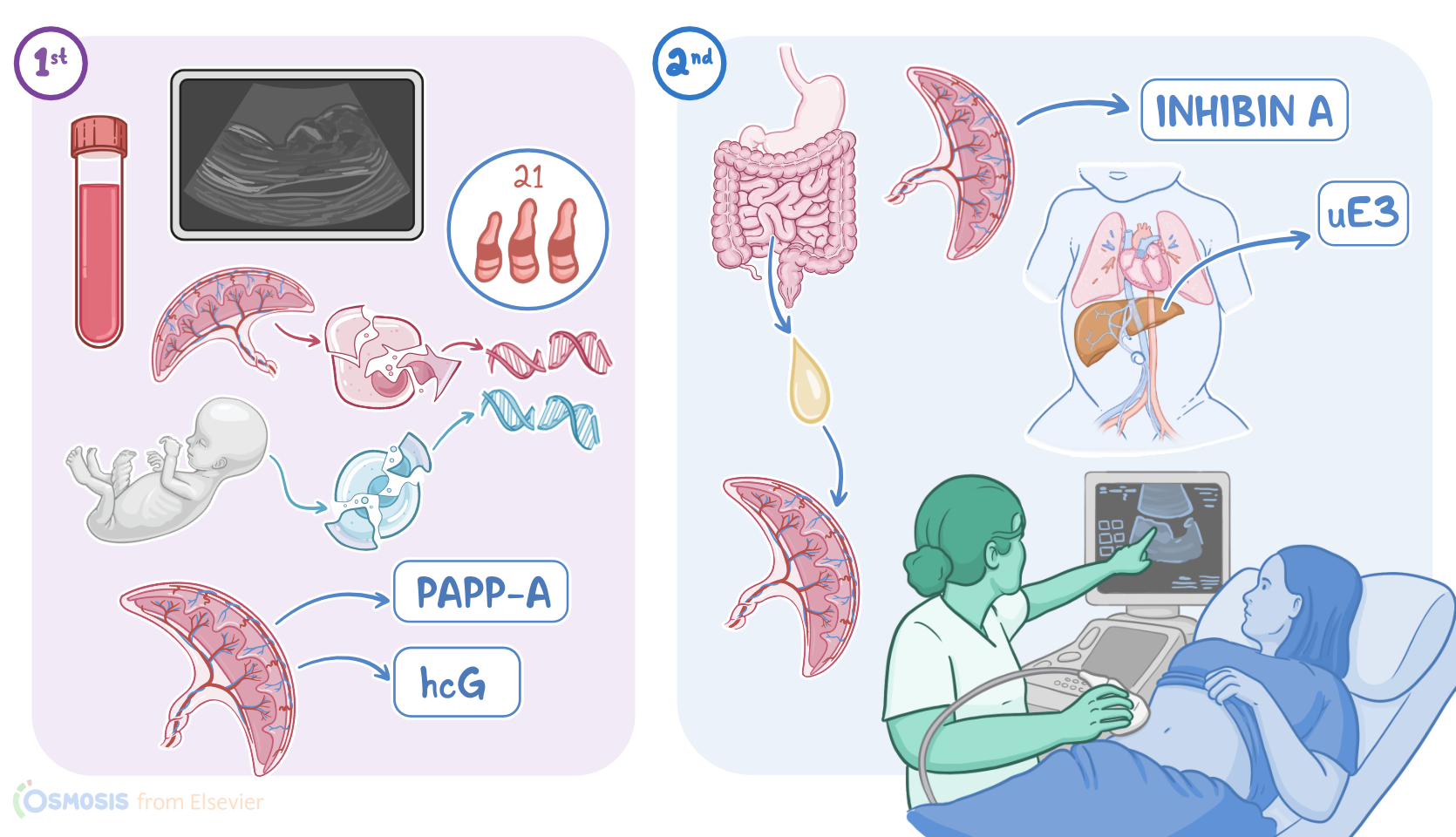
These tests include nuchal translucency, or NT, using ultrasound; as well as a measurement of maternal serum levels of pregnancy-associated plasma protein-A, or PAPP-A; human chorionic gonadotropin, or hCG; and cell-free fetal DNA, or cfDNA.
Nuchal translucency measures the fluid-filled space behind the fetus' neck. An increased amount of fluid is associated with chromosomal abnormalities, including Trisomy 21, also known as Down syndrome, where there’s an extra copy of chromosome 21.
Next, PAPP-A is a glycoprotein made by the placenta. Low levels of PAPP-A are also linked to Trisomy 21.
Then, there’s hCG, which is a hormone made by the placenta. Increased levels of hCG are associated with Trisomy 21, whereas decreased levels are associated with both Trisomy 18, or Edward syndrome, where there’s an extra copy of chromosome 18; and Trisomy 13, known as Patau syndrome, where there’s an extra copy of chromosome 13.
Lastly, cfDNA refers to fragments of DNA from the breakdown of maternal and fetal cells. cfDNA can be used to screen for trisomies, sex chromosome aneuploidies, and other chromosomal microdeletions or duplications.
Prenatal Screening: 2nd Trimester1:58–3:59
In the second trimester, screenings are done between 16 to 18 weeks of gestation, and include hCG; hyperglycosylated hCG; alpha-fetoprotein or AFP; inhibin A; and unconjugated estriol, or uE3.
Screenings are combined in a quad screen, which includes hCG, AFP, inhibin A, and uE3; or a penta screen which adds the hyperglycosylated hCG to the quad screen.
As in the first trimester, hCG can be tested in the second trimester to screen for trisomies. On top of that, increased levels of hyperglycosylated hCG, a variation of hCG, can be indicative of Trisomy 21 or other chromosomal abnormalities; whereas lower levels could predict the likelihood of preeclampsia or early pregnancy loss.
Next, AFP is a glycoprotein that’s produced in the fetal GI system and moves from fetal urine into maternal circulation.
Normally, AFP is undetectable after 14 weeks gestation, but if levels continue to increase past 14 weeks, it can indicate neural tube defects, or NTDs, like anencephaly and spina bifida; or other congenital anomalies, like abdominal wall defects.
On the other hand, low levels of AFP can indicate Trisomy 21 and gestational trophoblastic disease, a condition where abnormal cells grow in the uterus, which can be malignant.
Then, there’s inhibin A, which is a glycoprotein produced by the placenta. Increased levels are associated with Trisomy 21.
Lastly, uE3, is a protein produced by the placenta and fetal liver that rises throughout pregnancy. If uE3 levels are low, it can indicate Trisomy 21 or 18.
Alright, as a quick recap...Prenatal screening can be done to identify the likelihood that a certain fetal disorder or condition is present.
Review3:59–4:32
Screening is typically completed during the first and second trimesters and can be followed by diagnostic testing to confirm if the fetus is affected.
First trimester screenings include nuchal translucency; pregnancy-associated plasma protein-A; human chorionic gonadotropin; and cell-free fetal DNA.
Second trimester screening includes quad or penta screening.
| PRENATAL SCREENING | ||
| KEY POINTS | NOTES | |
| DEFINITION |
| |
| FIRST TRIMESTER |
| |
| SECOND TRIMESTER |
| |
- "Maternity and women’s care. (12th ed.)" Elsevier (2020)
- "Foundations of maternal-newborn & women’s health nursing. (8th ed.)" Elsevier (2024)
No notes for this video yet
Try adding a note below