Psychosocial changes - Postpartum: Nursing

Last updated: July 01, 2022

Psychosocial changes - Postpartum: Nursing

Watch later

Watch later

Preeclampsia and eclampsia: Nursing
Placental abruption: Nursing process (ADPIE)
Lung surfactants and antenatal corticosteroids: Nursing pharmacology
Postpartum hemorrhage: Nursing
Rho(D) immune globulin: Nursing pharmacology
Stages of labor: Nursing
Components of the birth process: Nursing
Analgesics for obstetrics: Nursing pharmacology
Oxytocin and prolactin
Postpartum infections: Nursing
Postterm infant: Nursing
Intrapartum assessment - Uterine activity: Nursing
Perinatal depression: Nursing
Major depressive disorder
Treponema pallidum (Syphilis)
Anatomy and physiology of the female reproductive system
Anatomy of the pelvic girdle
Shoulder dystocia: Nursing
Nutrition - Newborn: Nursing
Newborn adaptation to extrauterine life: Nursing
Persistent pulmonary hypertension of the newborn (PPHN): Nursing
Childhood nutrition and obesity: Information for patients and families (The Primary School)
Prostaglandins: Nursing pharmacology
Psychosocial changes - Postpartum: Nursing
Infant of a diabetic mother (IDM): Nursing
Large for gestational age (LGA) infant: Nursing
Preterm labor: Nursing
Placenta previa: Nursing process (ADPIE)
Premature rupture of membranes (PROM): Nursing
Pain management during labor: Nursing
Cesarean birth: Nursing
Preterm infant: Nursing
Coronary artery disease (CAD) and angina pectoris: Nursing process (ADPIE)
Electrocardiogram (ECG) - Normal sinus rhythm (NSR): Nursing
ECG basics
Antidepressants - Tricyclic antidepressants (TCAs) and monoamine oxidase inhibitors (MAOIs): Nursing pharmacology
Lyme disease: Nursing process (ADPIE)
Shock - Anaphylactic: Nursing
Hypertension: Nursing process (ADPIE)
Amino acids and protein folding
Acute kidney injury (AKI): Nursing process (ADPIE)
Myocarditis: Nursing
Geriatric considerations - Cardiac: Nursing
Hypoparathyroidism: Nursing
Trypanosoma cruzi (Chagas disease)
Pleurisy: Nursing
Angiogenesis inhibitors: Nursing pharmacology
Environmental emergencies: Nursing
Pericardial effusion and cardiac tamponade: Nursing process (ADPIE)
Hyperkalemia
Valvular heart disease: Nursing
Case study - Atrial fibrillation (Afib): Nursing
Preoperative care: Nursing
Myocardial infarction (MI): Nursing process (ADPIE)
Stroke: Nursing process (ADPIE)
Tumor lysis syndrome (TLS): Nursing Process (ADPIE)
Interleaved practice
Complete metabolic panel (CMP) - Potassium: Nursing
Arrhythmias - Ventricular fibrillation (Vfib): Nursing
Arrhythmias - Premature atrial contractions (PACs): Nursing
Rheumatic heart disease: Nursing process (ADPIE)
Arrhythmias - Supraventricular tachycardia (SVT): Nursing
Arrhythmias - Sinus tachycardia and sinus bradycardia: Nursing
Arrhythmias - Atrial flutter (Aflutter): Nursing
Arrhythmias - Asystole: Nursing
Arrhythmias - Premature ventricular contractions (PVCs): Nursing
Arrhythmias - Ventricular tachycardia (Vtach): Nursing
Anemia - Macrocytic: Nursing
Growth and development theories: Nursing
Growth and development - Preschool-age: Nursing

Notes

PSYCHOSOCIAL CHANGES - POSTPARTUM

KEY POINTS
NOTES
DEFINITION
  • Various adjustments and changes that occur during first 6 weeks after giving birth
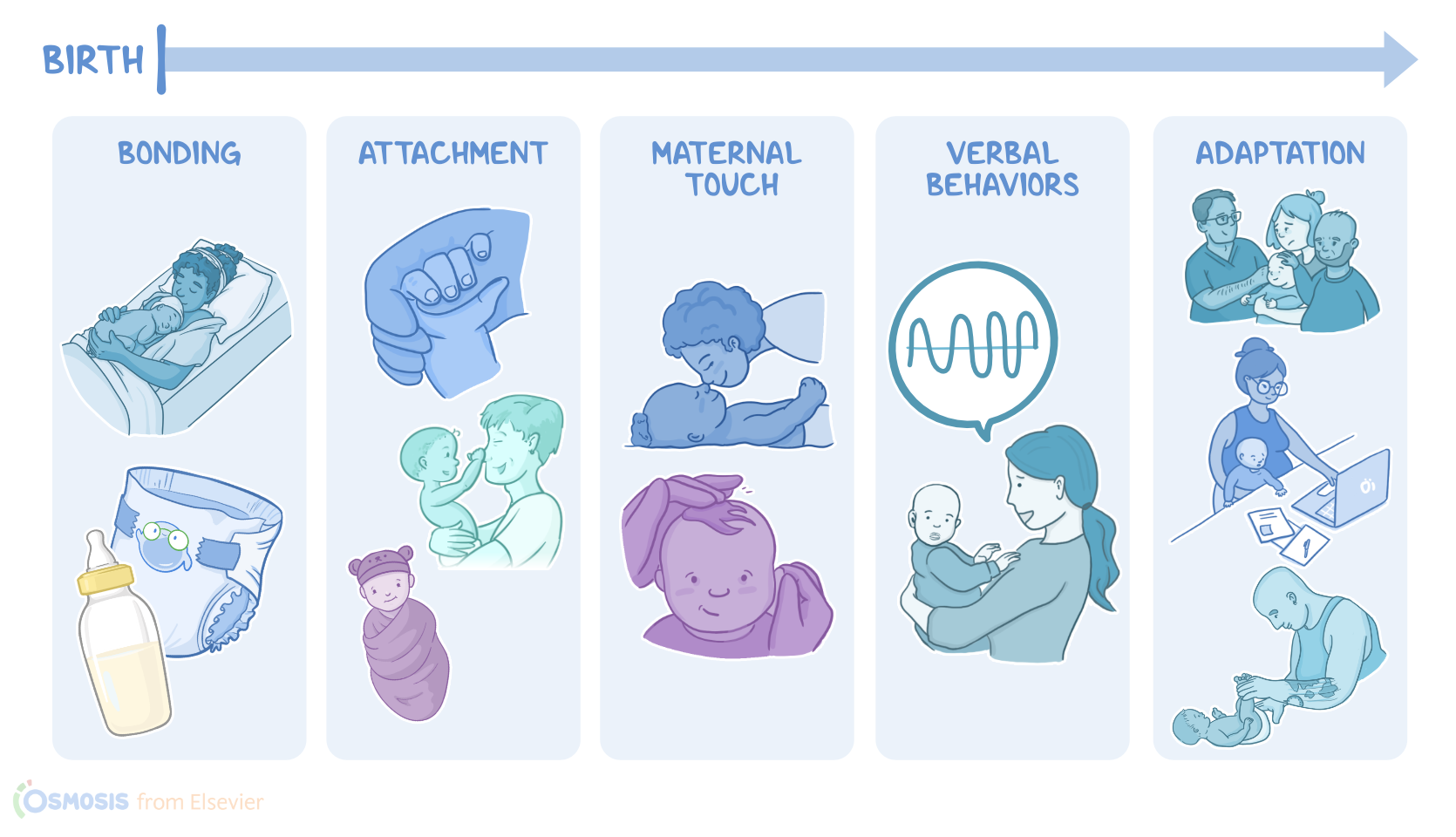
    • Bonding & attachment
    • Maternal touch & verbal behaviors
    • Adaptation
    • Maternal role attainment

BONDING & ATTACHMENT
  • Bonding
    • Intense connection developed by parents for baby
    • May be delayed due to neonatal complications
    • Maternal bonding
    • Paternal bonding
  • Attachment
    • Enduring linkage between the parents and child
    • Reciprocal relationship

MATERNAL TOUCH & VERBAL BEHAVIORS
  • Maternal touch
    • After delivery, mothers use fingertips to touch baby
    • As time passes, start stroking baby’s hair or chest with palm of hands
    • Hold baby close
    • Rub their nose against their baby’s nose or cheek
  • Verbal behaviors
    • Mothers typically use a high-pitched voice while interacting with baby

ADAPTATION
  • Three phases
    • Taking-in
      • Mother recovers from the labor
      • Patients are focused on own physical needs
      • Passive, may rely on a partner or HCP for decision-making
    • Taking-hold
      • Patient becomes more active in care 
      • Gradually adapt and begin focusing on baby.
      • At first, patient may be insecure about skills and competence 
    • Letting go
      • Patient “lets go” of the previous life
      • Embrace new role and responsibility
  • Patient's family will adapt
    • Partner
    • Other children
  • Factors impacting adaptation
    • Maternal age
    • Previous experiences
    • Maternal and infant temperament
    • C-section vs. vaginal birth
    • Neonatal or maternal complications

MATERNAL ROLE ATTAINMENT
  • Four-stage process
    • Anticipatory stage
      • Begins during the pregnancy
      • Seeking role models
      • Fantasizing about maternal role
      • Attending childbirth classes
    • Formal stage
      • Begins after delivery
      • Patient recovers from the labor
      • Learns more about baby’s unique features, cues, and ways of communicating
      • Patient learns from others about maternal role
    • Informal stage
      • Patient has learned baby’s cues
      • Develops their unique mothering methods 
    • Personal stage
      • Development of competence and internalizing maternal role

COMMON MATERNAL CONCERNS
  • Body image
    • Unrealistic expectations of weight loss after pregnancy
  • Postpartum blues
    • Also called baby blues or maternal blues
    • Can begin several days after delivery and usually resolve within 14 days
    • May be associated with 
      • Emotional letdown after delivery
      • Postpartum discomfort
      • Body image concerns
      • Anxiety
    • Signs and symptoms
      • Fatigue
      • Mood swings
      • Irritability
      • Anxiety
      • Crying outbursts
    • Different from perinatal depression

Transcript

Watch video only

Psychosocial changes during the postpartum period include various adjustments and changes that occur during the first 6 weeks after giving birth. The most important psychosocial changes include bonding, attachment, maternal touch and verbal behaviors, as well as adaptation and maternal role attainment. During this period, the nurse should provide support for the new family and intervene to promote a healthy outcome during the postpartum period. First, let’s start with the bonding. Simply said, bonding refers to the intense connection that parents develop for their baby. Important methods to promote maternal bonding include promoting skin-to-skin contact and breastfeeding. On the other hand, paternal bonding can be enhanced with methods including presence during labor and delivery, bathing the baby, changing diapers, and bottle feedings.

Sometimes, the bonding process can be delayed due to neonatal complications that might require admission to the neonatal intensive care unit. When this happens, nursing care involves providing information, encouraging bedside visitation and involvement in their baby’s care, and coordinating resources to support the family. Now, bonding should not be confused with attachment, which refers to an enduring linkage between the parents and their child. It is a reciprocal relationship where the baby receives food, warmth, cuddling, and gentle interaction, and develops feelings of security and trust. In other words, babies can anticipate that their parents or caregivers will be available to support them in times of need. In turn, the baby demonstrates reciprocal attachment behaviors, including making eye contact, tracking their parent’s face or grasping their finger.

Okay, let’s switch gears and move on to maternal touch. Right after delivery, mothers usually use their fingertips to touch their baby. But, as time passes, they typically feel more comfortable and start to stroke their baby’s hair or chest with the palm of their hands. Additionally, they hold their baby close, rub the nose against their baby’s nose, or rub their cheek against their baby’s cheek. While interacting with their babies, mothers typically use a high-pitched voice. Next up is adaptation, which can be divided into three main phases. First is the taking-in phase, which provides time for the mother to recover from the labor, regain strength, and reorganize their thoughts. During this phase, clients are focused on their own physical needs like sleep and nourishment. They are often passive, often preferring to rely on a partner or healthcare providers for decision-making. Second is the taking-hold phase, where the client becomes more active, takes more responsibility for her own care, and does not rely on others for decision-making.

Clients gradually adapt and begin focusing on the baby. At first, clients might be insecure about their skills and competence as a parent. This is an ideal time for the nurse to provide positive reinforcement for caregiving activities, and to encourage the partner’s participation. Finally, the last phase is the letting go phase. That’s when they “let go” of the previous life, embrace their new role and responsibility, as well as the life changes that come with a new baby. Adaptation also applies to other family members, such as the client’s partner and other children. Regarding the partner, the arrival of the baby can change the relationship dynamics, and they also need to adapt and settle into their new role as a parent. Greater partner involvement with caregiving, such as diaper changes or feeding, indicates a greater acceptance of their new role.

The baby’s siblings also need to adapt, and they may show different reactions. Some children may experience fear of replacement, acting out, or regression, while others may have an easier time accepting the baby’s arrival. It’s important to assess their reaction and help them adapt by accepting their feelings, and teaching them to interact with the baby. Now, important factors that can affect adaptation during the postpartum period include maternal age, previous experiences, as well as maternal and infant temperament. Additionally, adaptation might be different in clients who undergo cesarean birth than those who have had a vaginal delivery. Finally, neonatal complications might slow down the process of adaptation, but the family can catch up with the adjustments and changes over the next several months.