Research - Levels of measurement: Nursing
Introduction0:00–0:54
Nurse Remi works in a rehabilitation unit where the majority of clients he cares for are recovering from total hip or knee replacement surgery due to osteoarthritis.
Nurse Remi is interested in conducting a research study to determine the predisposing characteristics of clients diagnosed with osteoarthritis in his unit, but first must complete a literature review to gather a list of these characteristics.
Nurse Remi shares his idea with the unit manager, Nurse Sharron, saying, “There are so many risk factors for osteoarthritis, how do I categorize them all?” Nurse Sharron says, “In research, there are rules for organizing data called levels of measurement, and I can help you manage these.” So Nurse Remi and Nurse Sharron went about using levels of measurement to categorize the risk factors associated with development of osteoarthritis.
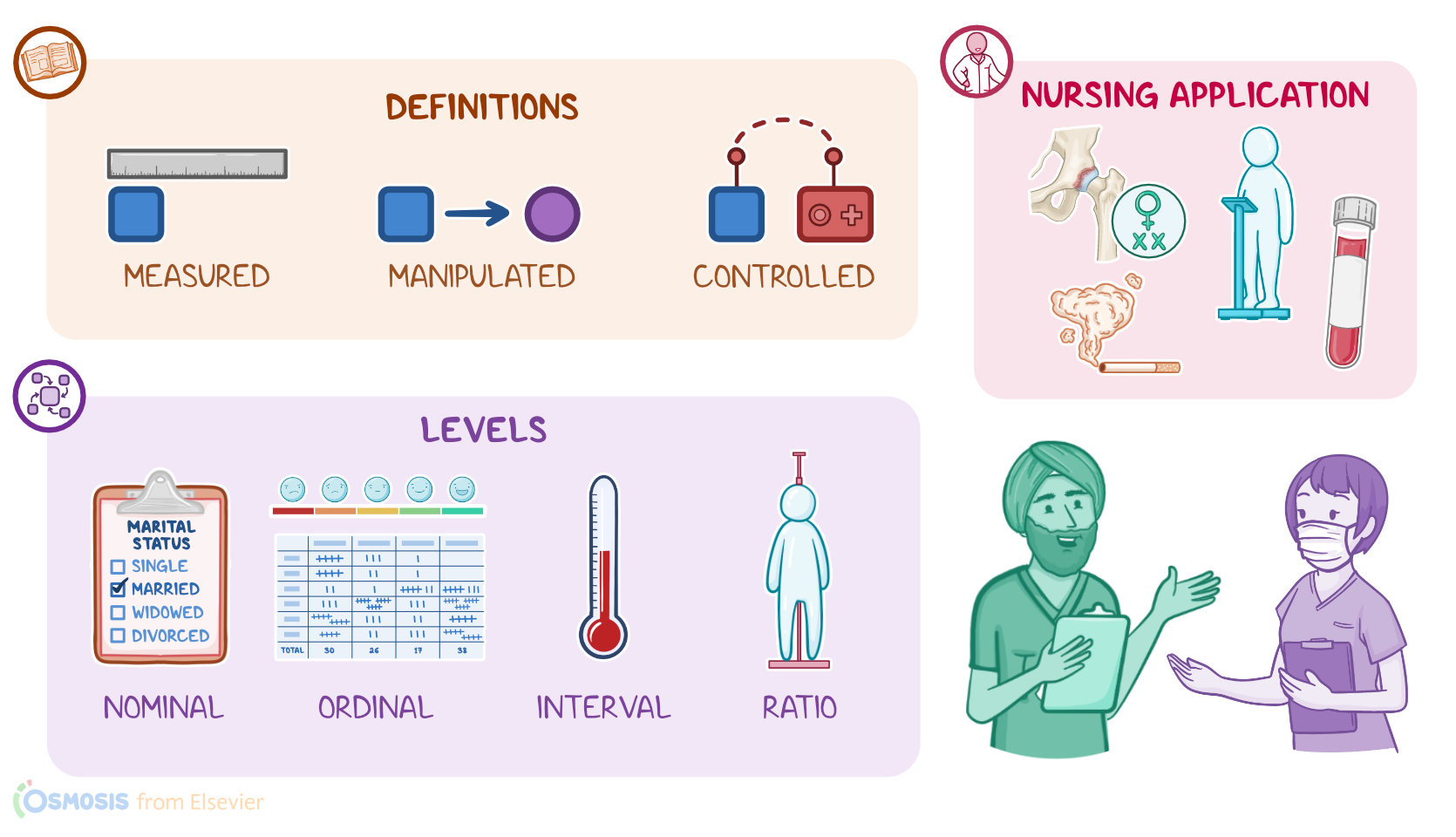
Okay, so levels of measurement, also called scales of measurement, tell you how variables are recorded in research. Variables are concepts that are measured, manipulated, and controlled in a study.
Defining Levels of Measurement0:54–1:14
Understanding the levels of measurement helps you to correctly measure the concept of interest, and then use the appropriate statistics to analyze your data.There are four levels of measurement which include nominal, ordinal, interval, and ratio.
The Four Levels of Measurement1:14–6:15
First, there is nominal, or categorical measurement. Nominal data is organized into categories that are exclusive, exhaustive, and unranked data.
For example, when assessing marital status, a participant cannot say they are both single and married; they must choose one exclusive category or the other.
In addition, marital status can’t be ranked, like being single is not better or worse than being married. Nominal data is exhaustive too, meaning they include all possible variations of the attribute that’s being measured.
For example, when you flip a coin, you must either get heads or tails. You can also use nominal measurement when collecting data on the participants, such as blood type or eye color.
Although nominal data cannot be used in mathematical operations, you can use it to keep a tally of your variables, and then provide a descriptive summary of them.
Next is ordinal which is a type of categorical measurement where, like with nominal data, the data are assigned into exclusive and exhaustive categories; but ordinal data also can be ranked to describe how much of an attribute they have.
An example of ordinal data is the level of education, such as high school diploma, Associate’s degree, Bachelor's degree and Master's degree.
Now, even though ordinal data can be ranked, the distance between the categories should not be assumed to be equal. For example, we can rank a Master's degree higher than an Associate's degree which ranks higher than a high school diploma, but this doesn’t tell us how much higher one degree is from another.
Another example of ordinal data is the responses study participants provide on a Likert scale, such as strongly disagree, disagree, neutral, agree, and strongly agree.
Just like nominal data, ordinal data cannot be used in mathematical operations, but it can be tallied and summarized. Then we have the interval level measurement, which has all the characteristics of nominal and ordinal data in that it’s exclusive, exhaustive, and can be ranked, but with interval data the values on the scale have an equal distance in between them, and it’s assumed that the numbers on the interval scale are on a continuum.
An example of interval measurement is body temperature measured in Fahrenheit. The difference between a temperature of 70 degrees Fahrenheit and 80 degrees Fahrenheit is the same as the difference between a temperature of 30 degrees Fahrenheit and 40 degrees Fahrenheit.
Although the Fahrenheit scale has a zero, it’s arbitrary since zero on the scale does not mean there’s an absence of temperature.
Also, interval data can be used in mathematical calculations, because it can be summed, averaged, and subtracted. Interval data can also be used in statistical calculations to understand relationships between variables.
Lastly, there’s ratio level measurement, which has all of the characteristics of the other types of measurement, including exclusive and exhaustive categories, rank ordering, and equal spacing between variables.
In addition, data on a ratio scale includes an absolute zero point. For example, measurement of height, weight, blood pressure, or laboratory values such as blood glucose, are considered ratio data.
This is because they all represent the absolute value of the variable, including a complete absence of it. Ratio data is considered the highest level of measurement because it allows you to perform all kinds of mathematical and statistical analyses to determine relationships between variables.
Okay, let’s check back in with Nurse Remi and Nurse Sharron who have gathered some data from the existing literature for inclusion in the study about osteoarthritis.
Nurse Remi compiled data for nominal measurement by documenting the assigned sex of participants that are most likely to develop osteoarthritis, which was female.
For ordinal measurement, Nurse Sharron collected data on cigarette smoking where participants were asked to rank their frequency of smoking as non-smoker, light smoker, medium smoker and heavy smoker.
Nurse Sharron also collects data on the body mass index, or BMI, which is considered interval data, where a higher BMI is correlated with development of osteoarthritis.
Finally, Nurse Remi collects data on the presence of serum inflammatory markers which are correlated with developing osteoarthritis; these are considered ratio measurements.
After reviewing this data, Nurse Remi says to Nurse Sharron, “Thanks for helping me organize these variables into levels of measurement.
I think I’m ready to start planning my study!” All right, as a quick recap…Levels of measurement, also called scales of measurement, tell you how variables are recorded in research.
Summary6:15–6:39
There are four levels of measurement, nominal, ordinal, interval and ratio. The level in which variables are measured can impact the production of statistically meaningful results, which are important to inform and guide nursing practice.
| RESEARCH - LEVELS OF MEASUREMENT | ||
| KEY POINTS | NOTES | |
| INTRODUCTION |
| |
| DEFINITION |
| |
| FOUR LEVELS OF MEASUREMENT |
| |
| NURSING IMPLICATIONS |
| |
No notes for this video yet
Try adding a note below