Rehabilitative care: Nursing
Introduction0:00–0:38
Rehabilitative care refers to the management of disabilities and chronic health conditions across the lifespan. It can take place in many settings like an acute care hospital, inpatient rehabilitation center, or at your patient’s home.
As a nurse, you’ll collaborate with the interprofessional health care team, including nurses, social workers, case managers, physical therapists, dietitians, speech-language pathologists, and physicians, to support your patient’s functional abilities and prevent complications.
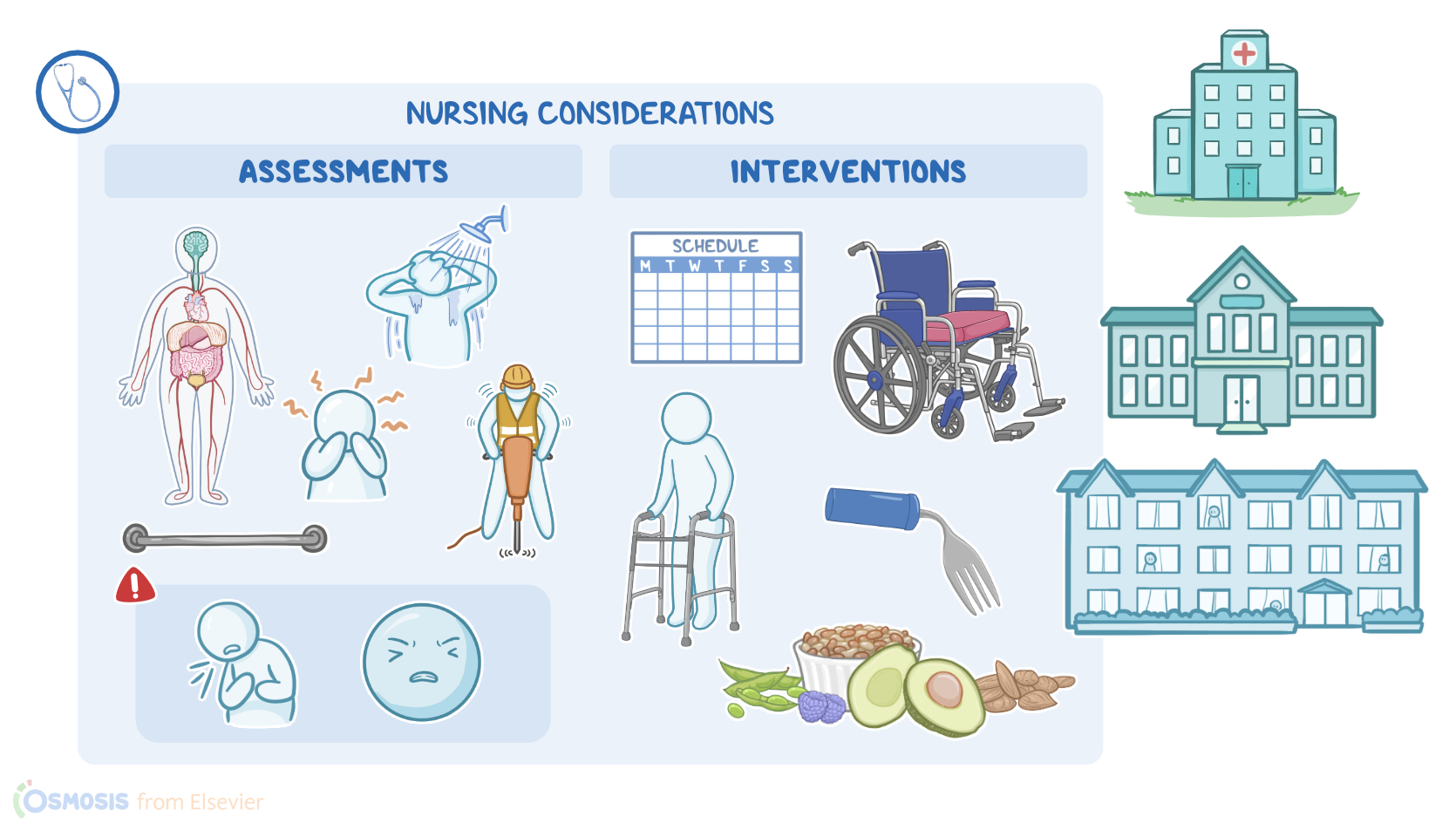
When caring for your patient in rehabilitative care, your assessments will include physical, functional, psychosocial, vocational, and home safety assessments.
Nursing Considerations - Assessments0:38–2:56
Begin by completing a physical assessment of your patient’s major body systems with a focus on their current functional abilities.
Assess their ability to complete activities of daily living, or ADLs, such as bathing, bowel and bladder elimination, and dressing.
You’ll also assess their nutritional status, including the presence of chewing or swallowing problems, and their ability to prepare meals.
Also be sure to assess their sensory function, and the use of glasses or hearing aids. During your assessment, note any signs or symptoms that may impact your patient’s ability to participate in rehabilitation, like shortness of breath or uncontrolled pain.
Next, assess their psychosocial status by determining how they feel about their changes in health and loss of function, sources of stress, and their support system.
Look for indications of anxiety or depression, such as loss of appetite or problems with sleep. Also, take note of any cultural, spiritual, or religious needs that may impact care.
If your patient is employed, you’ll also perform a vocational assessment to examine the cognitive and physical demands of your patient’s job.
Then, along with the rehabilitation team, you’ll determine if job modifications or adaptive equipment will be needed to help them continue working.
Lastly, you should perform a home assessment to ensure your patient will be discharged to a safe environment. You’ll examine the accessibility of frequently used rooms, such as the bathroom, bedroom, and kitchen, and determine if any modifications are needed, such as a raised toilet seat, handrails, or brighter lighting.
Alright, your interventions will be focused on supporting your patient’s functional abilities and preventing complications.
Nursing Considerations - Interventions2:56–6:29
First, you’ll work with the physical therapist to promote your patient’s mobility with gait training and the use of ambulatory aids.
To avoid fatigue, be sure to schedule therapy sessions when your patient has the most energy. For example, if your patient has more energy in the morning, encourage them to do more activities during that time, advise your patient to take rest periods periodically and space out activities accordingly.
Also be sure to take steps to prevent impaired skin integrity that can result from limited mobility. For example, if your patient uses a wheelchair, ensure they have a seating cushion that helps to reduce pressure on bony prominences, assist them with scheduled position changes, and provide regular skin care.
When assisting with ADLs, encourage your patient to perform as much independent self-care as possible. Collaborate with the occupational therapist to assist them in using adaptive devices, as needed.
Provide ample time for them to practice so they can increase their independence in ADLs. For instance, if your patient has a weak hand grip, help them to use modified eating utensils so they can feed themselves more easily.
To promote your patient’s elimination patterns, you’ll start by focusing your care on preventing urinary retention, infection, or incontinence.
If your patient has urge incontinence, establish consistent toileting routines to prevent incontinence. If your patient can’t completely empty their bladder, take steps to prevent infection from retained urine by measuring their post-voiding residual, which is the amount of urine remaining in the bladder after voiding; teach them how to perform a Crede maneuver by applying gentle downward pressure over the bladder to help it empty; or perform intermittent catheterization, as needed.
Likewise, you’ll help your patient establish a normal pattern for bowel elimination through interventions like establishing a toileting schedule, dietary modifications, or administering the prescribed laxative medications.
Next, collaborate with your unit’s dietitian to ensure your patient’s diet supplies the nutrients needed to promote healing and maintain tissue integrity.
If your patient has dysphagia, implement the recommendations of the speech-language pathologist for modified-textured foods or thickened liquids to prevent choking or aspiration.
Finally, you’ll play a central role in managing your patient’s transition from rehabilitative care to home or other facilities like a skilled nursing or long-term acute care facility.
Along with your patient’s family and the health care team, you’ll determine the potential needs of your patient after discharge and coordinate with the social worker to provide the support services and resources they’ll need.
Discuss the details of their follow-up appointments, and ensure they know how to contact their health care provider if needed.
Alright, as a quick recap...Rehabilitative care refers to the management of disabilities and chronic health conditions across the lifespan.
Review6:29–6:51
Your nursing assessment for a patient undergoing rehabilitative care includes physical, functional, psychosocial, vocational, and home assessments; while your interventions are focused on supporting
| REHABILITATIVE CARE | ||
| KEY POINTS | NOTES | |
| DEFINITION |
| |
| NURSING CONSIDERATINOS - ASSESSMENTS |
| |
| NURSING CONSIDERATIONS - INTERVENTIONS |
| |
- "Medical-surgical nursing: Concepts for interprofessional and collaborative care. (10th ed.)" Elsevier (2021)
No notes for this video yet
Try adding a note below