Research designs: Nursing
Introduction0:00–0:45
However, after assessing them, Nurse Ian isn’t able to identify a specific cause. It seems, though, that the students generally tend to feel better after sitting quietly in the office for a few minutes and then are ready to return to class.
Nurse Ian wonders if the symptoms are related to stress and decides to conduct a literature review to better understand if implementing stress reduction techniques helps to lower nurse office visits.
As Nurse Ian reviews the literature, he discovers different kinds of research designs that address the topic. Okay, so research is a systematic process of validating, refining, and generating knowledge.
Defining Research and Research Designs0:45–1:21
It is used by nurses and other members of the healthcare team to answer questions that come up when caring for clients. When conducting research, a research design is chosen, which is the overall strategy used to organize the study in order to answer the research question.
The two broad approaches to research design are quantitative and qualitative. There are also mixed-method designs, which combine both quantitative and qualitative into one research study.First, let’s look at quantitative research designs, which are systematic and objective.
Quantitative Research Designs1:21–3:33
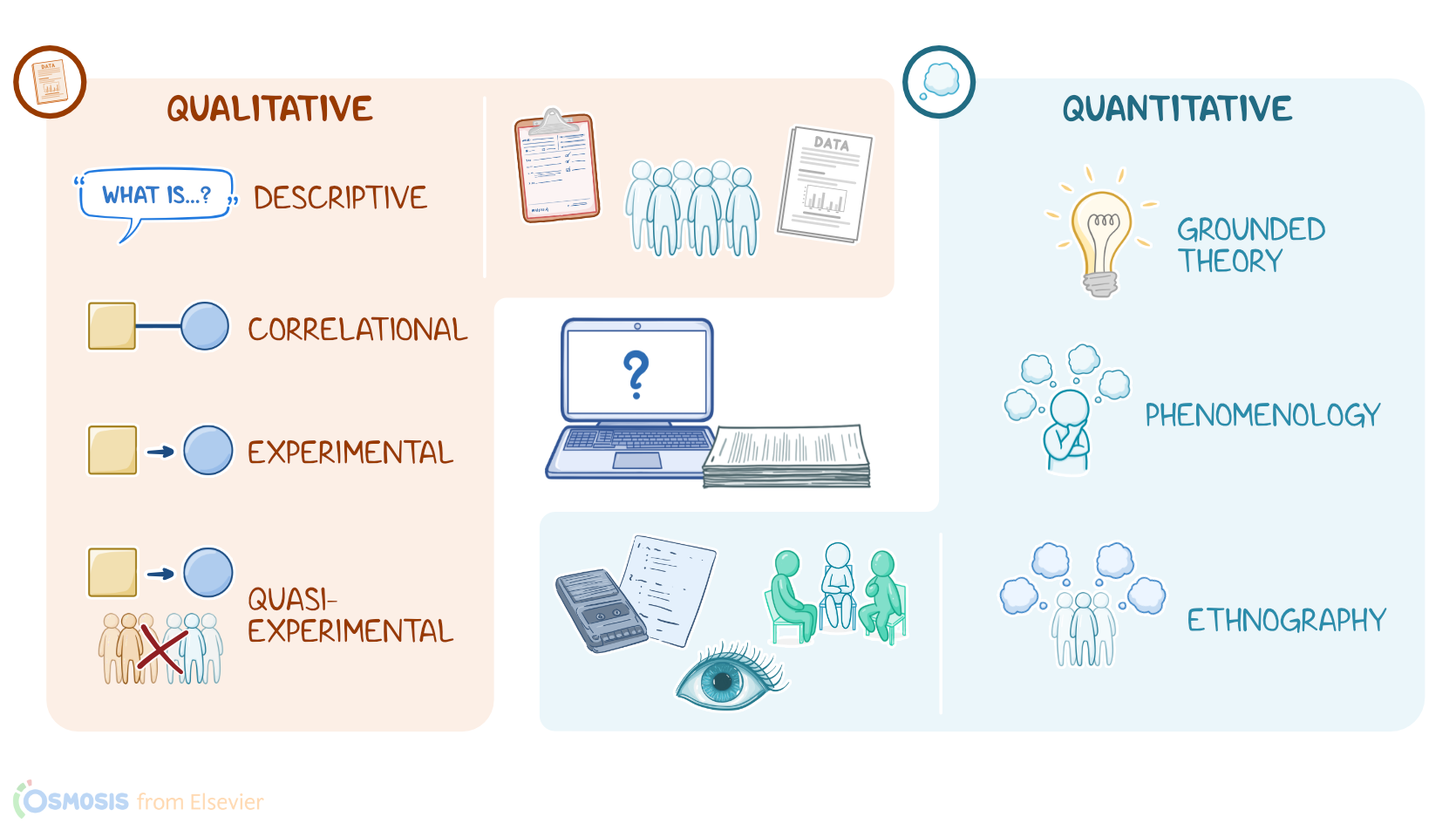
These studies primarily use numerical and statistical data, which can come from formal experiments, surveys, clinical trials, information from existing data sets, or questionnaires.Now, quantitative research designs include descriptive, correlational, experimental, and quasi-experimental designs.
Descriptive research is used to understand more about a population or phenomenon. It often answers a “What is?” type of question, like the article Nurse Ian finds that answers the question “What are the characteristics of students who visit the school nurse?” Next, there’s correlational research, which shows the relationship between two or more variables.
An example of a correlational research study that Nurse Ian found showed the relationship between stress reduction techniques like meditation and the number of nurse office visits.
Another type of quantitative research is experimental research, which aims to find a cause and effect relationship. Nurse Ian located a study where the researchers randomized one group of students into an experimental group that did guided meditation at the beginning of each day, and a second, control group, that did no guided meditation at the beginning of each day.
Their research showed that the students in the experimental group required significantly less visits to the school nurse than the control group.
Lastly, quasi-experimental research is similar to experimental research in that it looks for cause and effect relationships; however, it does not use randomization of experimental and control groups, typically because randomization is not possible in the population being studied.
In one quasi-experimental research study that Nurse Ian discovered, the researchers collected data over 2 months on the number of times 4th grade students at one school had to leave early due to illness.
Then, they had the same 4th grade students do 10 minutes of yoga daily during recess to see if the number of times the students had to leave early due to illness increased, decreased, or had no change.The other approach is qualitative research design, which focuses on collecting information that is non-numeric.
Qualitative Research Designs3:33–5:07
Qualitative researchers generally aim to understand participants’ experiences and perceptions rather than statistical data.
When conducting qualitative research, data can be collected through interviews, observations, focus groups, and artifacts, such as diaries or documents.
Now, just like quantitative designs, there are also several types, including, grounded theory, phenomenology, and ethnography.
First, there are grounded theory studies that aim to create theories about social processes from the data collected. A grounded theory study Nurse Ian read was about a researcher who interviewed 55 school-aged students about their experience with stress, and developed a theory about school-related stress in school-aged students.
Phenomenological studies are designed to understand the lived experiences of participants who have a shared experience or phenomenon, such as the study that Nurse Ian found which described the experiences of school-aged students who were experiencing bullying at school.
Lastly, there’s ethnography, where the researcher seeks to understand the shared experiences of a particular group, often by observing the group and becoming immersed in their lives.
Okay, so nurses should understand the different types of research designs so they can evaluate which type of design will best help to answer their clinical practice question.
Research Designs and Nursing Practice5:07–5:07
Research Designs and Nursing Practice5:07–6:06
Once a clinical practice question is answered, the research findings can be translated into practice, which will ultimately benefit clients and the healthcare system.
He also determines that stress reduction techniques show promise in reducing stress as well as the number of nursing office visits.
With this in mind, Nurse Ian uses the research findings in his own practice as a school nurse, and develops a project to promote stress reduction techniques like meditation to decrease stress in school-aged children.
Review6:06–6:55
Alright, as a quick recap… Research is a systematic process of validating, refining, and generating knowledge to answer questions that can improve clinical practice and client outcomes.
The design of a research study is a crucial part of conducting a successful research study, which can be approached quantitatively, qualitatively or through a mixed-method design.
Quantitative research can be descriptive, correlational, experimental, or quasi-experimental; whereas qualitative studies can include grounded theory, phenomenology, and ethnography.
Nurses should be familiar with the different types of research designs so they can evaluate which type of design will best answer their clinical practice question.
The research can then be translated into practice and improve
| RESEARCH DESIGNS | ||
| KEY POINTS | NOTES | |
| INTRODUCTION |
| |
| DEFINITIONS |
| |
| QUANTITATIVE RESEARCH DESIGNS |
| |
| QUALITATIVE RESEARCH DESIGNS |
| |
| NURSING IMPLICATIONS |
| |
No notes for this video yet
Try adding a note below