Standards and methods of documentation: Nursing
Introduction0:00–1:26
Nurse Steve is a nurse working on a medical unit. He calls the healthcare provider to address a client’s pain, and the healthcare provider gives Nurse Steve an order over the phone, saying “You can put in a prescription for 30 mg codeine PO every 4 hours.” Nurse Steve reads the order back aloud and the healthcare provider confirms it.
Nurse Steve calls the healthcare provider back and informs them of the allergy alert. The healthcare provider tells Nurse Steve, “You can override that alert.
They have taken this medication before and tolerated it fine.” After ending the call, Nurse Steve enters the client’s room to inquire about this documented allergy.
But in reality, it was a side effect of taking the medication on an empty stomach. The client reports that she has taken codeine at home as prescribed without any allergic reactions.
Nurse Steve will use what he knows about documentation to ensure there’s an accurate account of this clinical decision in the health record.Documentation is a communication strategy that allows members of the healthcare team to provide a written account of client information, such as assessments, interventions and responses.
Defining Documentation in the Health Record1:26–1:47
Documentation can be handwritten or electronically stored within the health record, which provides a real-time account of medical and nursing care.
Okay, accurate documentation in the health record is necessary to communicate with all members of the healthcare team regarding the client’s status, plan, and care.
Significance of Documentation1:47–3:47
It is also crucial for several other reasons such as legal protection, facility reimbursement and quality improvement, or QI.
First, documentation is one of the best defenses for litigation in healthcare, and by documenting nursing care you can limit legal liability by showing evidence that you followed the standards of practice.
Remember the common saying, “If you didn’t document it, it didn’t happen.” This means that documenting the care you provide is just as crucial as providing safe and effective care.
For example, if a client develops an extravasation from an IV medication and the nurse didn’t document the assessments they performed, the nurse could be liable for this preventable complication.
Next, documentation is also crucial for financial reimbursement for healthcare services. Insurance companies look at the health record to determine the amount of payment healthcare facilities receive for providing client care.
Nursing documentation that includes a clear description of a client’s treatments, prescriptions, and the supplies used helps to expedite timely and appropriate reimbursement.
If Nurse Steve administers the codeine but forgets to document a pain reassessment later on, the hospital may lose reimbursement for failing to follow the quality standards for the treatment and assessment of acute pain.
The health record can also generate data for QI since it allows for clinicians to track and evaluate client care over time.
For example, if nursing documentation reflects that clients who are out of bed more often develop fewer postoperative infections, this could prompt a QI project aimed at increasing client ambulation.Let's learn about the different methods of documentation.
Methods of Documentation3:47–5:20
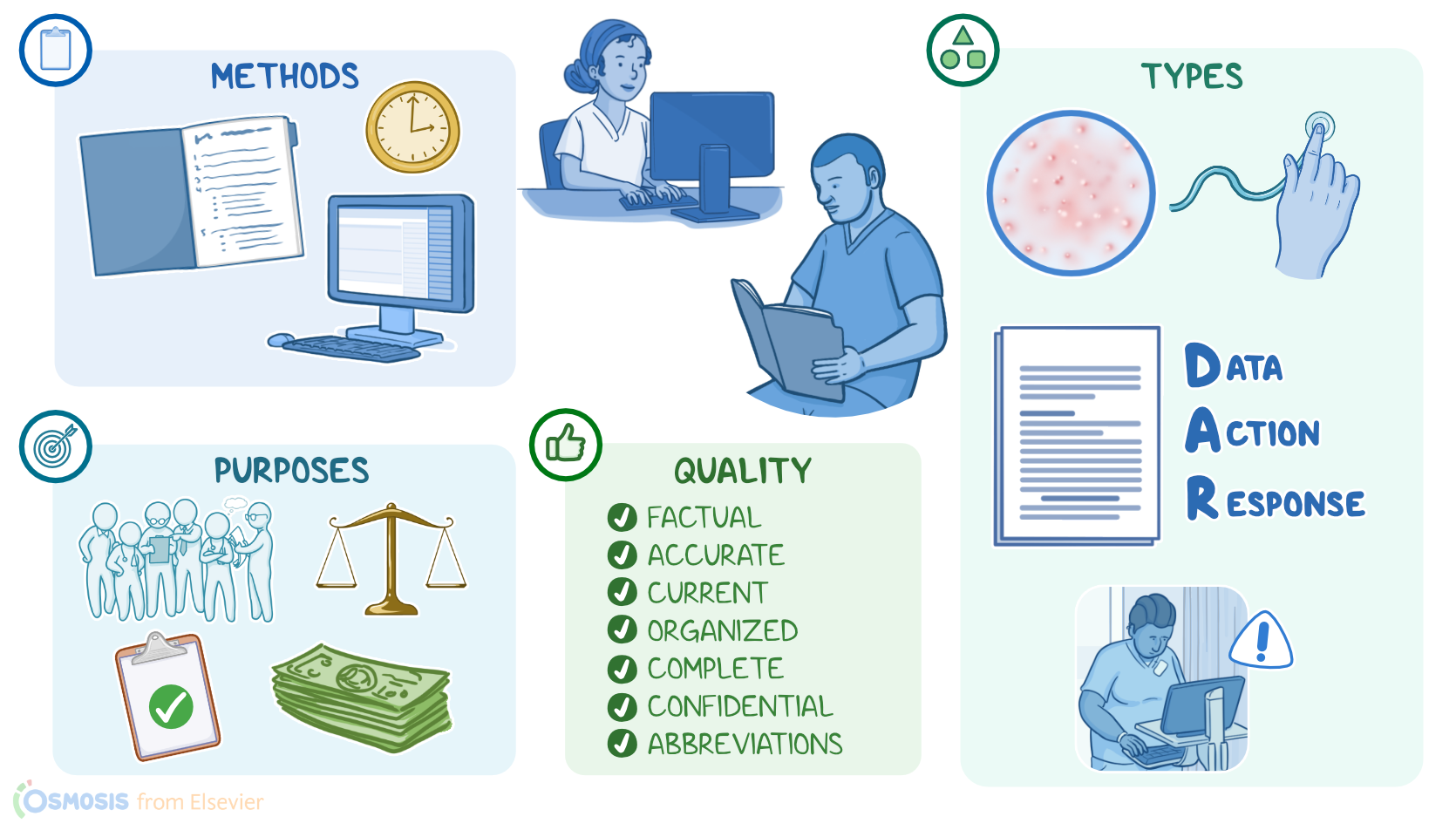
Although each healthcare facility chooses their own type of documentation, a few common examples are client assessment data, progress notes, and charting by exception.
Client assessment data allows for nurses to quickly and concisely enter all of a client’s normal and abnormal assessment information, such as skin appearance and breath sounds, which can be viewed by all members of the healthcare team.
Next, progress notes are narrative forms of documentation, often written in paragraphs, where clinicians can explain clinical decisions and situations in detail.
Progress notes often use a format such as DAR, where D stands for assessment data; A stands for the nurse’s action; and R stands for the client’s response.Lastly, there’s charting by exception, which assumes that all assessment findings are normal and care tasks have been met unless something is documented as abnormal.
For example, if Nurse Steve is using this method, he might document that his client’s assessments are all “within normal limits,” or WNL, except for pain, which he’ll document in depth to explain further.
The nurse may also take a verbal or telephone order from the healthcare provider, and since there’s always the possibility of misinterpreting spoken information, it’s important for the nurse to read back all orders and confirm prior to completing them, just like Nurse Steve did.Quality nursing documentation should be factual, accurate, current, organized, complete, confidential, and contain only approved abbreviations.
Quality Guidelines for Documentation5:20–8:37
Factual documentation contains objective descriptions which are made using the nurse’s five senses, like the nurse documenting “the scent of body odor is present.” The nurse should avoid documenting non-factual information like documenting that the, “client isn’t hygienic.” To remain factual, the nurse should use quotations when documenting something the client said.
Accurate documentation uses the most precise language and measurements possible, like using standard descriptors such as centimeters or inches when measuring a wound instead of documenting that a wound is “big” or “small.” In addition, the nurse should avoid unnecessary words or assumptions such as, “the client hasn’t been compliant with wound care.” Instead, more accurate documentation would be, “the client reports an inability to complete dressing changes at home due to running out of supplies three days ago.” Next, the nurse should ensure that documentation is current, like when documenting an intervention that happened in the past, the nurse should document the date and time that it actually occurred.
Although it’s not always possible, documentation should be done as the assessments and care are completed so that the health record is kept current.
For example, if the nurse documents an admission assessment eight hours after the client was admitted, it wouldn’t be as relevant to other team members.
Then there’s organization, which means documentation is concise and clear, making the client situation and response easy to understand even if the person reading it wasn’t there.
Documentation should also be complete and contain all of the necessary information required by the healthcare facility. Each healthcare facility has different requirements for documenting which the nurse should be aware of.
It’s also important that the nurse maintains confidentiality while documenting. You should never share your passwords with others, log out of the computer when documentation is finished, and follow all of HIPAA practices.
Finally, the nurse should be aware of the approved abbreviations indicated by The Joint Commission who created a “do not use” list of abbreviations for healthcare documentation.
For example, the word “unit” should be written out instead of just documenting the letter “u” since it can be mistaken for a 0.
So let’s check back in with Nurse Steve who’s getting ready to administer the codeine to his client. While documenting in the health record, Nurse Steve indicates that he notified the healthcare provider about the allergy alert and then confirmed the tolerance of the medication with the client prior to administering it.
Nurse Steve also makes sure to document that the order for the codeine was made over the telephone. Then, he administers the codeine to the client and documents the intervention and response accordingly.
As a quick recap… Documentation is a communication strategy that allows members of the healthcare team to provide a written account of client information.
Documentation can be handwritten or electronically stored within the health record, which provides a real-time account of medical and nursing care.
The health record stores information which can be retrieved for legal purposes, facility reimbursement, as well as quality improvement.
Summary8:37–9:23
Although each healthcare facility chooses their own type of documentation, a few examples are client assessment data, progress notes, and charting by exception.
Lastly, quality nursing documentation should be factual, accurate, current, organized, complete, confidential, and contain approved abbreviations.
health record stores information, which can be retrieved for legal purposes, facility reimbursement, as well as quality improvement.
Although each Healthcare facility chooses their own type of documentation. A few examples are client assessment data, progress notes, and charting by exception.
Lastly quality nursing documentation should be factual accurate. Current organized complete confidential and contain approved abbreviations.
| STANDARDS AND METHODS OF DOCUMENTATION | ||
| KEY POINTS | NOTES | |
| DEFINITION |
| |
| SIGNIFICANCE |
| |
| METHODS |
| |
| QUALITY GUIDELINES |
| |
No notes for this video yet
Try adding a note below