The research process: Nursing
Introduction0:00–0:49
Nurse Miguel works in a physical rehabilitation facility. One of his clients, who has chronic back pain related to a car accident, mentions, “I feel so much better since starting yoga.
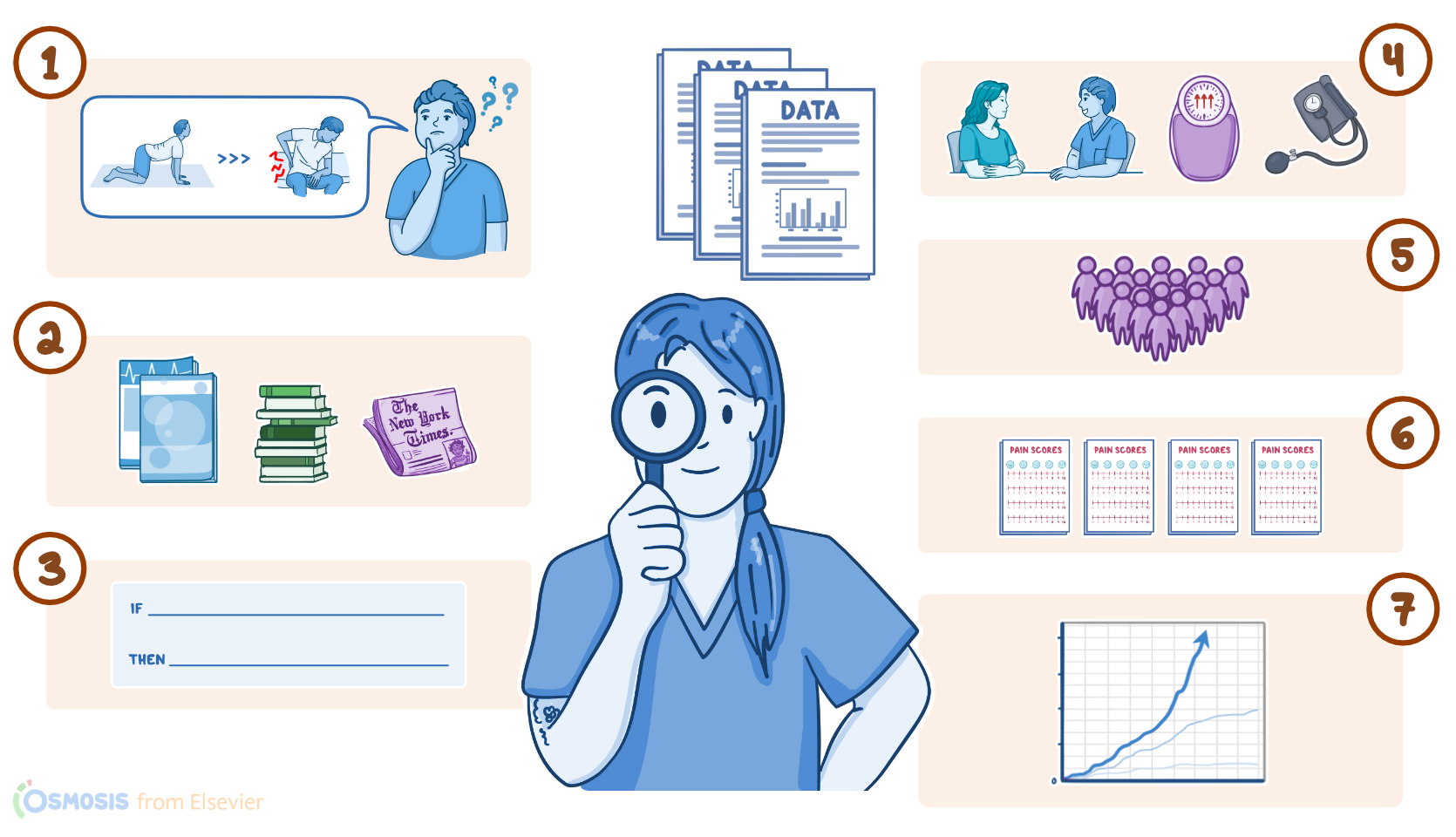
It’s made a big difference in my pain!” Nurse Miguel realizes this isn’t the first client who has mentioned yoga has improved their pain, so he wonders, “How can I know if yoga is an effective treatment for chronic, trauma-related back pain?” He decides to develop a research project to better understand how yoga affects back pain.
Before he develops his study, he reviews some of the basic principles of research to better understand the steps of the research process.Okay, so research is a systematic process of validating, refining, and generating knowledge.
Defining Research0:49–1:12
It can be used to answer questions that are encountered when providing care, like “What kind of diet is best for a client with heart disease?” or “What types of exercise help reduce joint pain in arthritis clients?” The first step in the research process is to identify a research problem.
The Research Process1:12–8:10
A research problem is sometimes referred to as a “gap” in knowledge. It is a specific issue, often identified by nurses in their everyday clinical practice that needs further investigation, Gaps can address specific issues with client care that don’t already have a clear answer.
This can be because there is not enough research demonstrating significance of a practice or there has been limited application to practice.
Nurse Miguel couldn’t find any information on the impact of yoga for the treatment of chronic back pain caused by trauma.
He recognizes this is a gap in the literature that he might be able to investigate with a research study. The next step is to complete a literature review.
To complete a literature review, the researcher will carefully search through scientific databases in order to find sources on their research topic.
The goal of the literature review is to develop a comprehensive understanding of what is currently known about the topic, it is sometimes referred to as “the state of the science.” This might include information like what types of studies have already been done to investigate the topic, or if the topic has been explored for one client population but not another.
Miguel will search through research databases to better understand everything that is already known about the effects of yoga on chronic back pain.
He discovers many sources about how yoga has been proven to improve back pain in acute injuries but, he only finds one study about how yoga might be helpful in clients with chronic back pain.
He realizes while reading the article that while the study focused on chronic back pain, it was in clients with osteoporosis and not trauma.Once Nurse Miguel has a better understanding of the state of the science, he can develop a formal hypothesis.
A hypothesis is a prediction that will be tested during the research. The hypothesis is usually presented as an if-then statement that predicts what the researcher thinks will happen.
Now, in Nurse Miguel’s hypothesis, he has two variables: yoga and pain scores. Variables are the concepts that are measured, manipulated, or controlled in a study.
Oftentimes, researchers want to understand the relationships between variables and will predict those relationships in their hypothesis.
The two most common types of variables are:The independent variable can be controlled by the researcher and is sometimes referred to as the “cause,” or the variable that influences the dependent variable.
The dependent variable, on the other hand, is sometimes referred to as the “effect” or the outcome variable, because changes in the dependent variable are thought to be caused by the independent variable.
In Nurse Miguel’s hypothesis, yoga is the independent variable because Miguel will control who participates in yoga and who does not.
Pain scores are the dependent variable because it is assumed the amount of pain will be determined by whether or not the client participates in yoga.Okay, once you have determined your hypothesis and defined your variables, it is time to select a research design.
A research design is the strategy used to complete a study and can be classified as either qualitative or quantitative. Qualitative research focuses on a person’s lived experience.
Qualitative studies collect and analyze data from interviews, narrative statements, or direct observations. A qualitative research study related to Nurse Miguel’s topic might explore how client’s with chronic trauma-related back pain describe their quality of life before and after beginning yoga.
On the other hand, quantitative research involves collecting and analyzing numeric data, like heights, weights, blood pressures, or test scores.
Nurse Miguel decides to develop a quantitative study to best address his hypothesis. He thinks a quantitative study is the best choice because he can collect and analyze numeric pain scores before and after clients participate in yoga to evaluate the effectiveness of the activity.The next step is to select a population to study.
A population is a well-defined group with specific properties that identify it as a group like age, ethnicity, or diagnosis.
Of course, in most cases, it’s not reasonable to study an entire population, like all clients who experience chronic, trauma-related back pain.
So instead, a portion of the population, called a sample, can be studied. A sample is a portion of the chosen population meant to represent the entirety of a population.
If a sample is large enough, study findings can be broadly applied to your whole population. When that is the case, the sample is said to be representative of the population.
So first, Nurse Miguel decides he will study a population of adults who have chronic, trauma-related back pain. Then, Nurse Miguel compiles a list of all of the clients at his physical rehabilitation facility who have chronic, trauma-related back pain as a diagnosis.
From this list, he randomly chooses 25 clients who will receive the intervention of daily yoga. Next, he randomly chooses another group of 25 clients who will not have daily yoga.
Together, these groups make up Nurse Miguel’s sample.Alright, now it’s time to define a method of data collection. This will describe the specific procedures that will be used to collect the data that will be analyzed.
There are many potential data collection methods to choose from like interviews, observations, and surveys. Nurse Miguel plans to collect numerical pain scores on a rating scale from 0-10.
After the data has been collected, the last step of the research process is data analysis. Data analysis is the conversion of raw data, or the data collected from the study, into a format that can inform practice.
Now that Miguel has planned his research study, he will have to apply for approval of his research proposal at his organization’s Institutional Review Board, or IRB before he can start his research.
The IRB is responsible for reviewing all proposed research plans before a research study can begin, to make sure the rights of the research subjects are protected.
Now, once Nurse Miguel complete’s his study, the findings can be used to inform nursing practice. Using research to inform client care is called evidence-based practice or EBP.
Applying Research to Practice8:10–9:01
Nurse Miguel uses the findings from his study to support funding for a new yoga instructor at his facility so all client’s can have access to daily yoga.Dissemination is another important step in the research process.
Dissemination means sharing what you have learned from performing your research study with other professionals. Examples of dissemination might include presenting a poster at a nursing conference or publishing an article in an academic journal.
Aright, as a quick recap…. Research is a systematic process of validating, refining, and generating knowledge, and it can be used to answer questions that are encountered by nurses when providing care.
Review9:01–10:04
A research problem identifies a specific area of knowledge in need of further investigation, sometimes referred to as a “gap.” Gaps can address specific issues with client care delivery that can’t be solved with what is already known in the literature.
A review of the literature can be done to compile everything that is currently known about the topic of interest. Then, a hypothesis is developed that makes a prediction about the relationship between variables, which are concepts that are measured, manipulated, or controlled in a study.
Research studies aim to learn about a population, and a sample of the population is studied to represent the entire population.
Next, a research method is selected, which describes the specific procedures that will be used to collect and then analyze the collected data.Once data analysis is complete, the findings of a study can be used to inform nursing practice.
| THE RESEARCH PROCESS | ||
| KEY POINTS | NOTES | |
| INTRODUCTION |
| |
| DEFINITIONS |
| |
| RESEARCH PROCESS |
| |
| APPLYING RESEARCH TO PRACTICE |
| |
No notes for this video yet
Try adding a note below