Definitions & Key takeaways

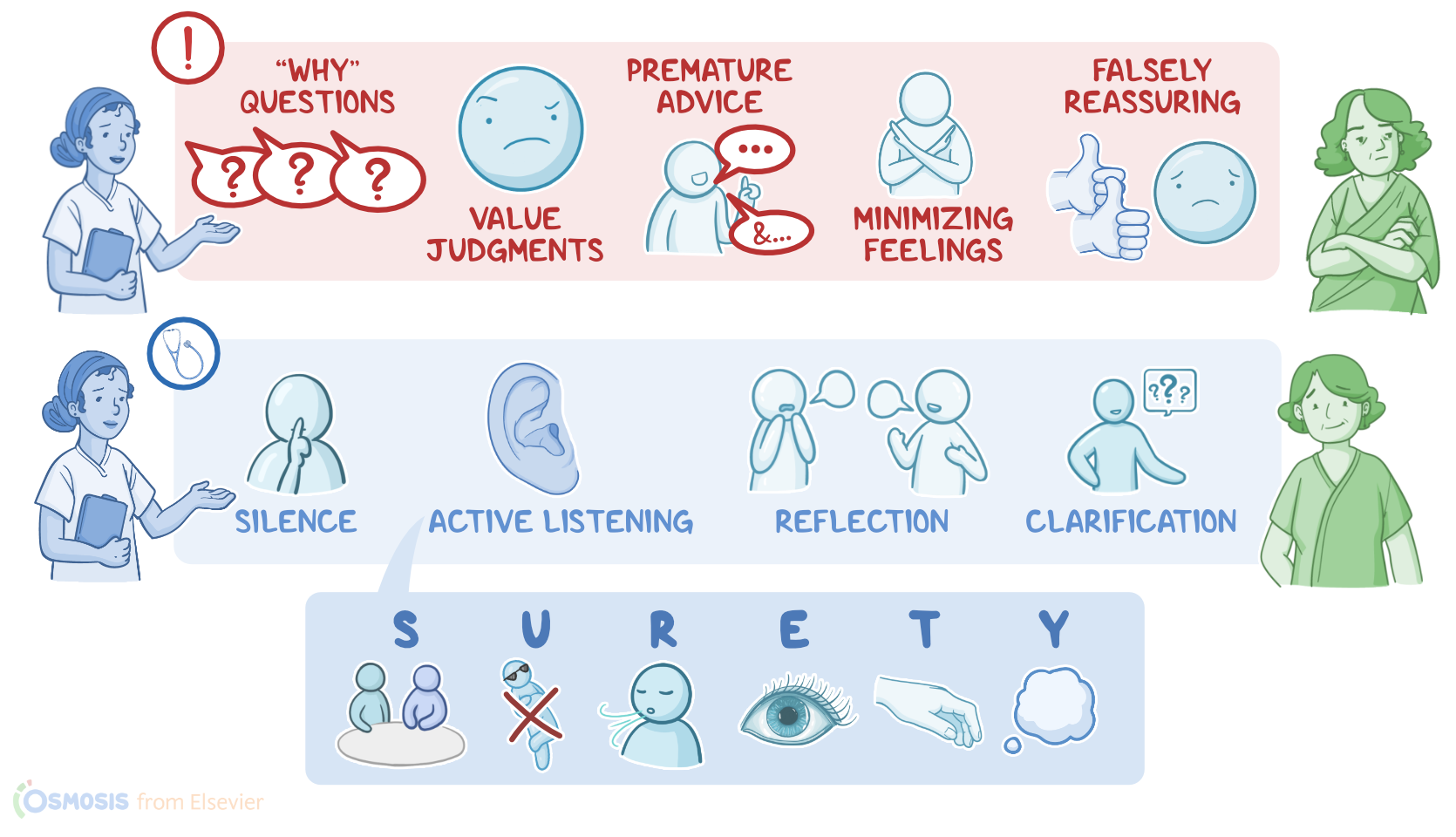
Therapeutic communication is a method of exchanging information which helps clinicians and clients collaborate effectively to promote the physical and psychological well-being of clients. Therapeutic communication is the foundation for productive relationships and positive nurse-client interactions. There are also factors that can impact communication such as personal, environmental, as well as relationship factors. Techniques that aid in therapeutic communication are silence, active listening, reflection, and clarification. Non-therapeutic communication can negatively affect the nurse-client relationship and includes asking too many why � questions, giving premature advice, falsely reassuring, making value judgments, and minimizing feelings.

Chapters:

Introduction0:00–0:44

Nurse Rose works in an outpatient mental health clinic and has noticed that one of the clients, Gabriella, is visibly upset and sitting by herself away from the other clients.
Nurse Rose says, “Gabriella, what’s wrong? Is something bothering you?” Gabriella rolls her eyes and shakes her head stating, “I just want to be left alone.” Nurse Rose is formulating a response when Gabriella stands up and yells, “Why don’t you go and talk to one of the other patients?
You like them better anyway!” Nurse Rose is surprised by the increase in intensity of Gabriella’s emotions and does not understand what she is referring to.
Nurse Rose will use what she has learned about therapeutic communication to determine how best to handle this situation.

Definition of therapeutic communication0:44–2:01

Communication is the process of sending and receiving information between two or more people. One type of communication that is used by many disciplines, including nurses, is therapeutic communication.
Therapeutic communication is a type of communication where information between clinicians and clients is exchanged in order to collaborate effectively and promote the physical and psychological well-being of clients.
Therapeutic communication is crucial to the formation of client-centered relationships, which can foster trust and respect, especially for clients experiencing emotional distress, like Gabriella.Another use of therapeutic communication is de-escalation, which is a goal of communication when escalation occurs.
Escalation refers to an increase, or rise in intensity, during an interpersonal interaction. This is what is occurring between Nurse Rose and Gabriella.
Nurse Rose can recognize Gabriella’s emotions are escalating when she stands up and yells. When faced with an escalating interaction, it is important for the nurse to de-escalate the situation.
De-escalation occurs when a person reduces the intensity of a conflict. One way to do this is through therapeutic communication.There are two main types of communication: verbal and nonverbal.

Types of communication2:01–2:27

Verbal communication refers to spoken or written words, so Gabriella could’ve told Nurse Rose, “I want to be left alone.” Nonverbal communication can include sighs, moans, physical gestures, and even eye contact.
So when Gabriella rolls her eyes and shakes her head, she is using nonverbal communication. Now, there are several factors which can affect the process of communication.

Factors that affect communication2:27–3:16

These factors include personal factors, relationship factors, and environmental factors. Personal factors that affect communication include emotions, such as Gabriella’s anger and jealousy as well as social factors, like the primary language that’s spoken by Nurse Rose and Gabriella.
Relationship factors can also affect communication such as when the individuals communicating are equals, like two nursing colleagues or when the people communicating are not equals, such as Nurse Rose and Gabriella.
Lastly, environmental factors can also impact communication; such as an uncomfortable temperature or a lack of privacy, like trying to communicate in a busy mental health clinic such as the one Nurse Rose and Gabriella are in.You can use therapeutic communication skills to enhance information exchange and build rapport with clients.

Therapeutic and non-therapeutic communication skills3:16–6:05

These skills include silence, active listening, reflection, and clarification. Silence is an effective tool to encourage clients to open up.
It is beneficial for clients who are reluctant to speak because it provides them with extra time to gather their thoughts.
Next, active listening means being attentive to what a client is saying both verbally and nonverbally. SURETY is a model to help you to remember the steps of active listening.
During active listening, you should sit at an angle facing the client, uncross legs and arms, relax, make eye contact, use gentle touch and trust your intuition.
Reflecting involves repeating back what the client says to show them you are listening. Lastly, clarification is a technique used to verify the interpretation of the client’s message.
This gives the opportunity to clear up any misconceptions and avoid misunderstandings. On the other hand, non-therapeutic communication can negatively impact the nurse-client relationship.
Non-therapeutic communication includes asking too many “why” questions, giving premature advice, falsely reassuring, making value judgments, or minimizing feelings.
Asking frequent “why” questions implies criticism and can cause the client to feel defensive, an example is the nurse asking, “Why did you stop taking your medicine?” Giving premature advice assumes that the nurse knows better than the client and does not give the client a chance to make a decision for themselves, an example of this is the nurse saying “You should do this instead of this.” Providing false reassurance belittles the client’s concerns and may cause them to stop sharing feelings.
An example of this would be if the nurse says, “I wouldn’t worry about that.” Another non-therapeutic communication skill is making value judgments, such as the nurse asking, “How can you still smoke when you have a family history of lung cancer?” This can make the client feel guilty and prevent them from sharing.
Lastly, minimizing feelings indicates that the nurse is not able to empathize with the client. An example of this technique is the nurse saying, “You should be happy, you’re being discharged.” Non-therapeutic communication can result in stress and negative feelings between the nurse and the client.
Alright, let’s check back in with Nurse Rose and Gabriella. After recognizing that the interaction with Gabriella had escalated, Nurse Rose decides to use her therapeutic communication skills to de-escalate the situation.

Therapeutic communication in action6:05–7:46

In order to understand the reason for Gabriella’s reaction, Nurse Rose uses reflection by stating, “I understand you’re upset because you think that I like the other patients better.” Then she uses clarification by saying, “Gabriella, could you tell me a little more about your feelings so I can understand where you’re coming from?” While Gabriella prepares to respond, Nurse Rose employs silence to allow time for Gabriella to gather her thoughts to speak.
Eventually Gabriella says, “Yesterday when you were walking to your car, I tried to tell you about a problem I was having, but your responses were so short with me and it made me feel like I don’t matter.” Nurse Rose makes eye contact and continues to actively listen as Gabriella speaks, showing respect and attentiveness.
Next Gabriella says, “I felt like you didn’t even care about me, which is why I’m upset.” Nurse Rose nods her head and responds, “I’m so sorry that I caused you to feel this way, Gabriella.
Unfortunately yesterday when you tried to talk to me, I was running late to pick up my son from school. I didn’t mean to minimize your feelings.
I let my personal stress affect my communication with you, which wasn’t right.” Gabriella smiles and says, “That makes sense.
I’m sorry I got so upset; I understand that running late can be stressful.” Nurse Rose gently pats Gabriella’s shoulder and says, “You don’t have to be sorry, it seems we had a miscommunication and I’m glad we were able to resolve it.” Alright as a quick recap… Therapeutic communication is a method of exchanging information which helps clinicians and clients collaborate effectively to promote the physical and psychological well-being of clients.

Review7:46–8:37

Therapeutic communication is the foundation for productive relationships and positive nurse-client interactions. There are also factors that can impact communication such as personal, environmental, as well as relationship factors.
Techniques that aid in therapeutic communication are silence, active listening, reflection, and clarification. Non-therapeutic communication can negatively affect the nurse-client relationship and includes asking too many “why” questions, giving premature advice, falsely reassuring, making value judgments,